Another beautiful day was waiting for us, but first things first: breakfast. Our hotel had given us a voucher to use at one of the cafés across the street, and we chose Shtroudl—purely because of the name. Known mainly for its European-style desserts, it turned out to be the best breakfast spot we found in Israel. No trace of Austria or strudel though on the breakfast menu—instead, a spread of Arabic and Israeli dips and savory egg dishes. Simple but delicious, it suited us perfectly, especially since we had already reduced our days to just two meals—the food here is wonderfully rich.
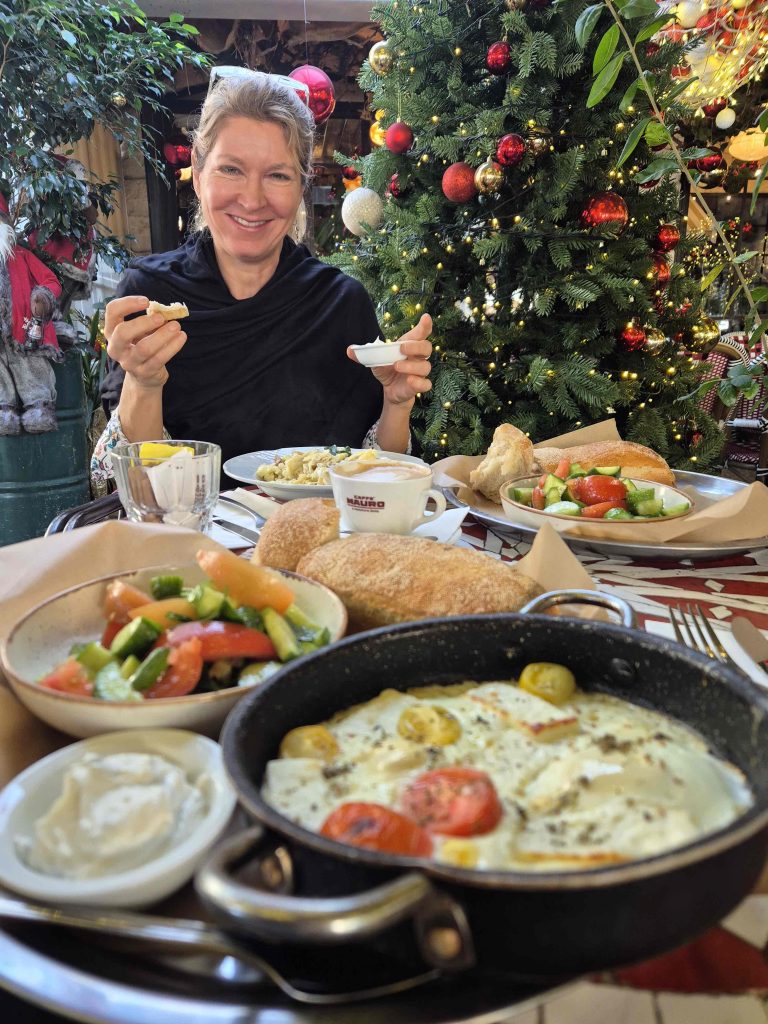
Omlettes with potatoes and spinach or eggs sunny side up with roasted cheese, always with a fresh tomato and cucumber salad as well as fresh bread and usually hummus and/or labneh on the menu. Sweet breakfast is not customary here. Labneh is a kind of Tsatziki without the cucumbers, and the roasted cheese is a bit chewy and salty version of Feta. It all tasted delicious though.
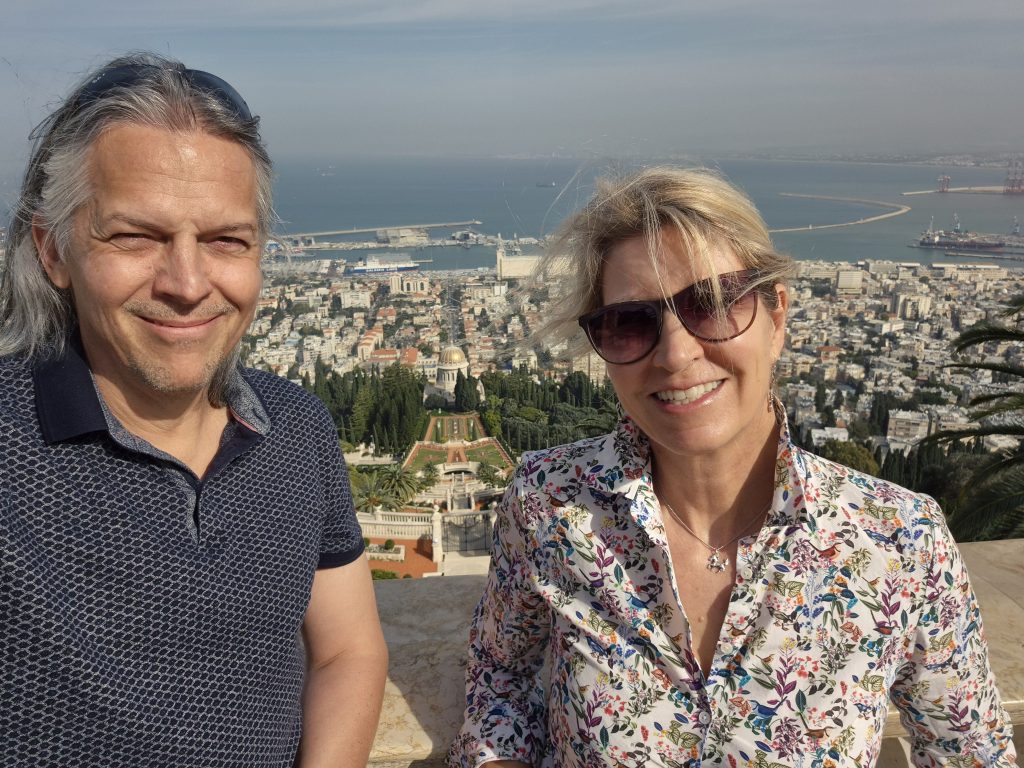
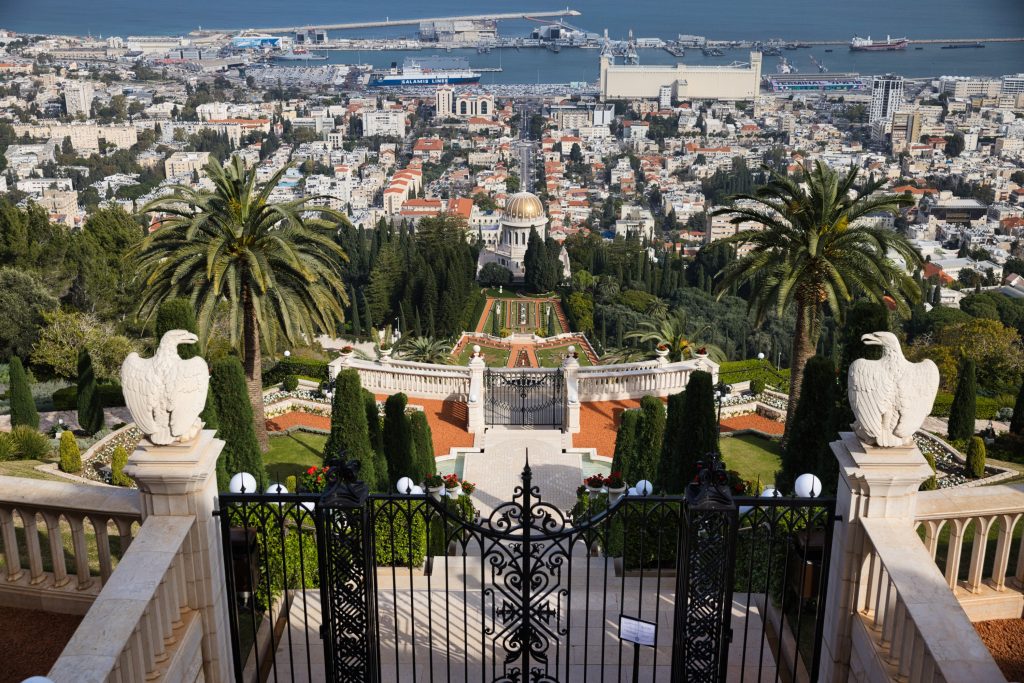
After filling our bellies, we decided to tackle the uppermost part of the Baháʼí Gardens. This time, instead of walking up, we drove along the winding roads to the top of the Carmel Ridge—a car ride of barely seven minutes. The gardens from up top were just as stunning as the ones below the shrine.
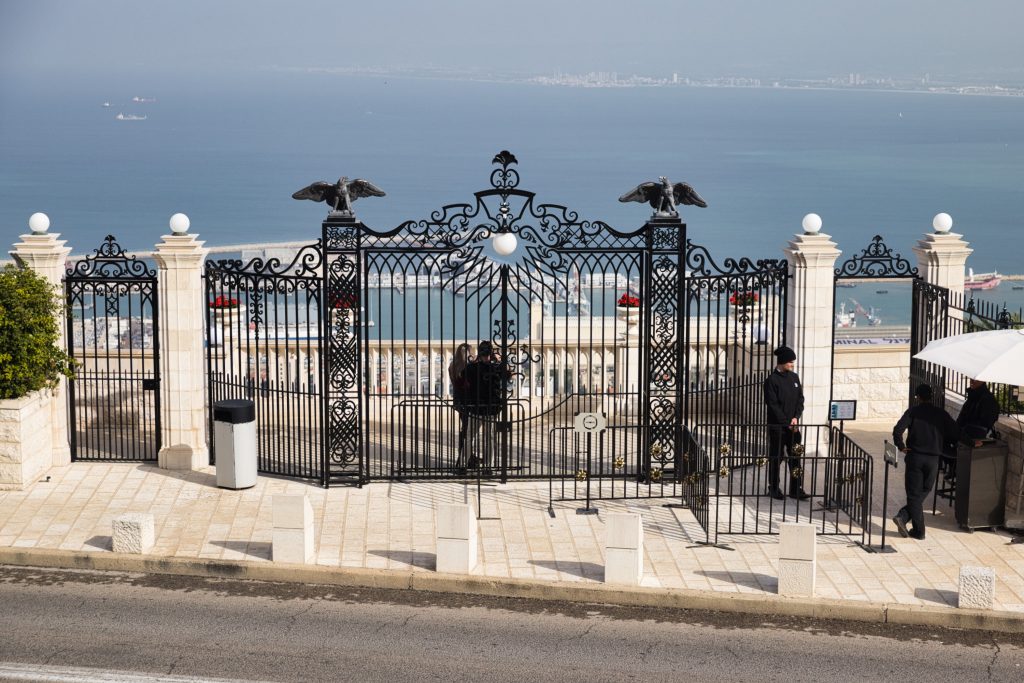
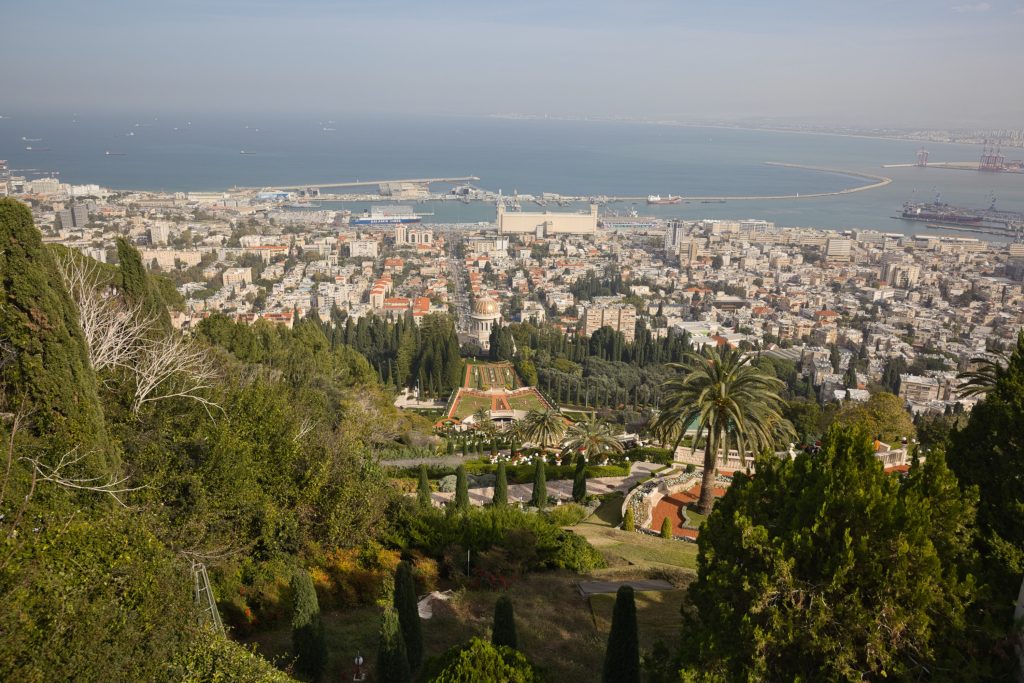
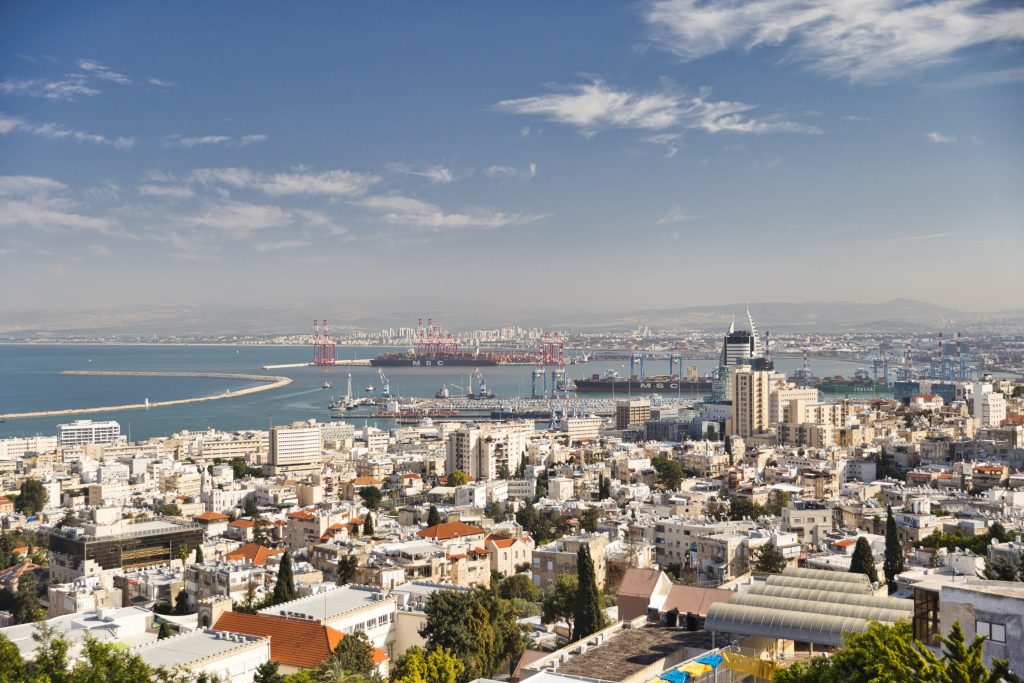
Beautifully crafted gardens, grass kept very short, beautiful blue skies and a stunning view over the haifa bay, even though Haifa is not a pretty city. It‘s industrial character can be seen everywhere. Nearly the entire coast line of Haifa is commercial harbour. Large unloading cranes lift their heads into the sky andfreight vessels are everywhere. Parallel to the coast line the train lines run, wires and electricity posts everywhere. Then put a city autobahn next to it and what‘s left has a hard time being picturesque. It is more of a functional city than a beautiful one.
For beauty and interest you have to drive outside haifa either North to Akko or south to Caesarea.
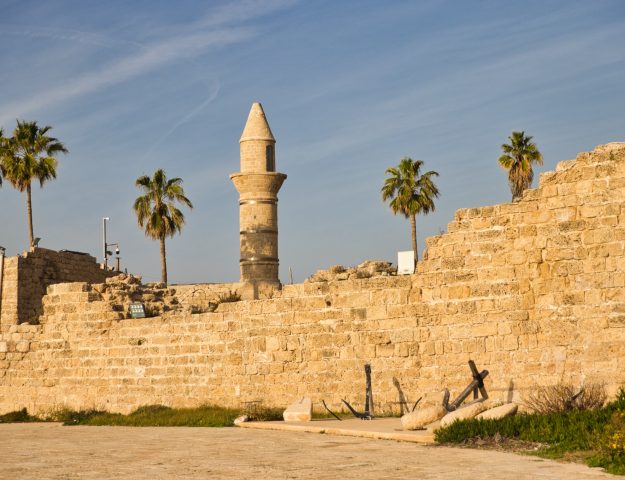
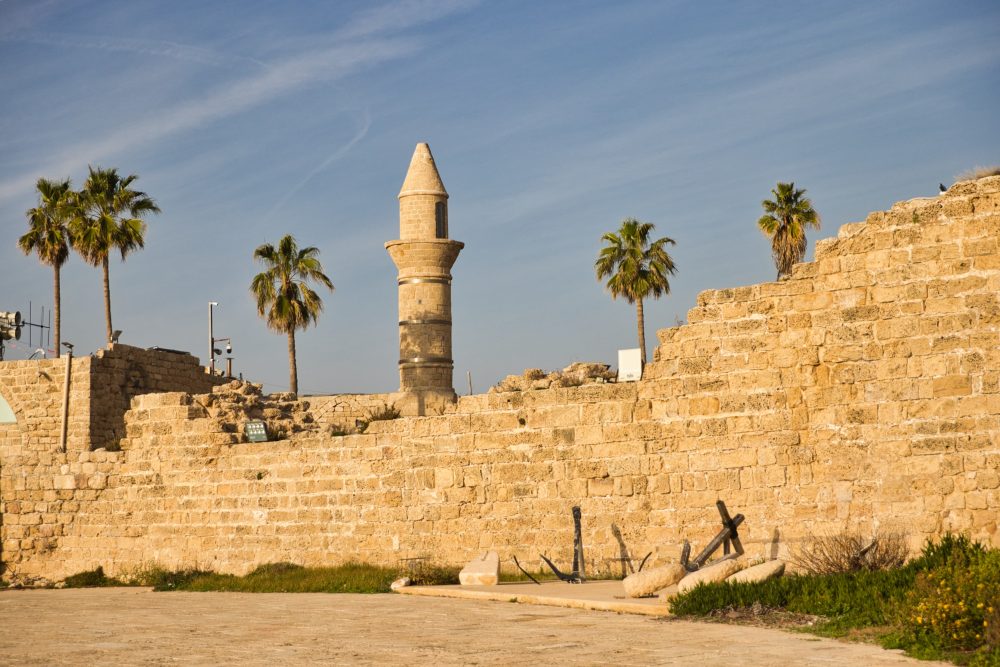
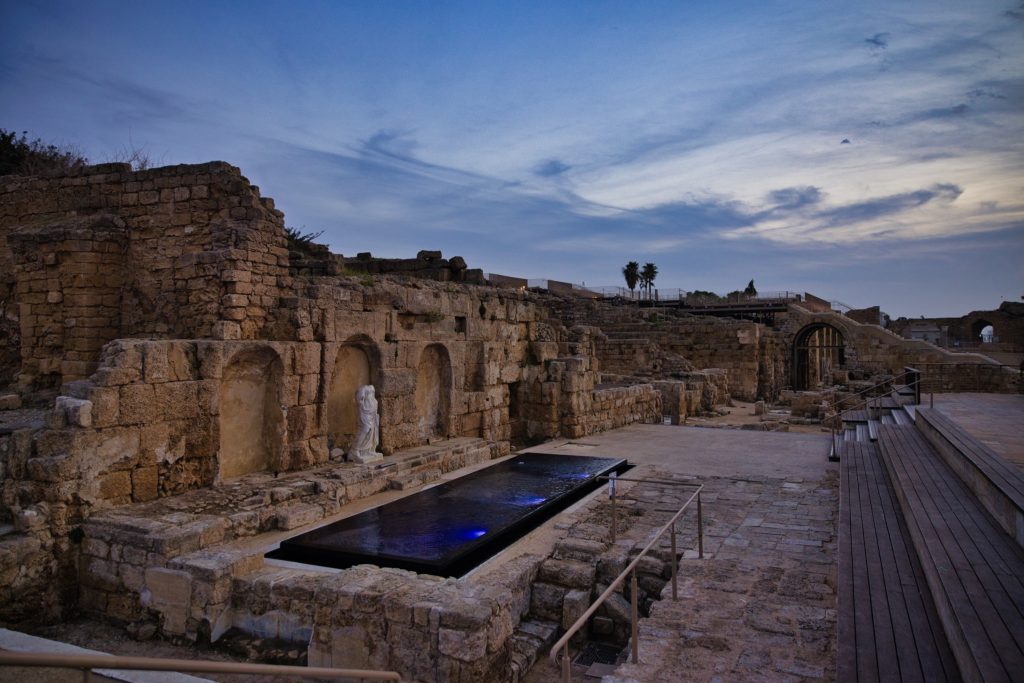
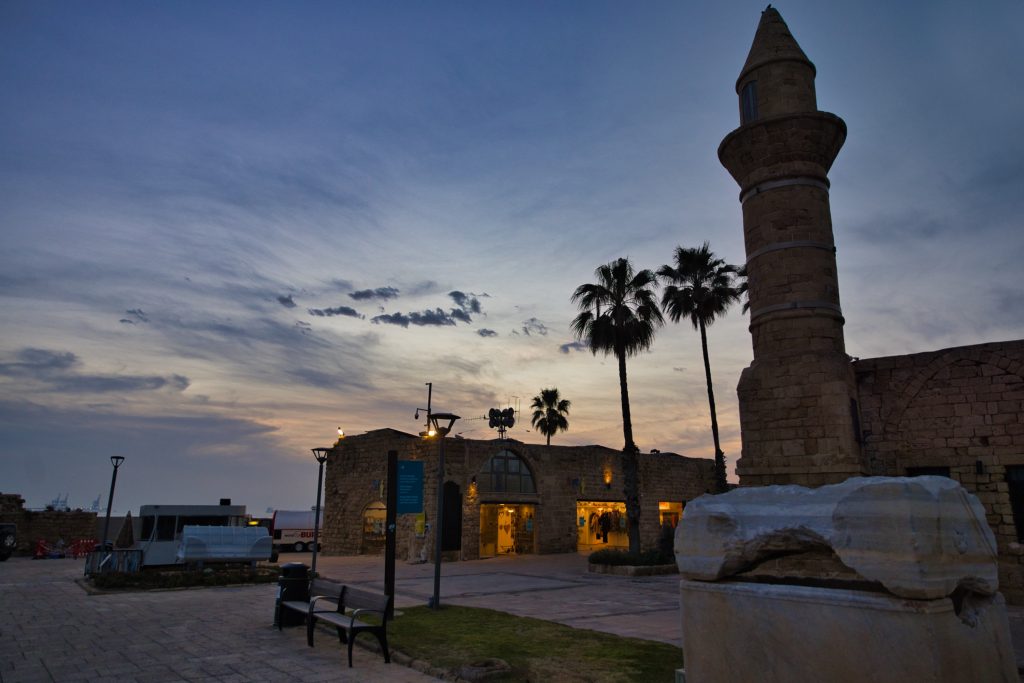
Caesarea is an ancient sea port and had it‘s importance mostly during the Roman period. Under Emperor Augustus (formerly Octavian), his client king Herod the Great built an extraordinary engineering masterpiece in his honor.
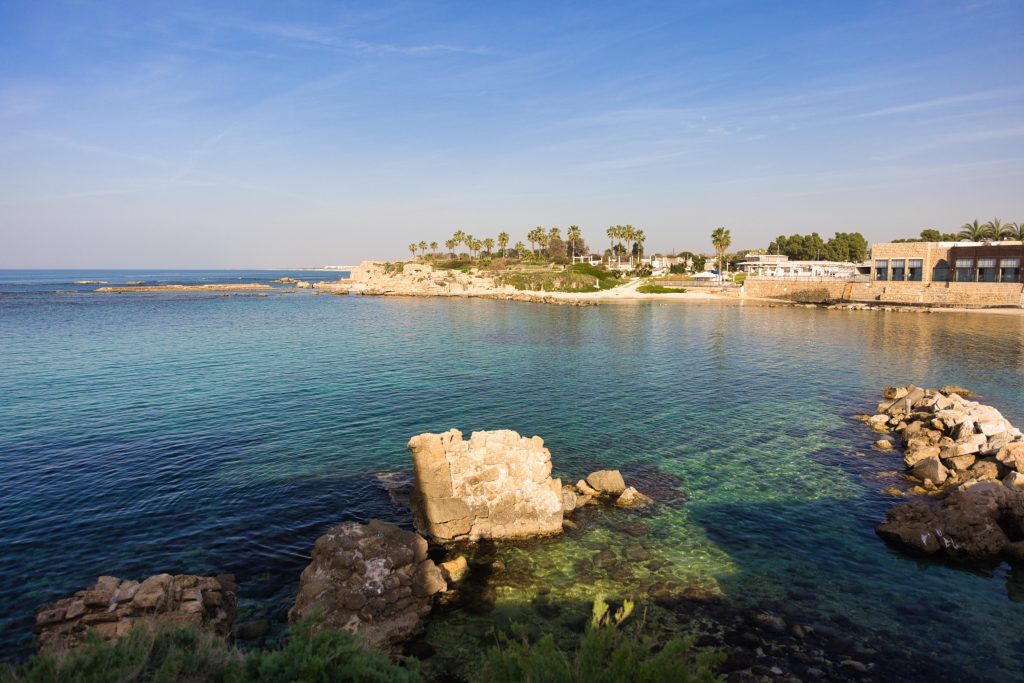
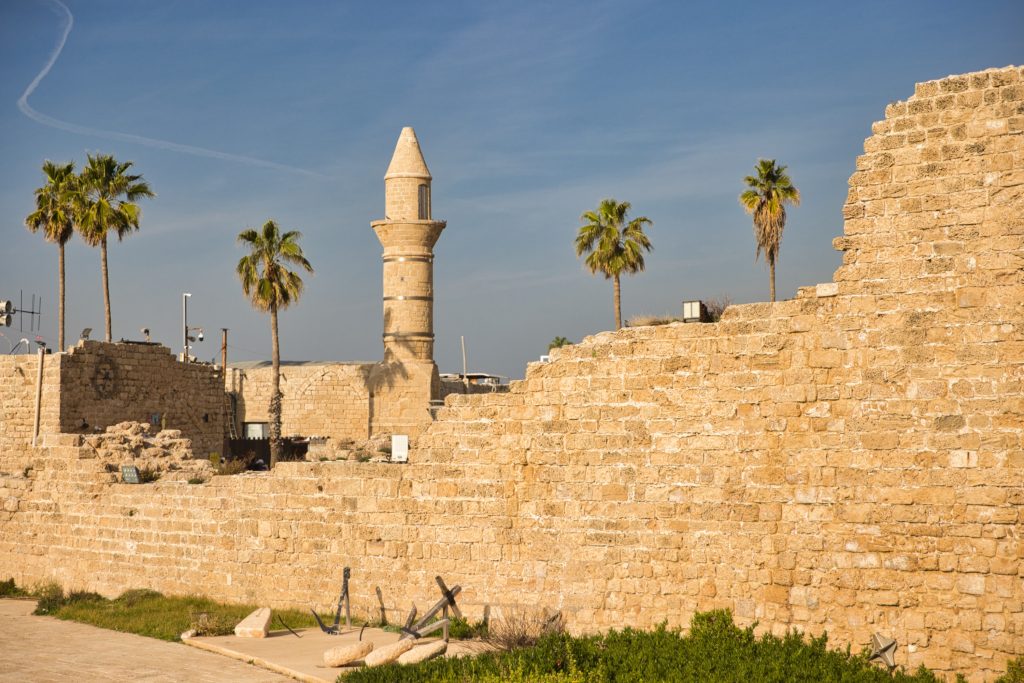
Not only did he build the deep sea harbour that allows even large ships to safely land, he also built a fortified city for 10.000 people, complete with several palaces, temples, bath houses, circus (Hippodrome) and Amphitheater.
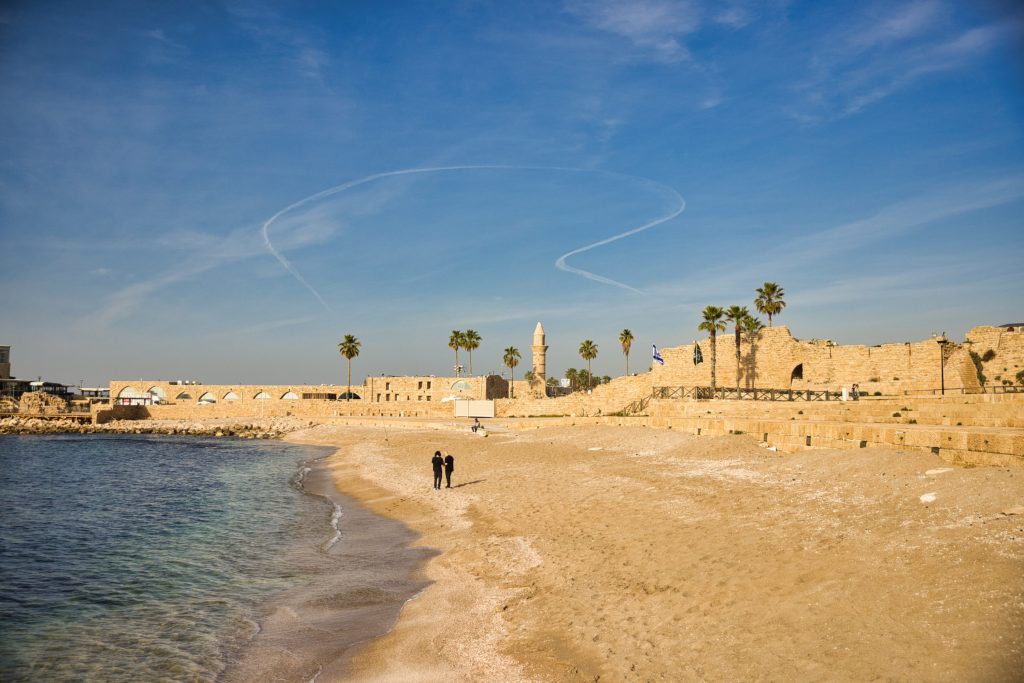
The harbor itself was an engineering breakthrough. Herod used a new kind of Roman hydraulic concrete, poured into wooden frames underwater and mixed with volcanic ash, which hardened even below sea level. This allowed massive breakwaters to be constructed, forming protective walls on both sides of the harbor entrance and making Caesarea one of the first true artificial deep-water ports in the ancient world.
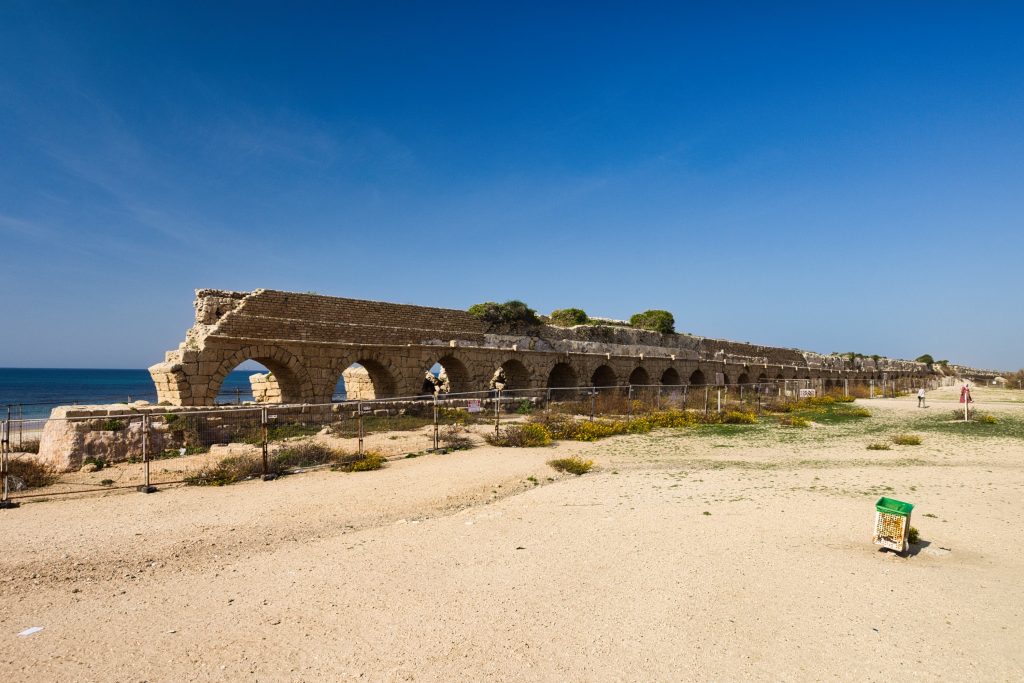
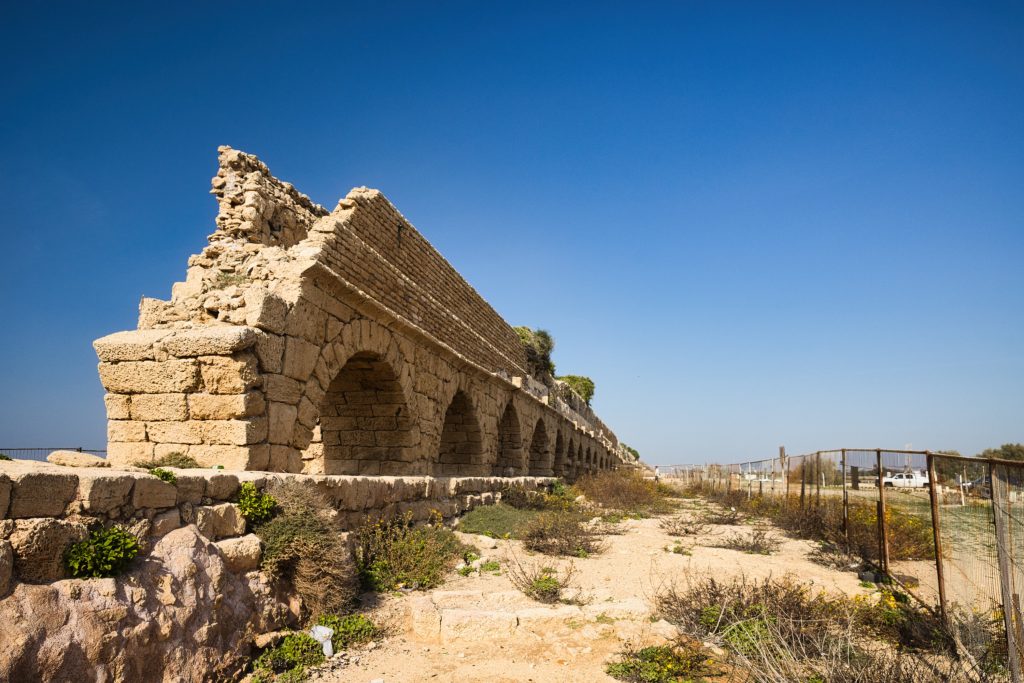
On top of all that he also built an aqueduct leading from the springs in the Carmel Mountains to Caesarea to make sure the city always had fresh water available. The ruins today don‘t do it always justice how much of a feat that must have been. But then again: But the fact that so much of it still stands after two thousand years is proof enough of its ingenuity.
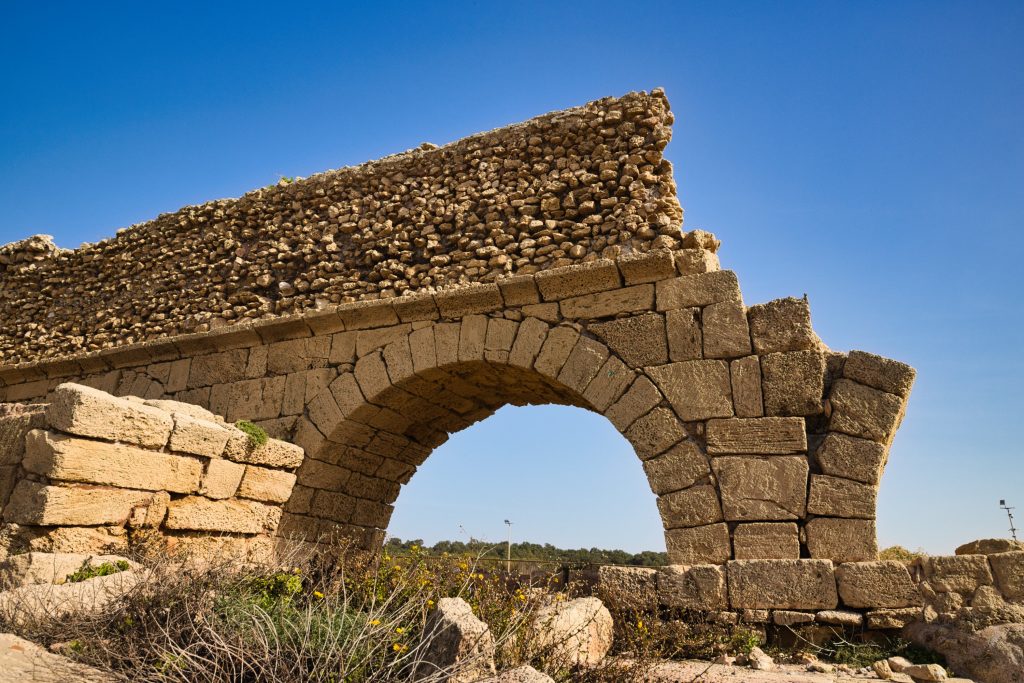
In later times, the cruisaders took over Caesarea and fortified just the main areas around the harbour and the city, but built over the hippodrome and the Amphitheater. During the cruisader times, just like Akko, Caesarea was an important entry gate into the holy land. But over time, however, the harbor began to silt up. The coastline in this area is highly dynamic, with strong currents and shifting sand dunes gradually clogging the ancient breakwaters. Without constant maintenance, the harbor lost its function, and large parts of the city were slowly buried under sand. For centuries, much of Caesarea lay hidden until systematic archaeological excavations began in the late nineteenth and early twentieth centuries, revealing the scale of what had once been one of the Mediterranean’s great ports.
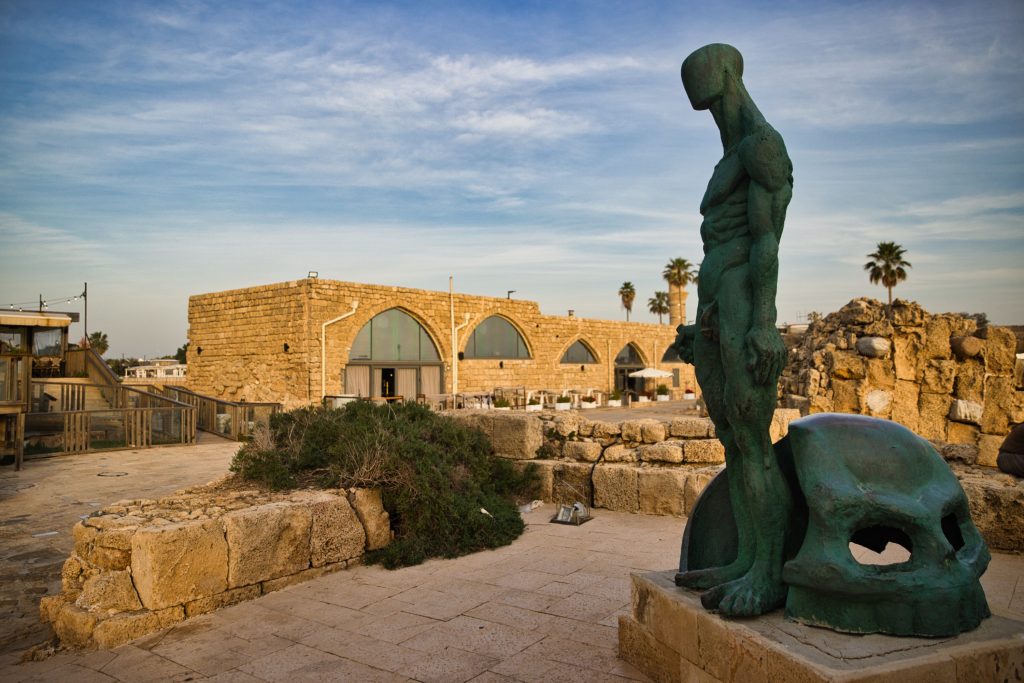
We spent a good four hrs walking the grounds, and getting the feel for how it must have been when 10.000 people came to the games at the Circus to watch the chariot races and battles of slaves or prisoners against wild animals.
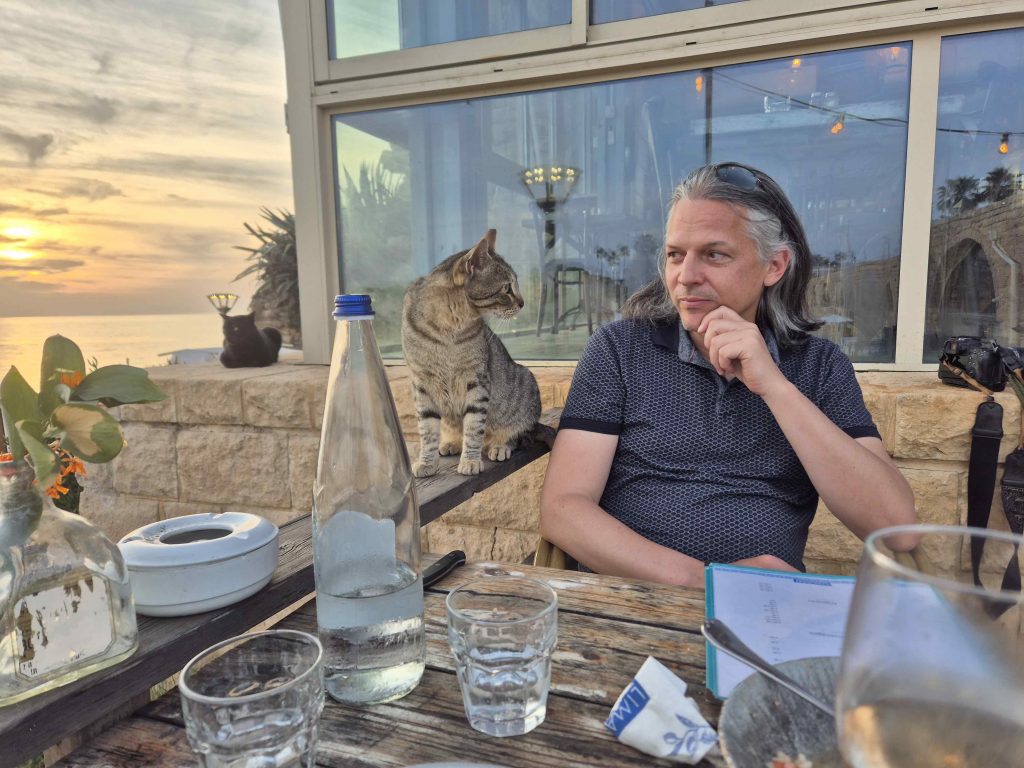
We decided to enjoy our last late afternoon and a nice sunset with 25 degrees and a balmy breeze sitting in a restaurant in the sun enjoying a glass of wine and a fresh grilled sea bream. In cat company of course…
We are staying at the Templar Hotel right in the German Colony in Haifa with view onto Haifa‘s main attraction, the Baháʼí Gardens.
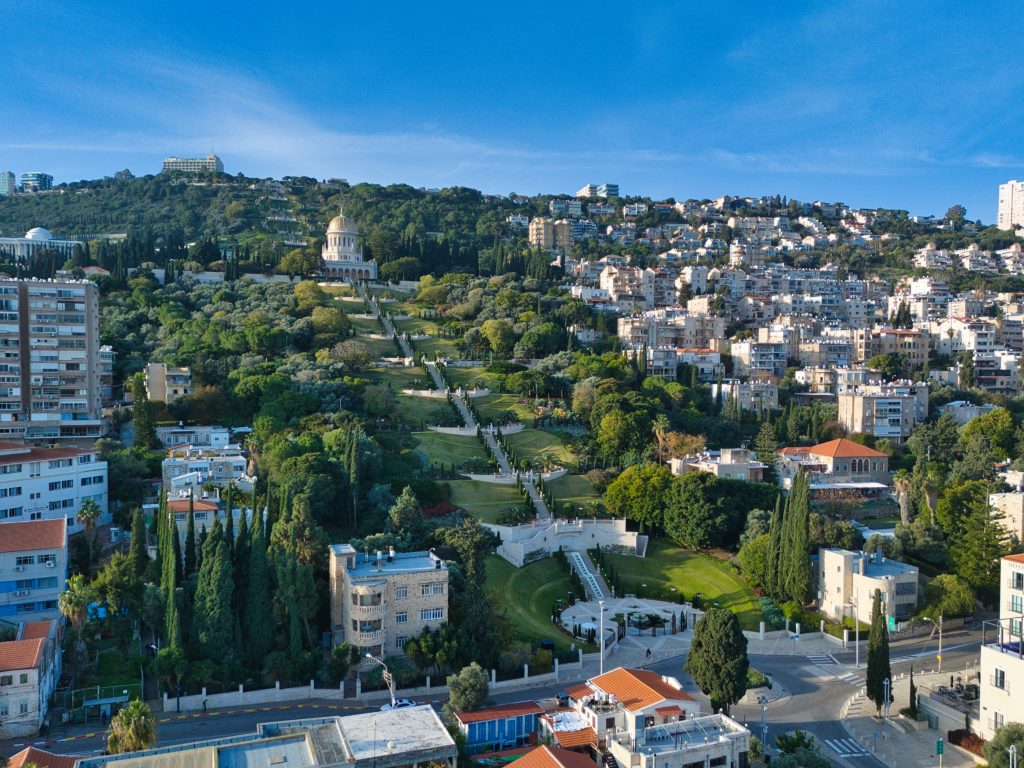
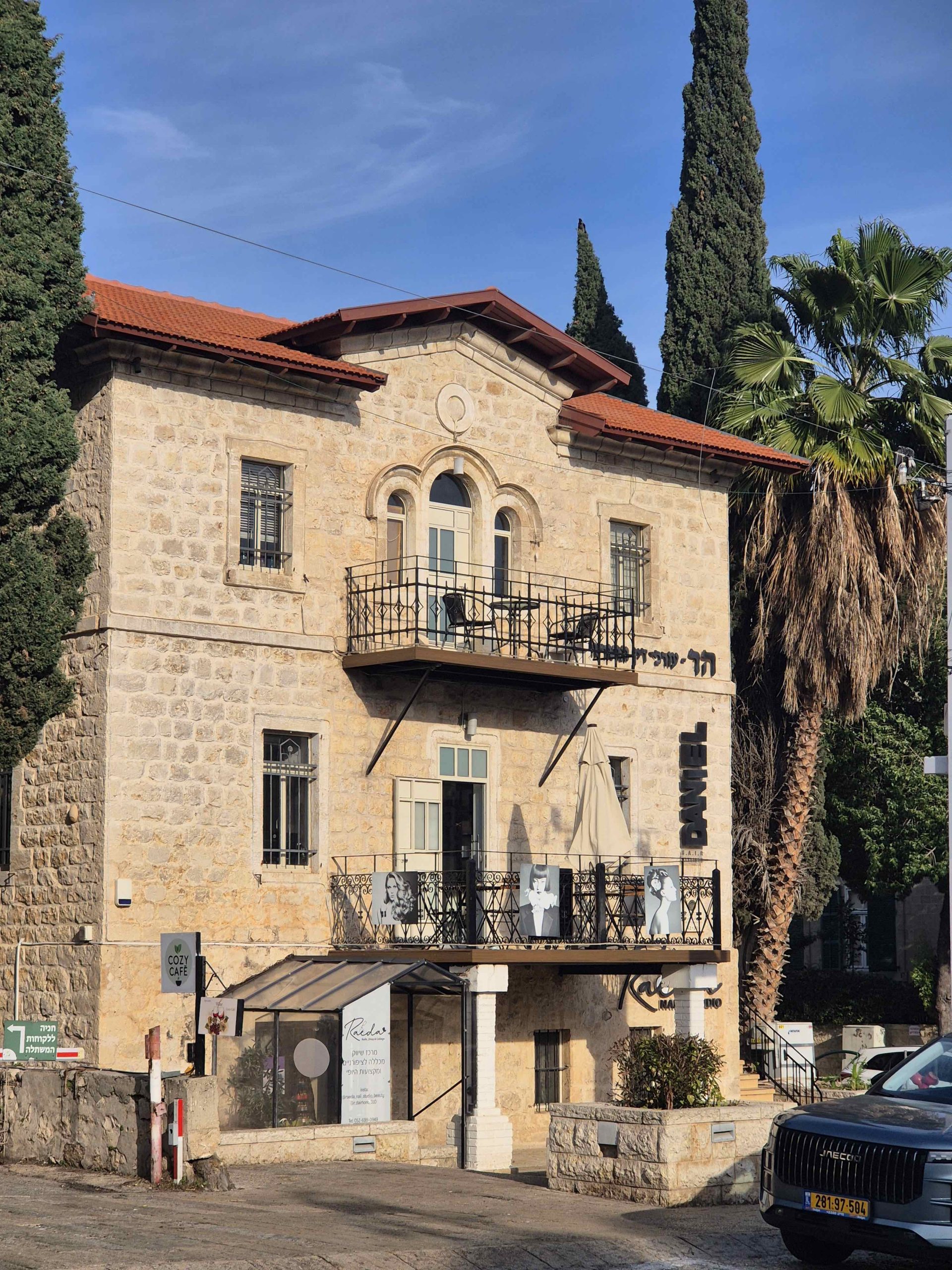
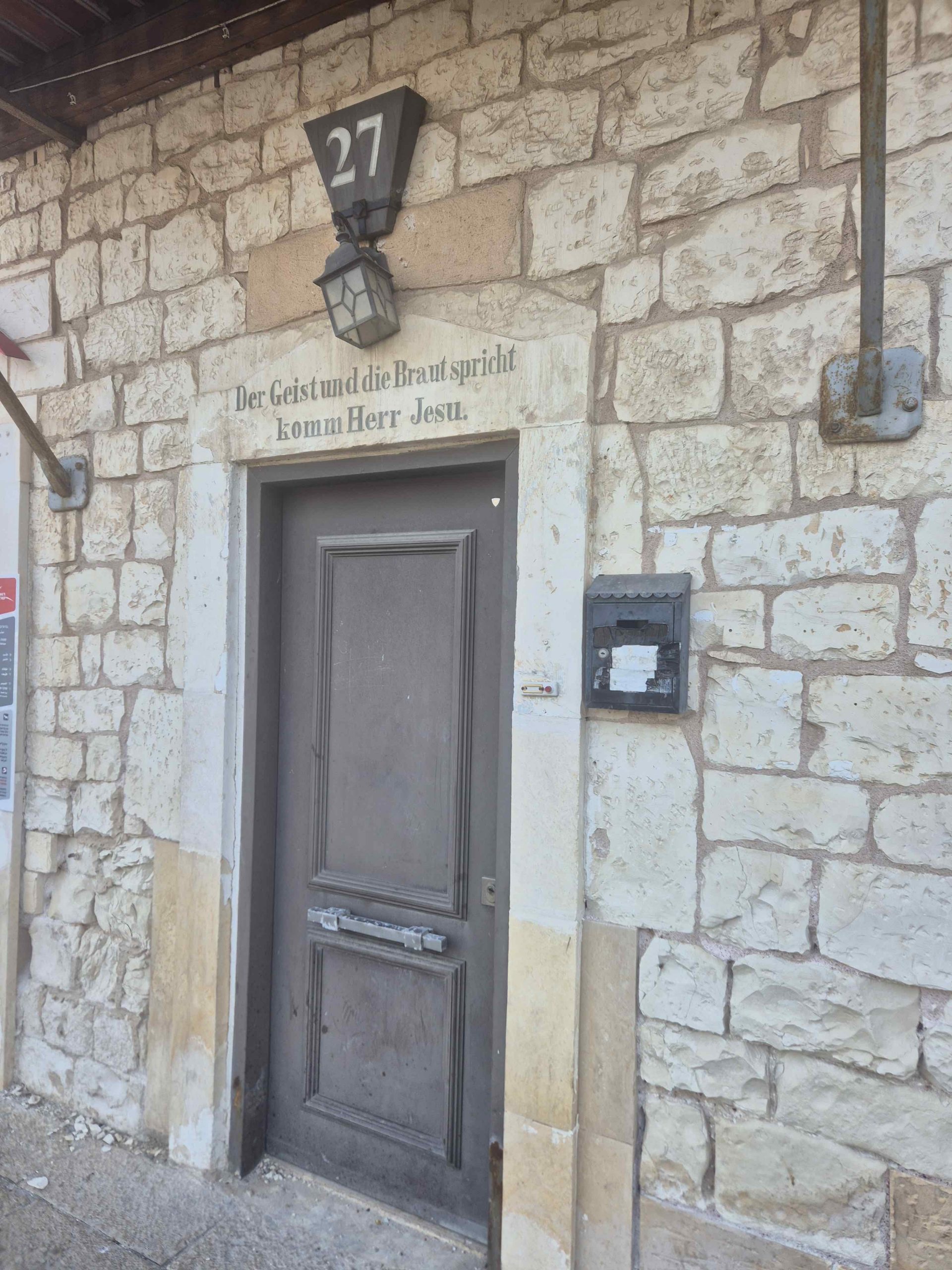
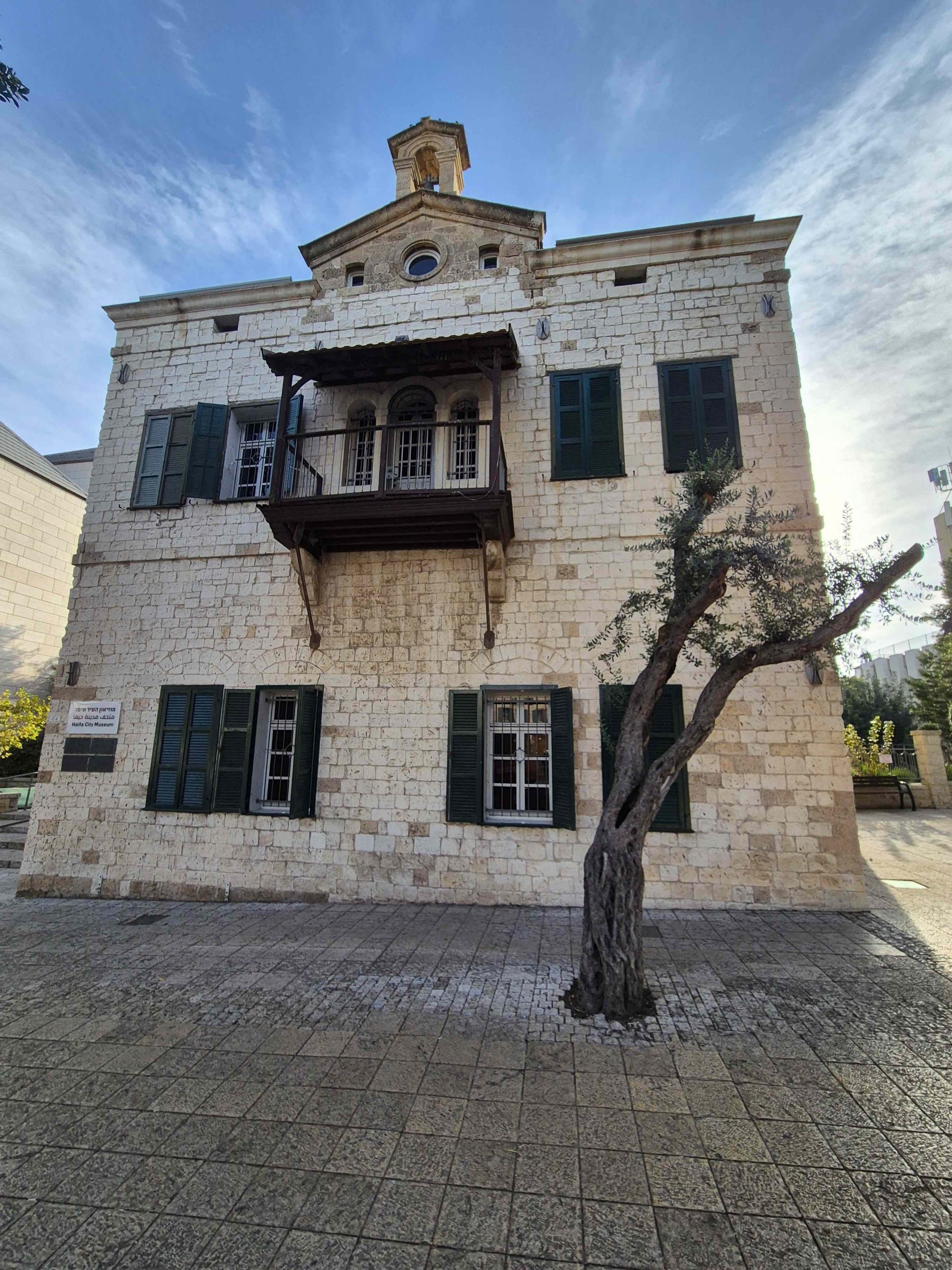
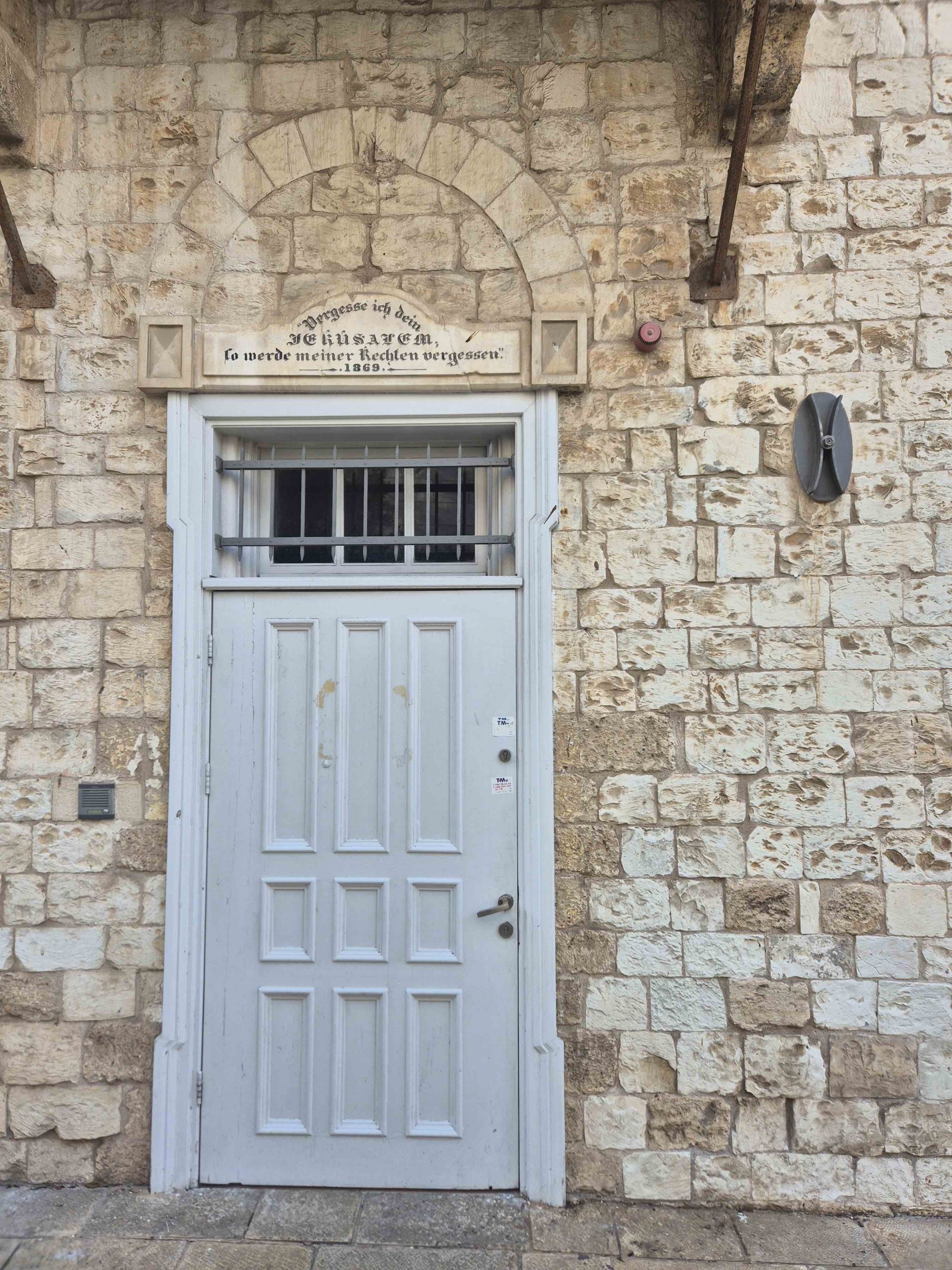
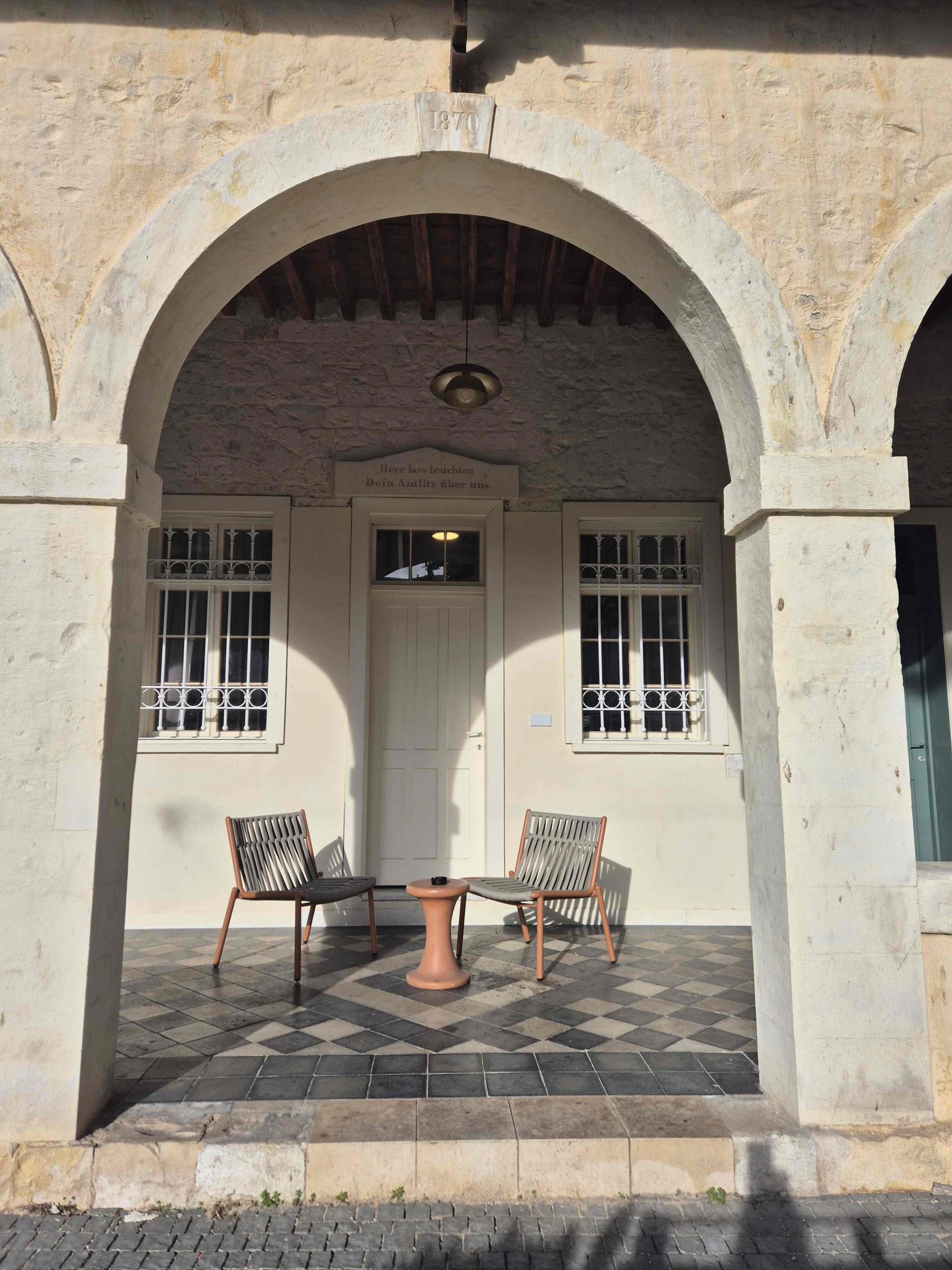
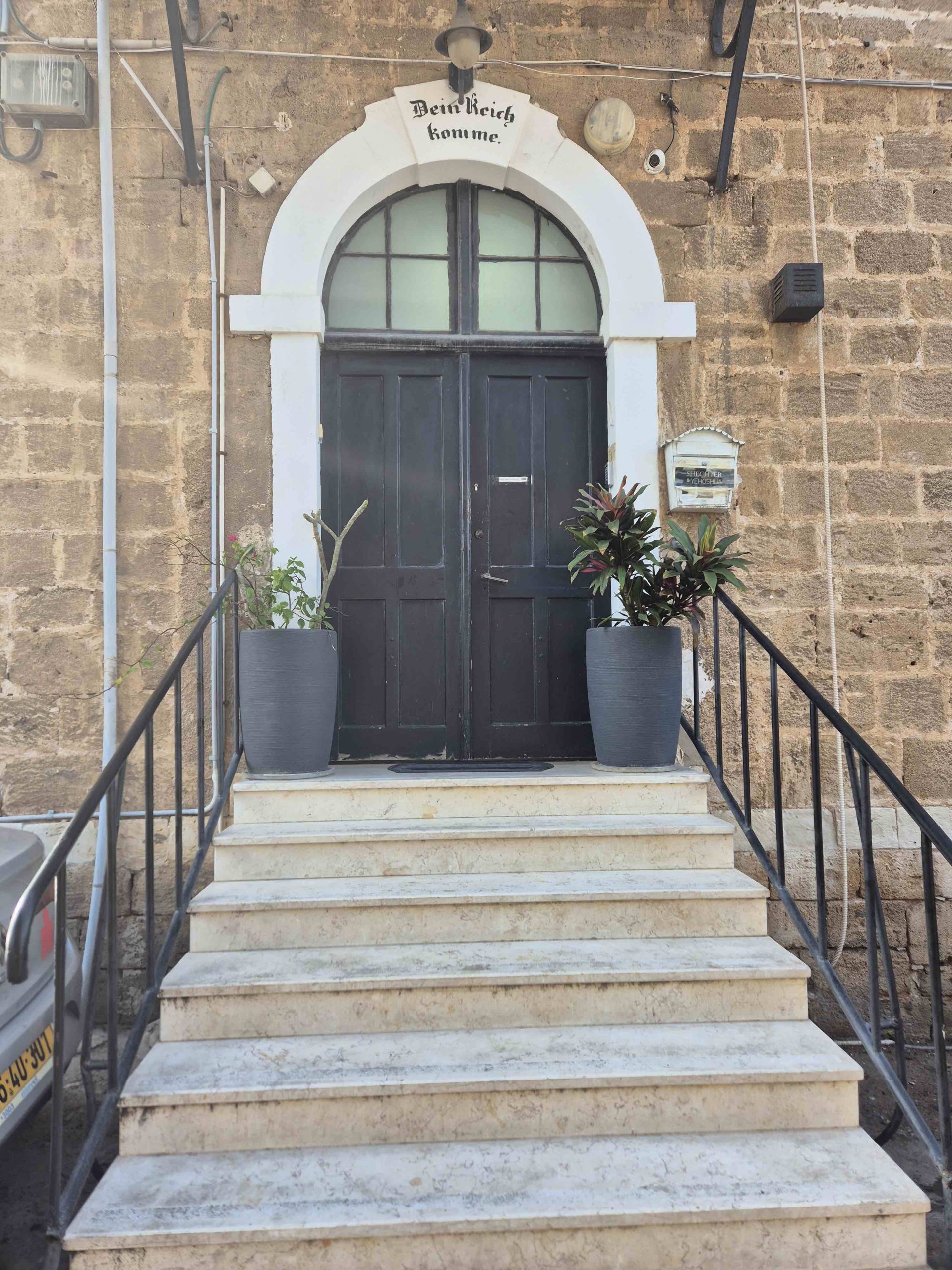
The German Colony was just that. German settlers coming to the holy land and setting up shop here very successfully bringing engineering, agriculture, wine making and beer brewing skills with them. The German colony are pretty, well restored houses often with German phrases on top of the doors and restaurants called Schtrudel. Our hotel is on the main drag leading up to the gardens.
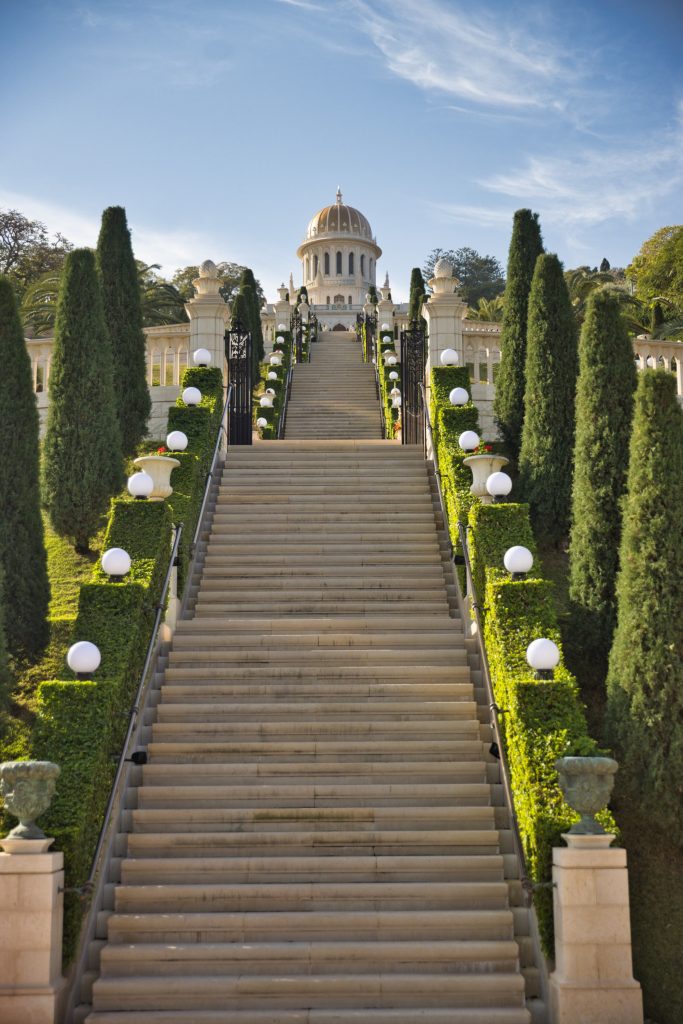
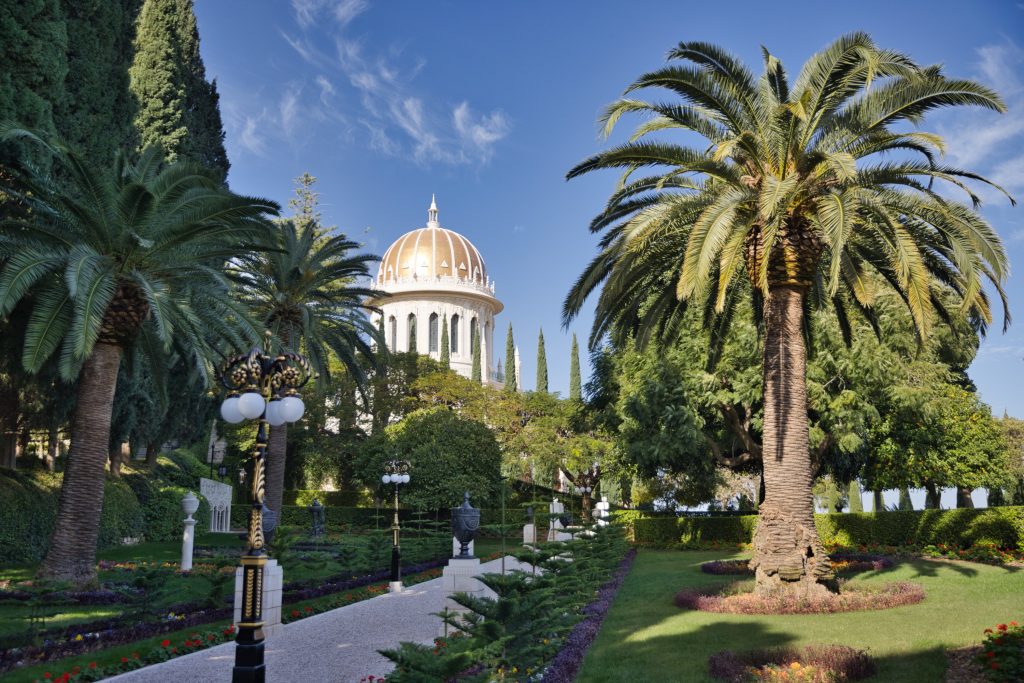
The gardens were created to house and honor the grave/shrine of Bab, visible by a golden domed building in the middle of the gardens. Baháʼí started as a fairly modern religion founded by an Iranian, Ali Muhammad Shirazi proclaimed himself to be the Báb, literally the “Gate” to a new era of divine revelation and a forerunner to future prophets. This relatively young religion, founded around 1850, introduced ideas that were radically progressive for its time. Central to the Baháʼí faith is the belief that all men and women are equal, and that all religions share a common origin and should coexist peacefully.
What sets the Baháʼí faith apart is its conviction that faith and reason—religion and scientific inquiry—are not in conflict, but complementary. Both are seen as equally valid paths toward truth and understanding. In a world so often divided between belief and knowledge, this insistence on their harmony feels strikingly modern. The global headquarters of the Baháʼí World Centre are located in Haifa to this day.
The Baháʼí faith currently counts an estimated six to eight million followers worldwide. Today, the largest Baháʼí communities are found in India, parts of sub-Saharan Africa, Southeast Asia, and Latin America, with smaller but established communities across Europe and North America. The faith is also considered one of the fastest-growing global religions, largely because of its emphasis on education, social engagement, and its non-missionary but open approach to belief. It also has its own calendar, with distinctive holy days and festivals that structure religious life independently of other traditions.
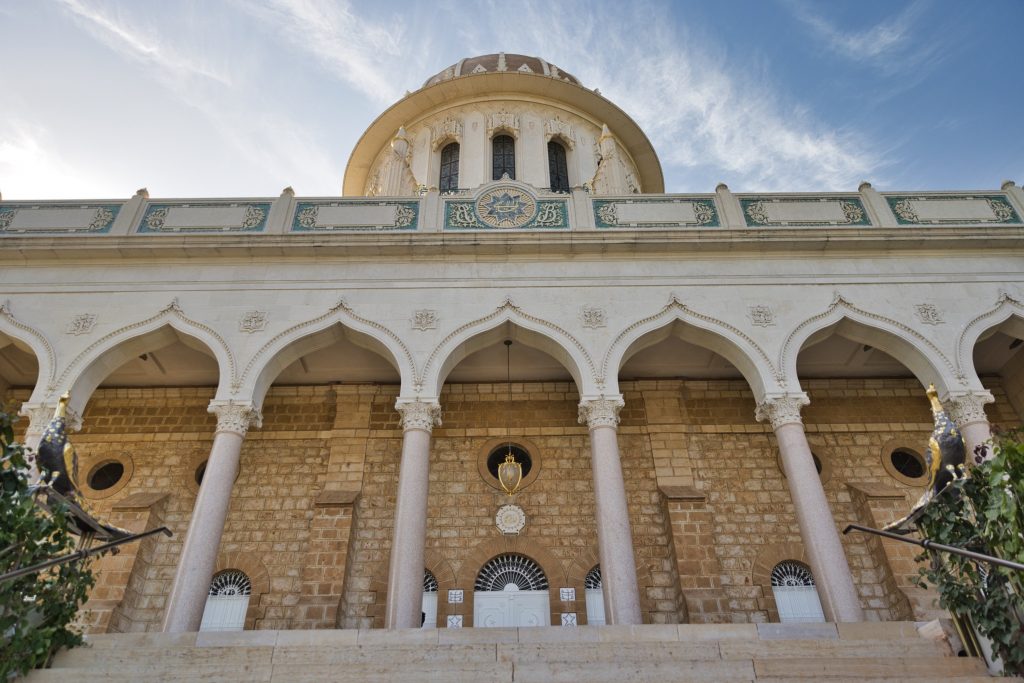
While the human remains of Bab were laid to rest here in 1909 (after having been hidden in Iran for many decades) the upper and lower gardens were created much later, between 1989 and 2001. They are beautifully laid out across many terraces in a very symmetrical fashion. Like botanical gardens complete with fountains, statues and palm trees. Weirdly enough you cannot visit the entire gardens from one access spot.
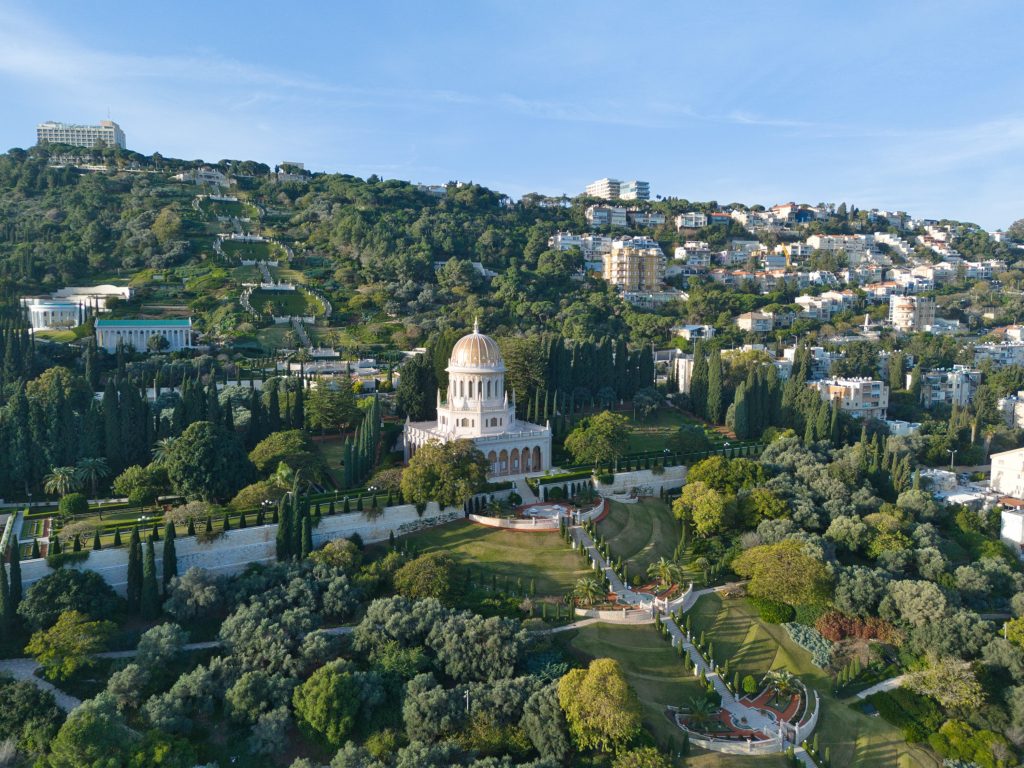
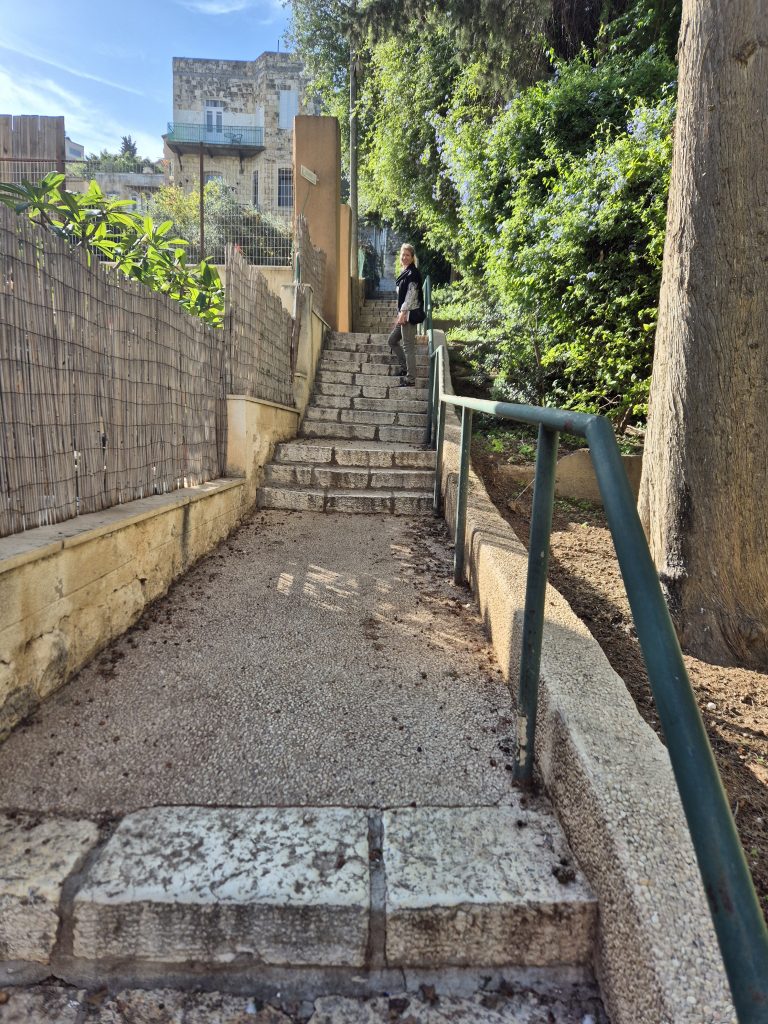
On the lower end there is a limited access only to the first fountain. In the middle the access is only to the shrine (which looks prettier from the outside than the inside) and for the upper access one needs to drive or walk to yet another entrance gate with limited access to a portion of the gardens. Why that is we have no idea. So we went to the lower access, and the middle one, walking up hundreds of stairs, leaving the top access for tomorrow.
Nevertheless the view from the middle terrace over Haifa and the Mediterranean sea is stuning. The gardens do look very pretty in sunlight.
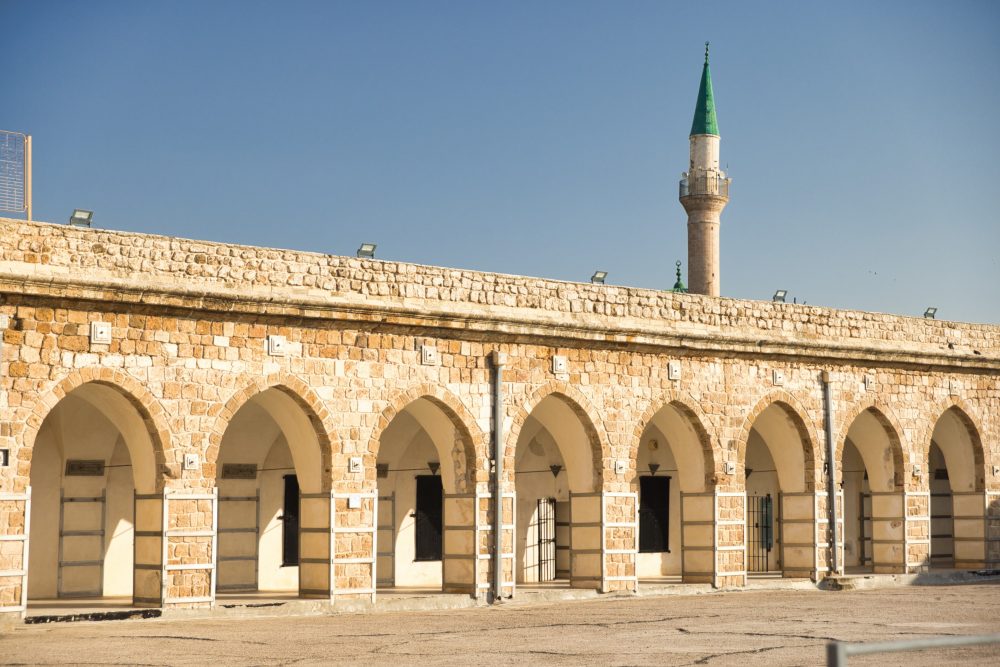
Rather then climbing up another 25 minutes to the top entrace, we decided to leave that for tomorrow and go to Akko instead for the remaining half day. The drive was short (30 min only) and after parking our car outside the old city we set out on foot to explore one of the most important ports during the cruisader period.
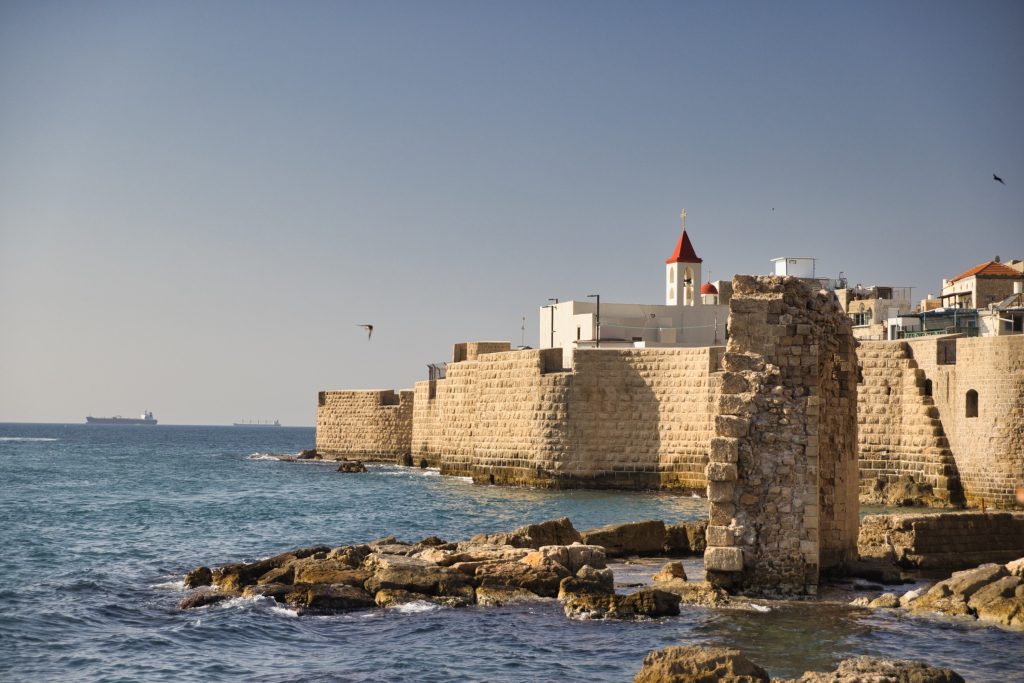
Akko is North of Haifa and was of immense importance due to the harbour that allowed easy access for larger ships and was ideally placed for trade in the Mediterranean. Artefacts from as early as the bronze age were found here and the city was built, destroyed, rebuilt and extended multiple times over the millenia by various groups.
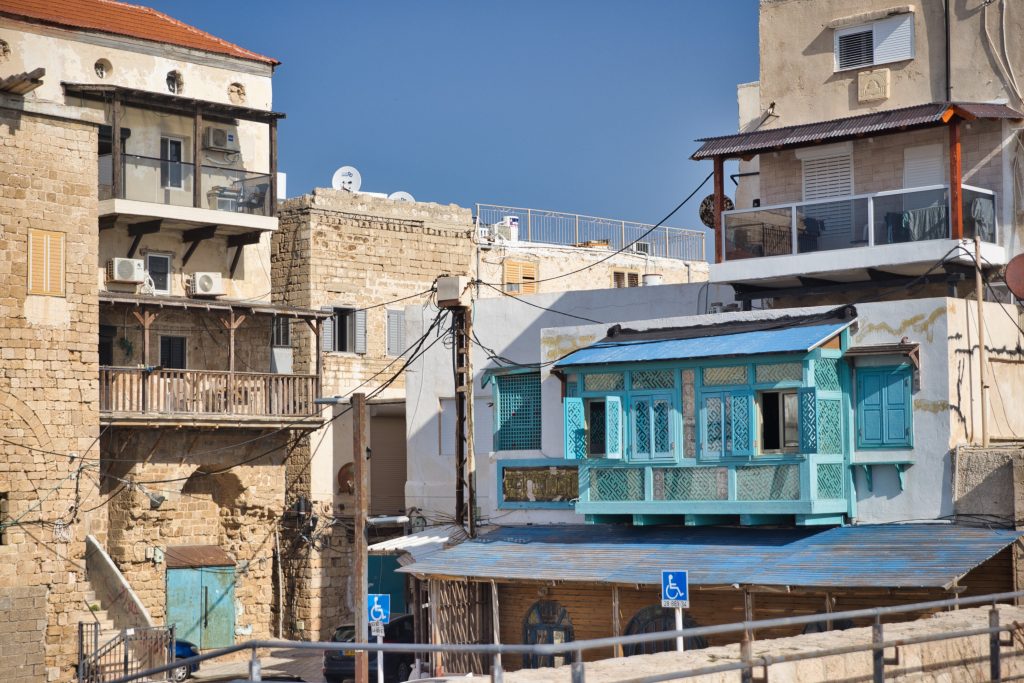
Powers such as the Phoenicier, Mameluks (todays Egypt), Byzantinians, Romans, Arabs and European cruisader nations have all had their share of control and loss of it over the years. Today Akko is like a open air museum with real people in it. We wish they would have restricted the use of cars in that old city more, as wherever possible there is space a car is parked there. The atmosphere would have been even more authentic without all the cars, motorbikes and scooters whizzing about.
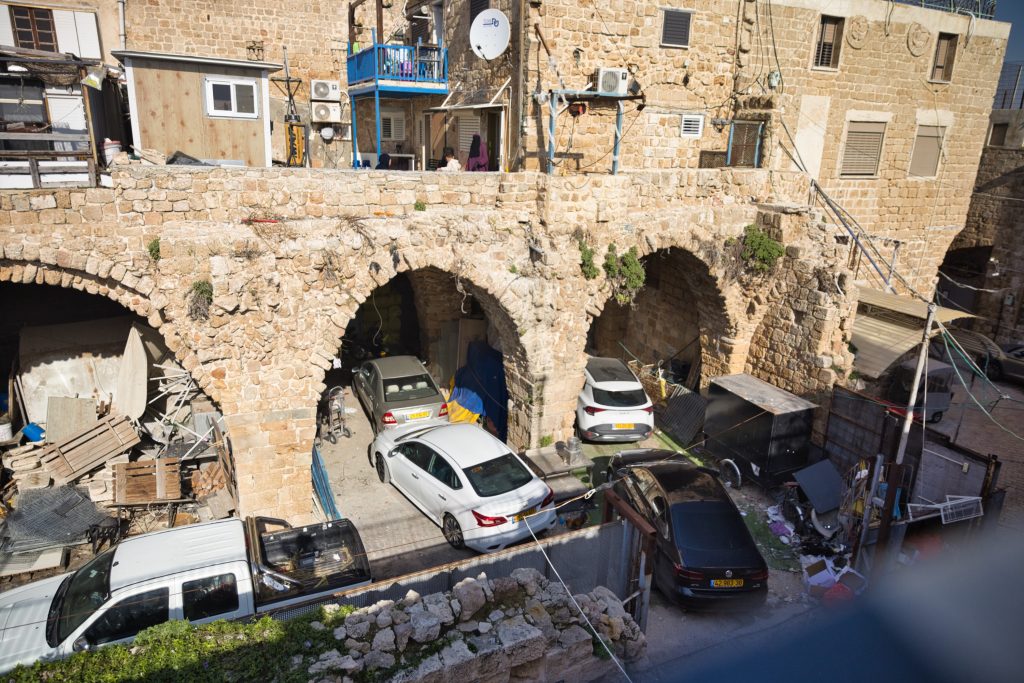
Someone described Akko as a having a flair of Dobrovnik with edges. Much of the old town is just as it was in ancient times. Two storey houses, narrow streets, some so narrow that no car can even pass through. A souk with many shops lining the street sides, offering all kinds of wares, not only touristy souvenirs which is refreshing.
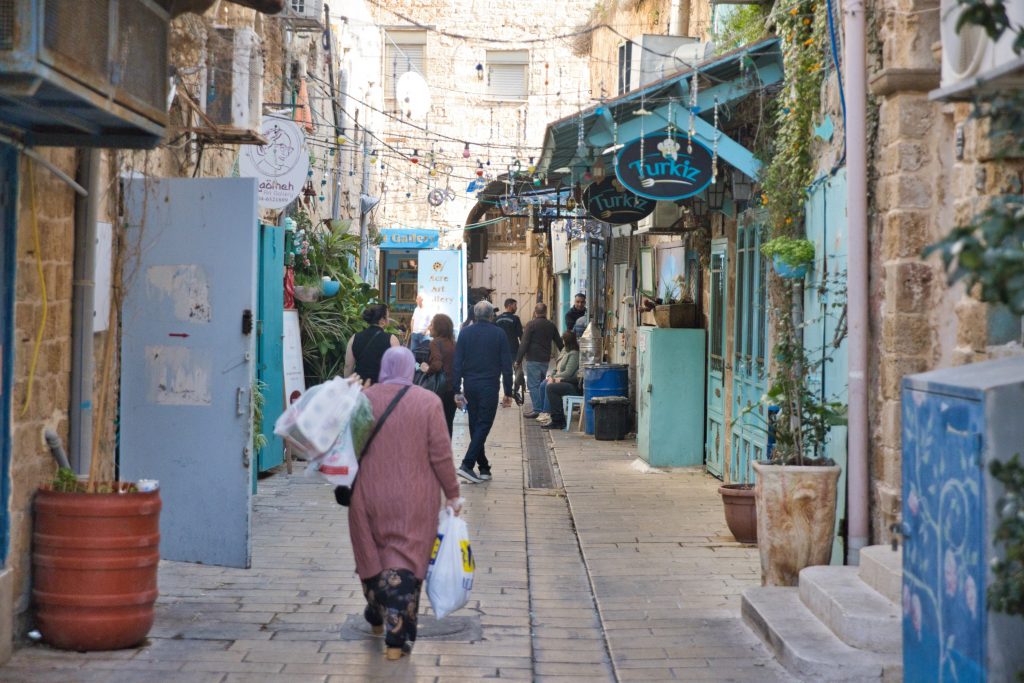
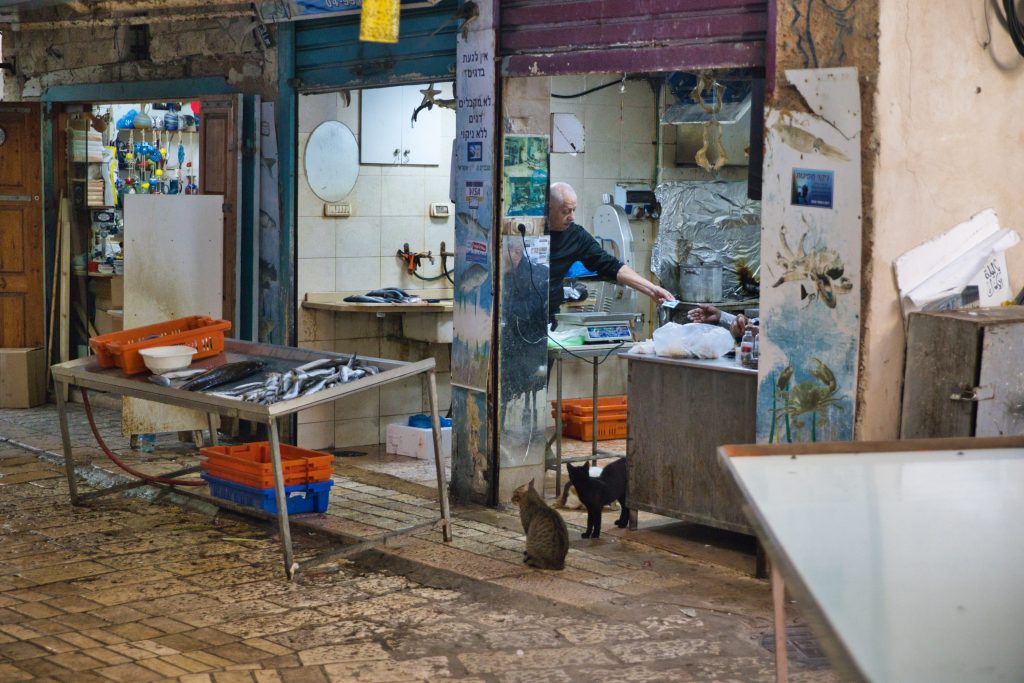
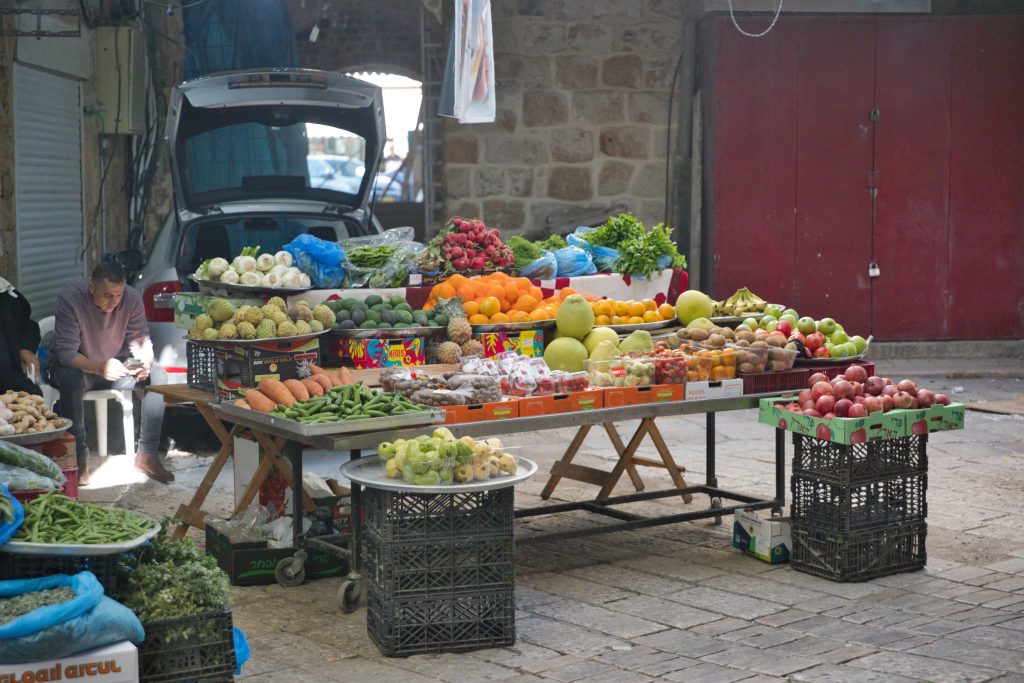
Akko has 6 mosques and 4 christian churches, as well as a large synagoge. It is a mix of religion and population like in most places in Israel.
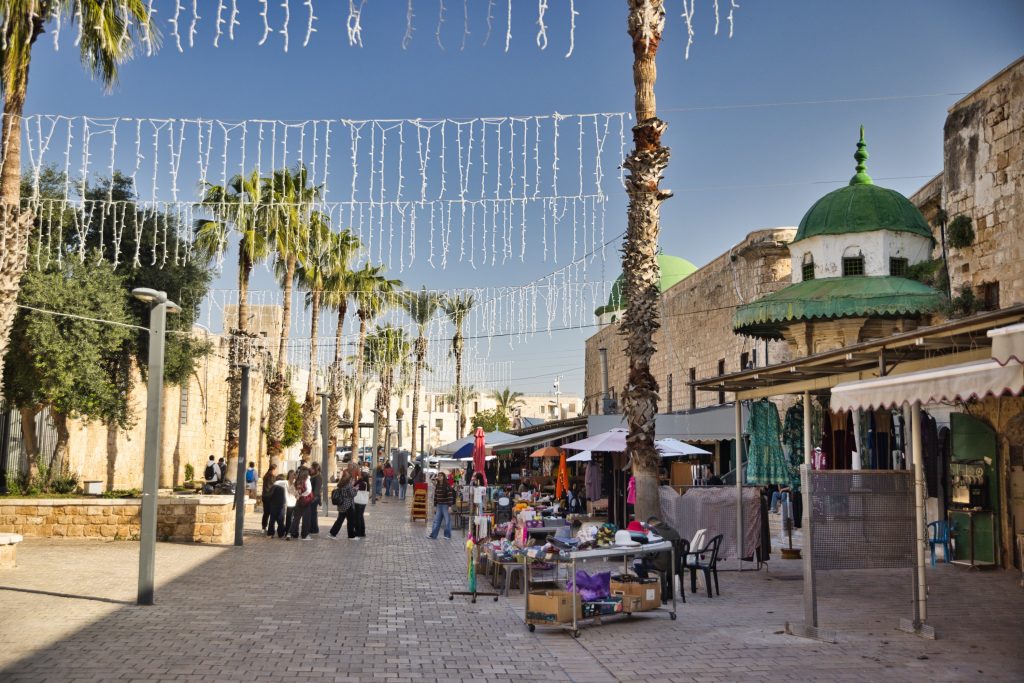
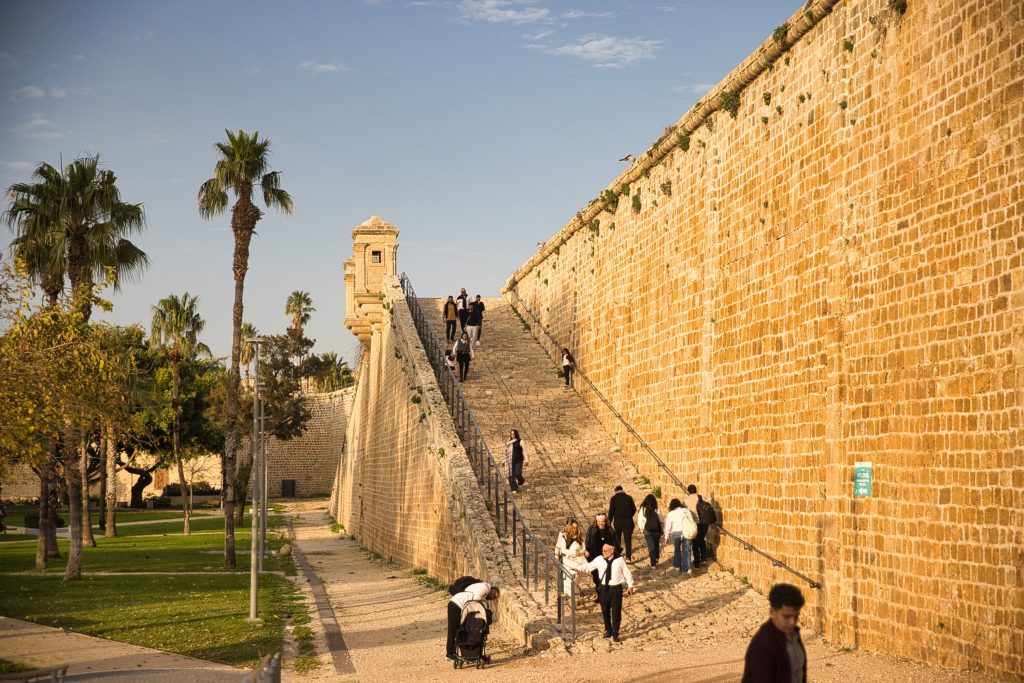
For many cruisaders and pilgrims Akko was the port of entry into the holy land. They were welcomed into the impressive Akko Citadel complete with reception hall and knights halls. We walked the entire building with its many chambers, halls and corridors – a massive stone construction, the thickness of the walls as well as the height of the various knights halls is staggering. Tons and tons of stones must have been hewn and moved into position over the years.
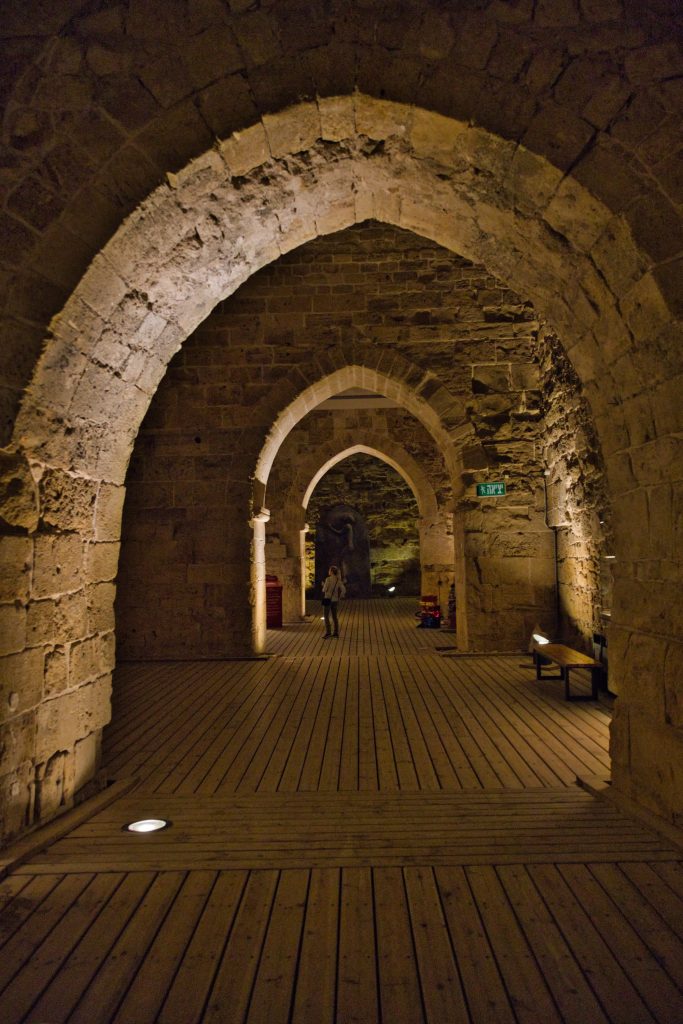
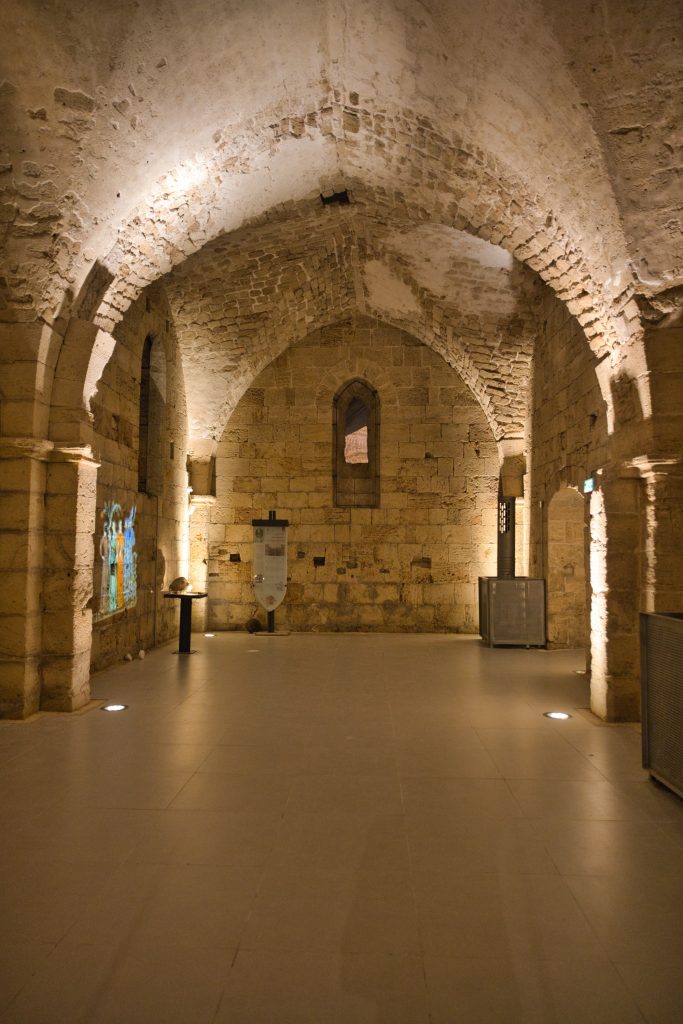
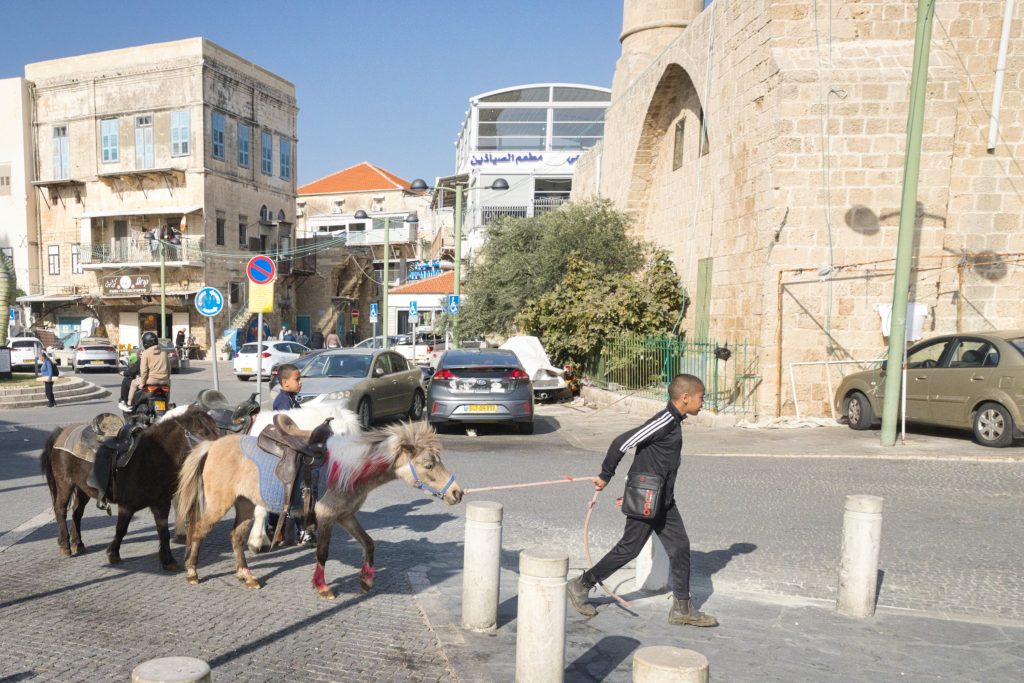
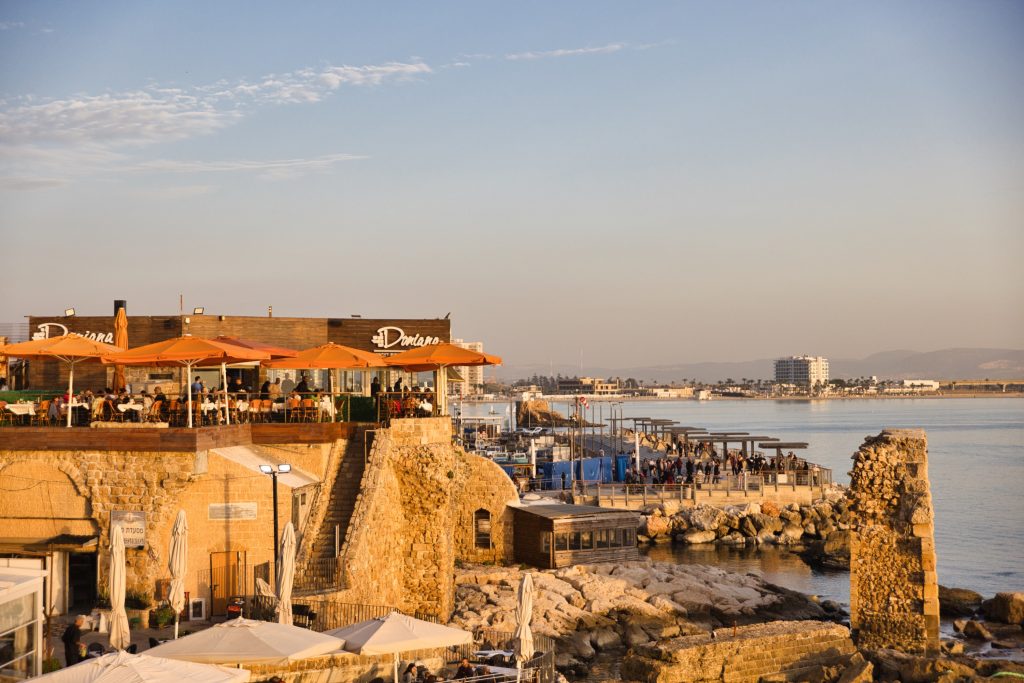
We took our time to visit and criss cross through the old town at leisure. We samples some delicious sweets at the souk, drank a cappucino at the harbour while watching the pony rides go on in front of us.
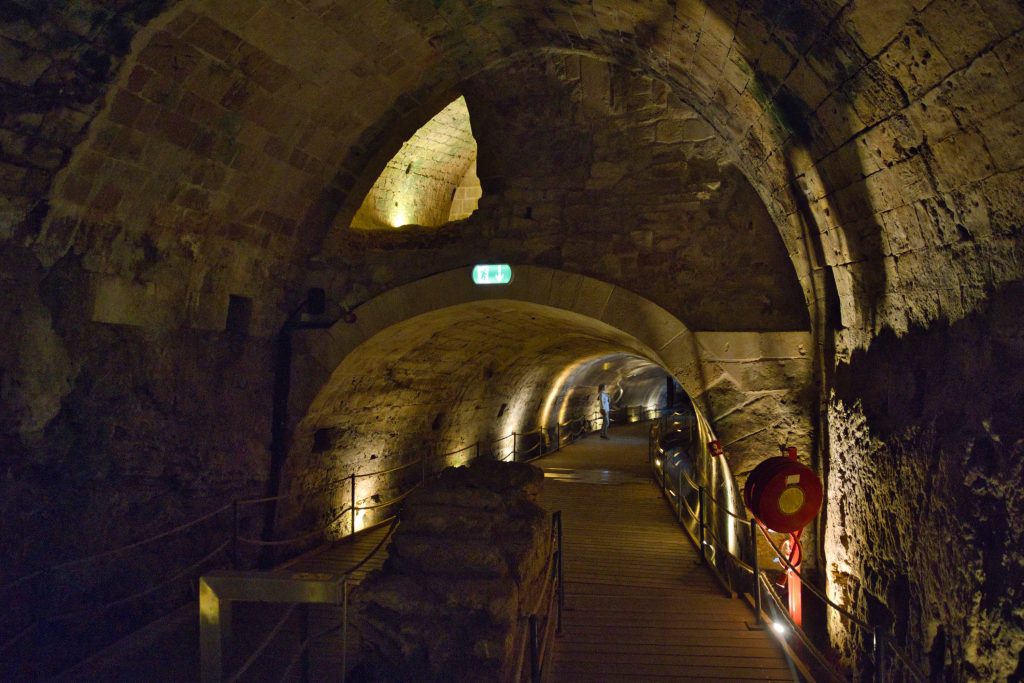
We ducked our way through the Templar tunnel connecting the citadel with the harbour. A 350 meter long underground tunnel that was only discovered in 1994 allowing direct access from the sea to the citadel in a protected way, in case of a land siege of the town.
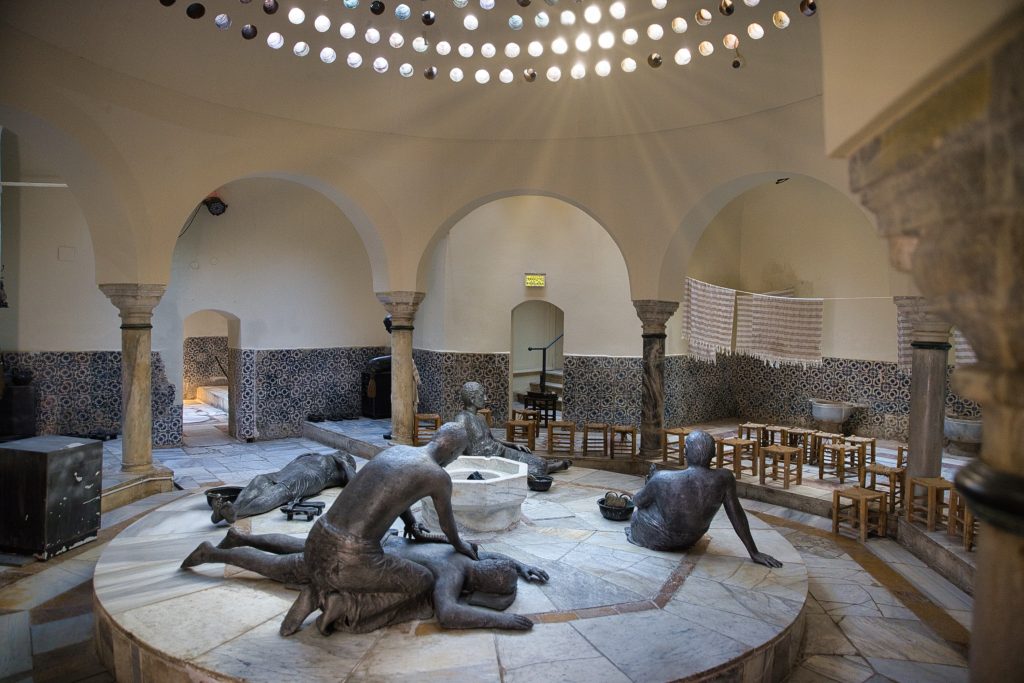
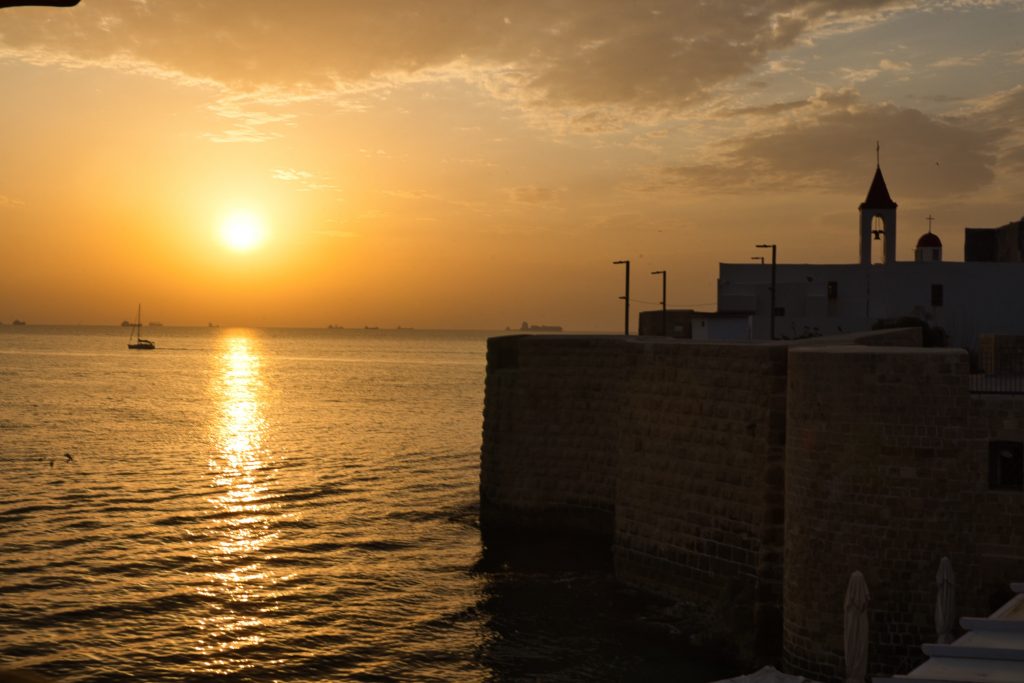
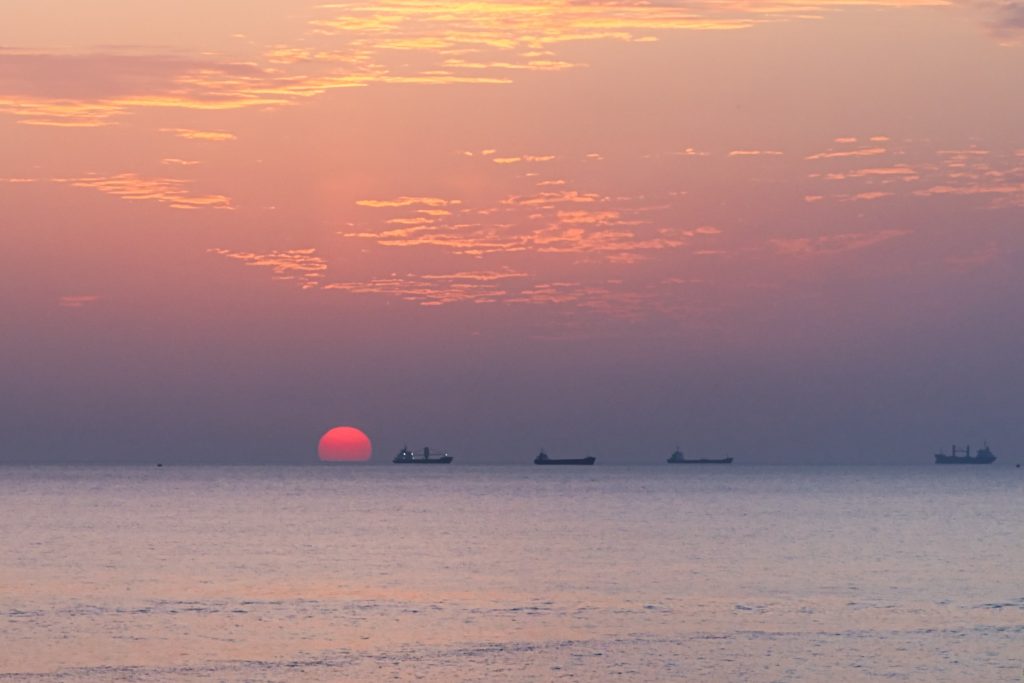
We visited the Turkish bath house, at the time a central meeting point for town folk, where politics were discussed, deals made and personal hygiene observed. After a sun filled stroll on top of the massive city walls, after all, Akko was one of the best to defend fortresses of it‘s time, we let the day end with a sumptuous dinner at a great restaurant at Akko harbour enjoying the setting sun and an excellent grilled sea bass.
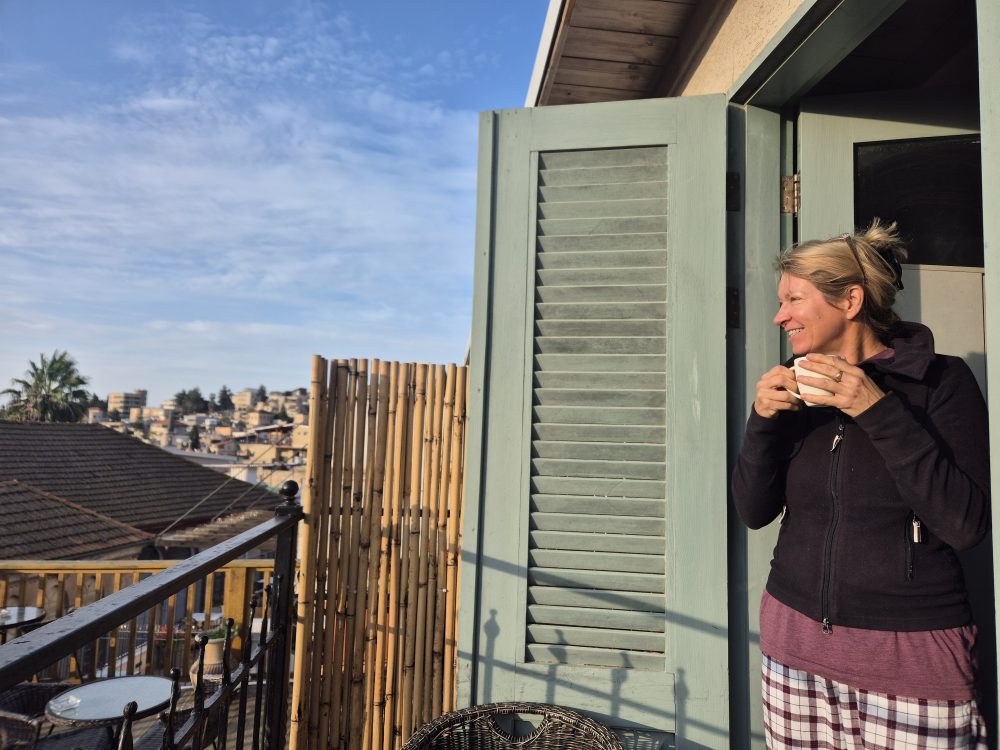
Today was our second riding day with Yair and the two Australian ladies. For that one we had to drive 45 minutes towards Haifa, where we would be staying for our three last nights in Israel. So we packed everything and loaded the car in the morning.
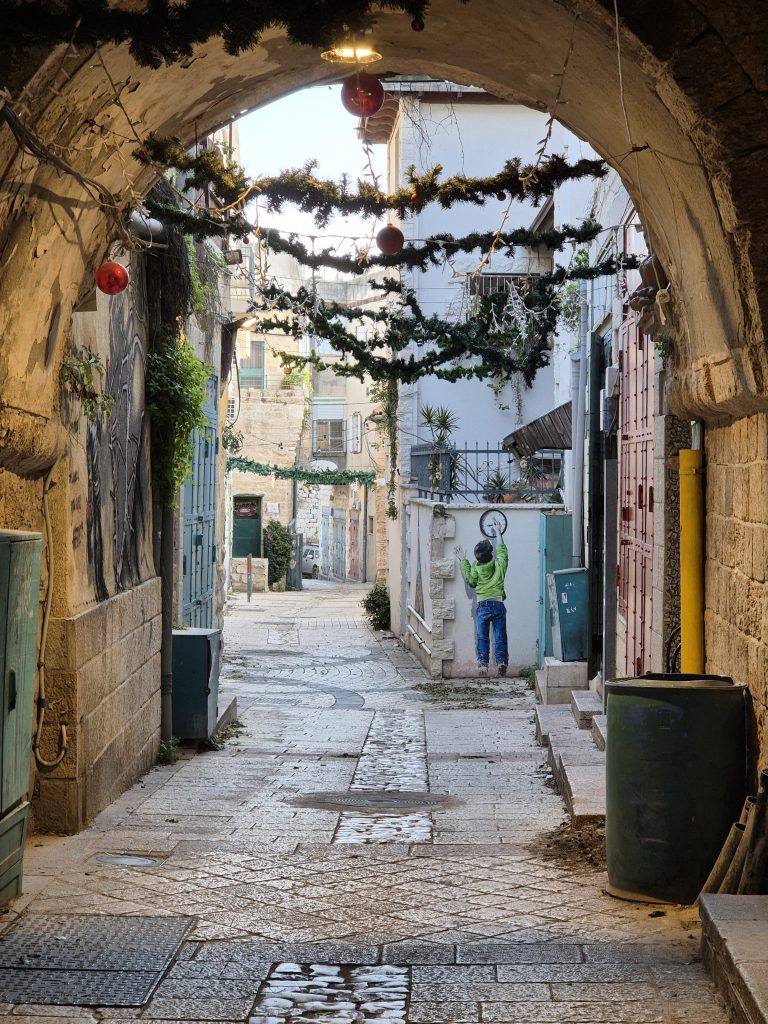
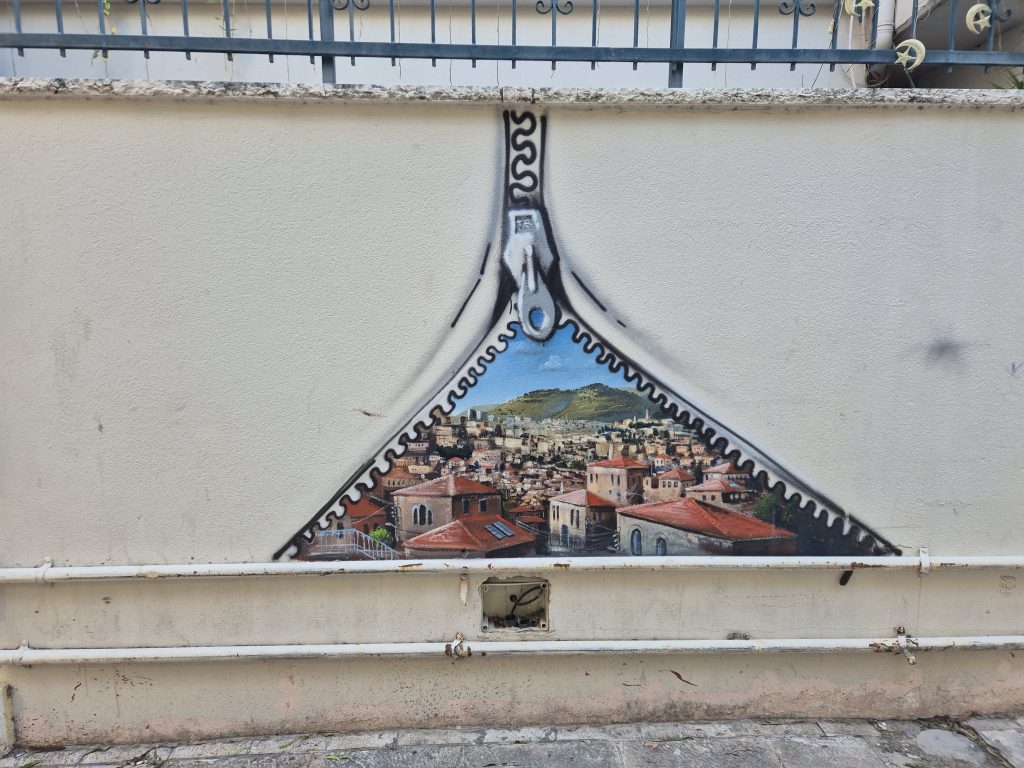
Emil, our very nice host at the Michel House Boutique Hotel made us a breakfast to go bag which was really nice of him. We can only highly recommend Michel House as it‘s central, charming and very welcoming.
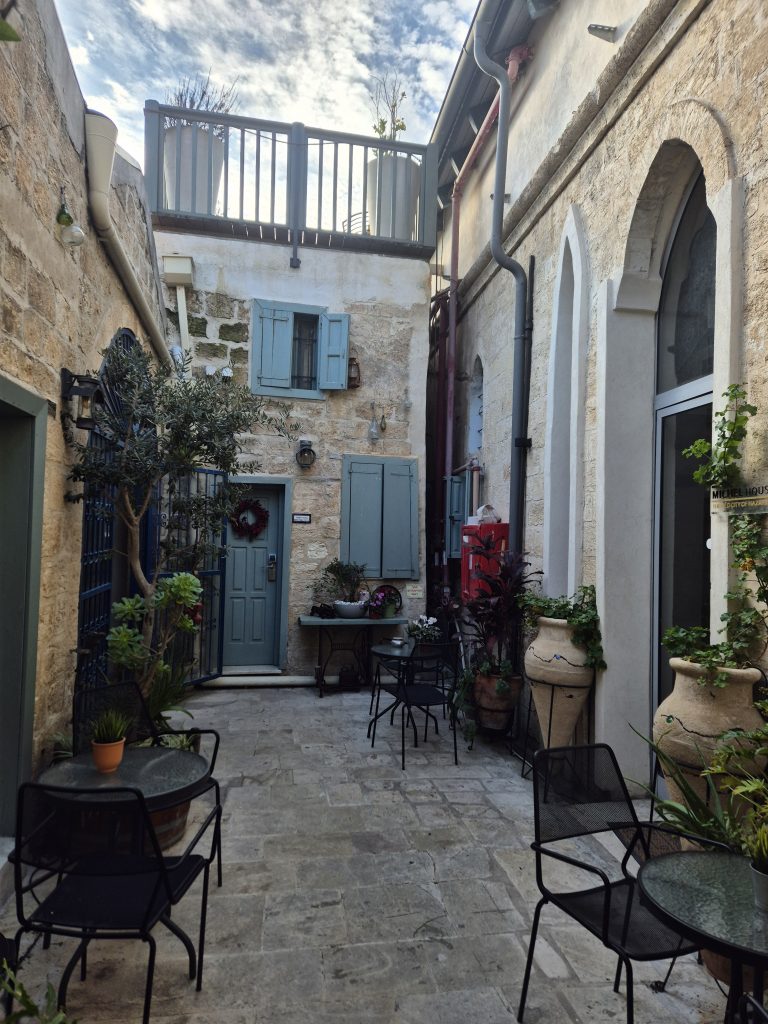
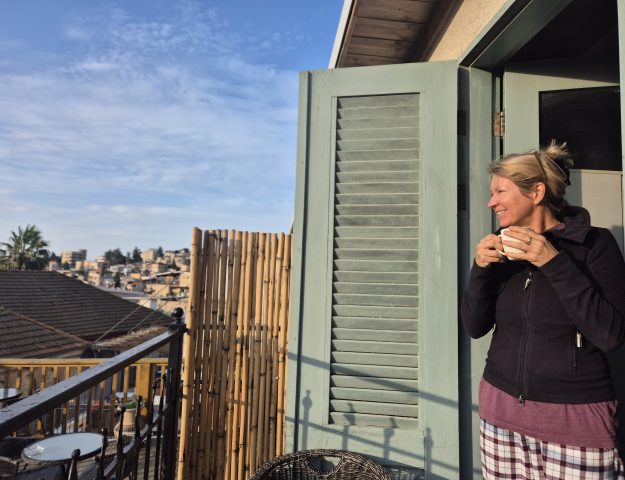
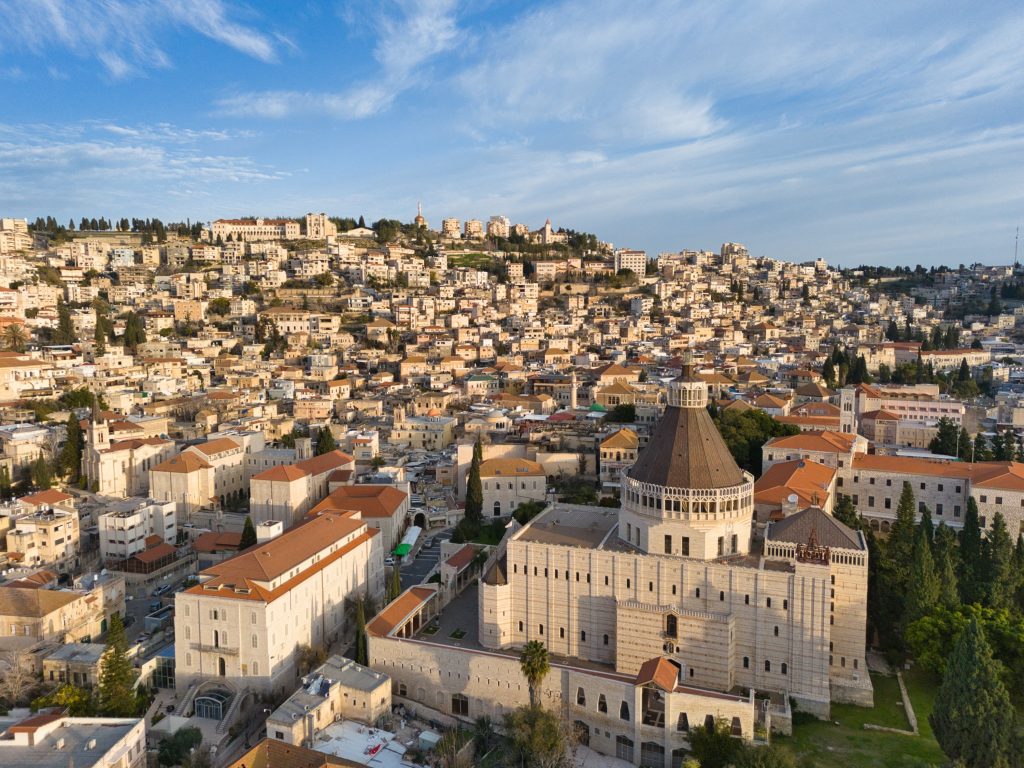
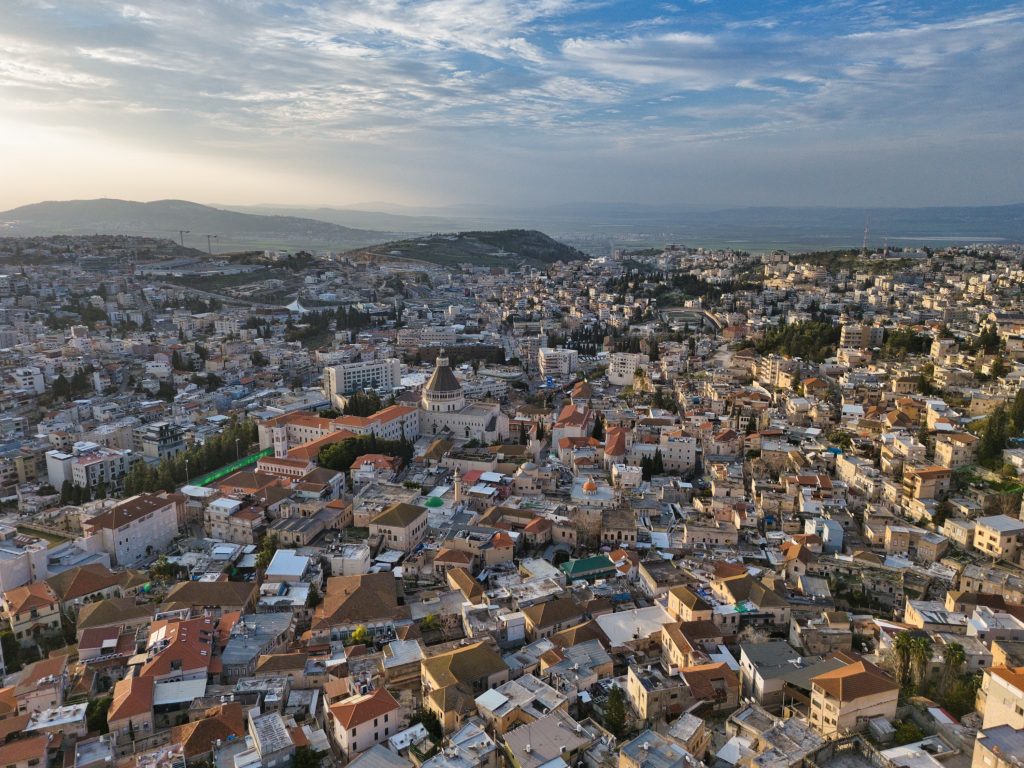
Having its own parking lot was an added bonus and made things much easier for us since the old town has only few parking spots. The view from our terrace over Nazareth was superb and a perfect location for Chris to fly his drone. For anyone planning to bring a drone to Israel, this is worth knowing: registration with the Israeli Drone Club is compulsory in order to import and operate a drone legally. As part of the process, pilots must pass a basic competency test covering airspace rules, safety procedures, and no-fly zones. Without this registration, drones can be confiscated at the airport. Done properly, though, flying a drone in Israel is entirely possible—and the views can be spectacular (but avoid to fly near military bases and in Jerusalem).
After the morning flight, off we went to Karmel heights and surrounding national parks. Tucked away in a former Kibbuz we saw a surprisingly large riding stable, complete with Arena and large stalls. Yair told us he rents stalls on a day by day basis from his various locations he starts rides from. He is trying to keep his fixed costs as low as possible, as most tourist businesses are still hurting badly. At least he has some Israeli tourists coming to him, international business is close to zero still after Covid followed by the war in Gaza.
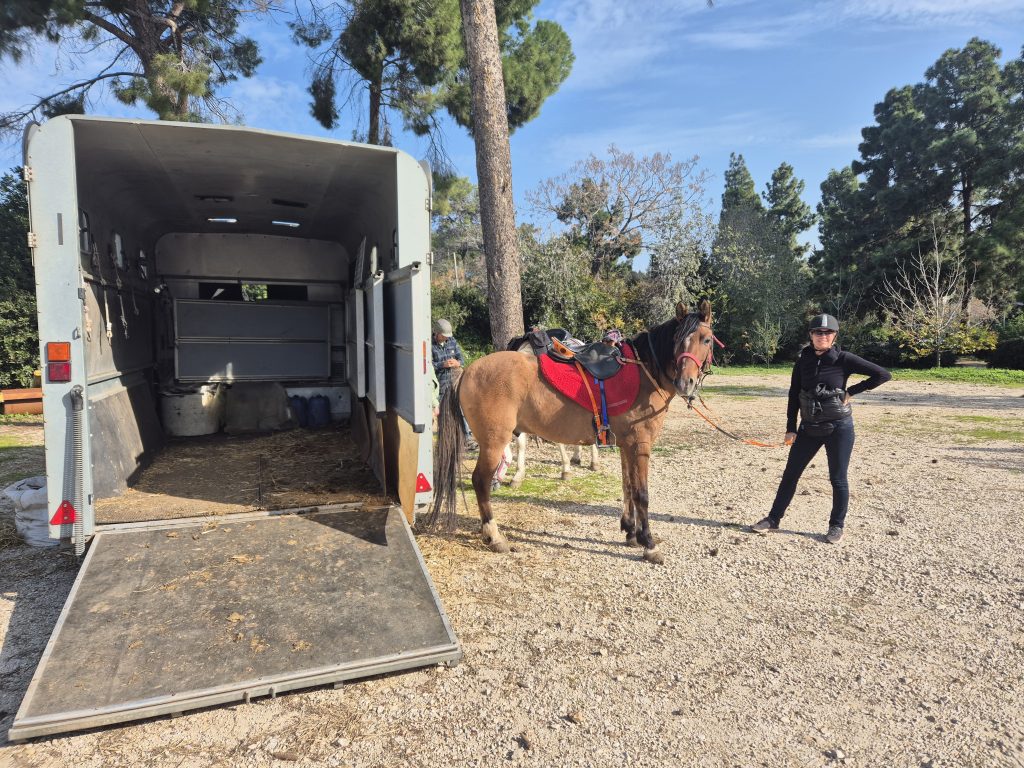
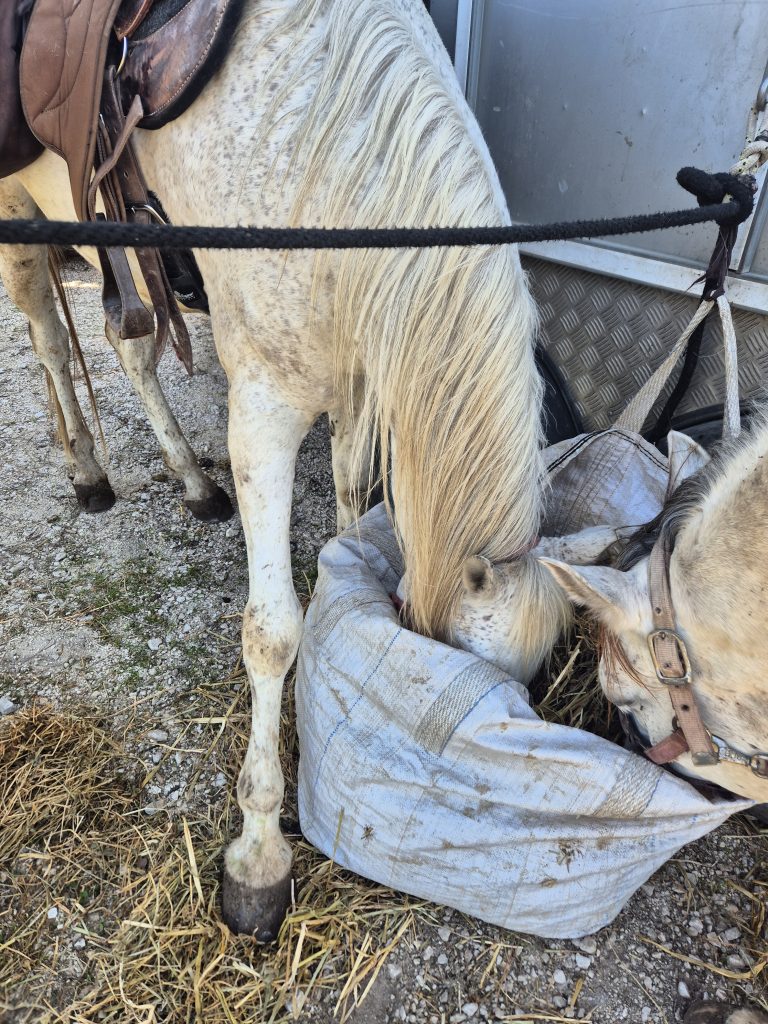
Chris got a new horse, called Rocky. A feisty grey Arabian horse that was quite forward. We others kept our horses from yesterday. Esther had Maple, which is a laid back little quarter horse, perfect for a leisurely ride.
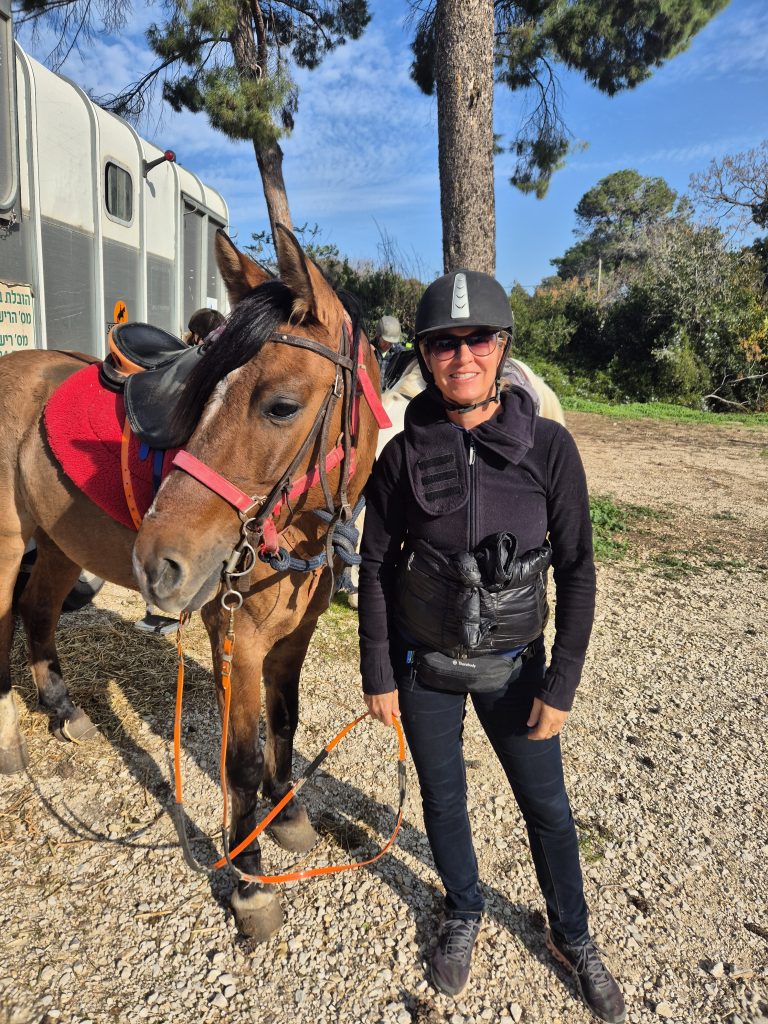
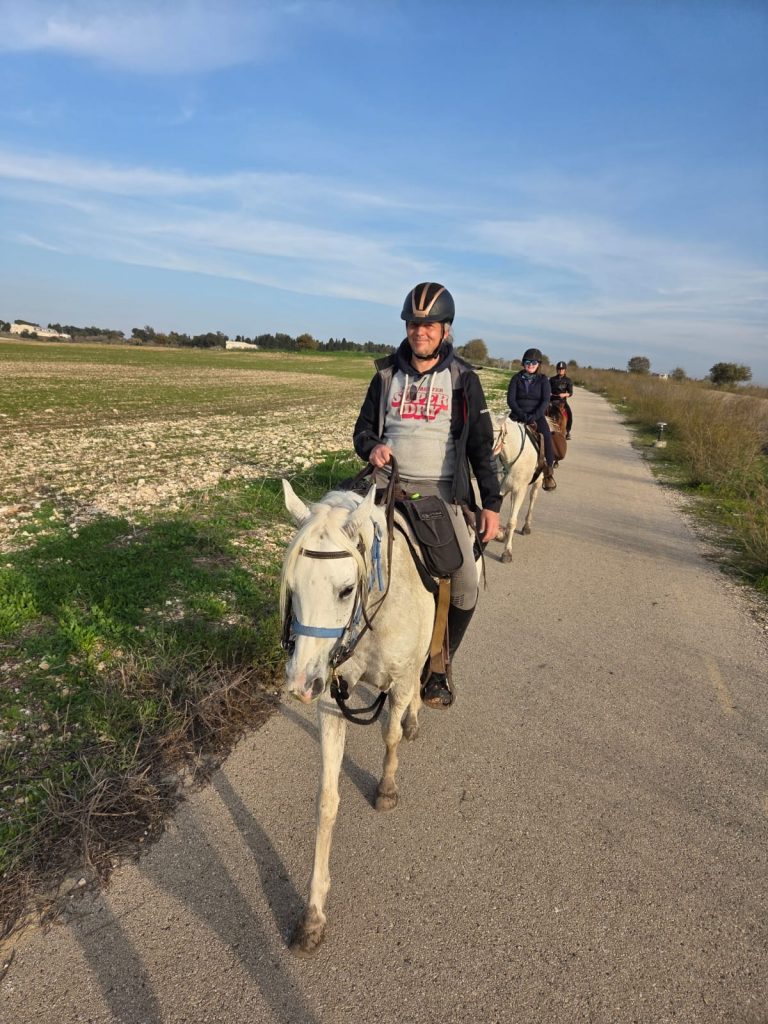
This time the ride was more through wooded areas, lots of cattle pastures and gates. It’s Israeli law that all ways must have a gate for riders/ hikers when a cattle grid is being used to block the road for cattle.
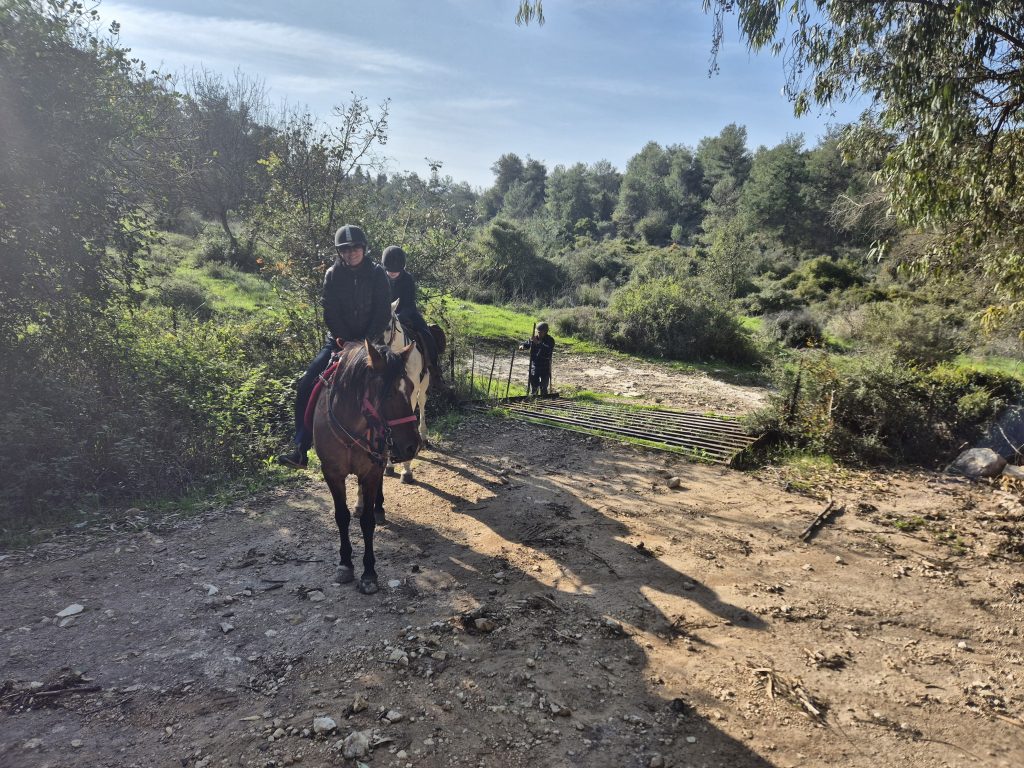
There is no such thing as blocking off private land for riders. Only military areas are off limits. We rode though forests, full of pine and eucalyptus trees, across many streams and over mountain ridges. We must have climbed as many meters and descended as many as the day before.
Lunch was on a beautiful hilltop overlooking Mount Tabor in the distance.
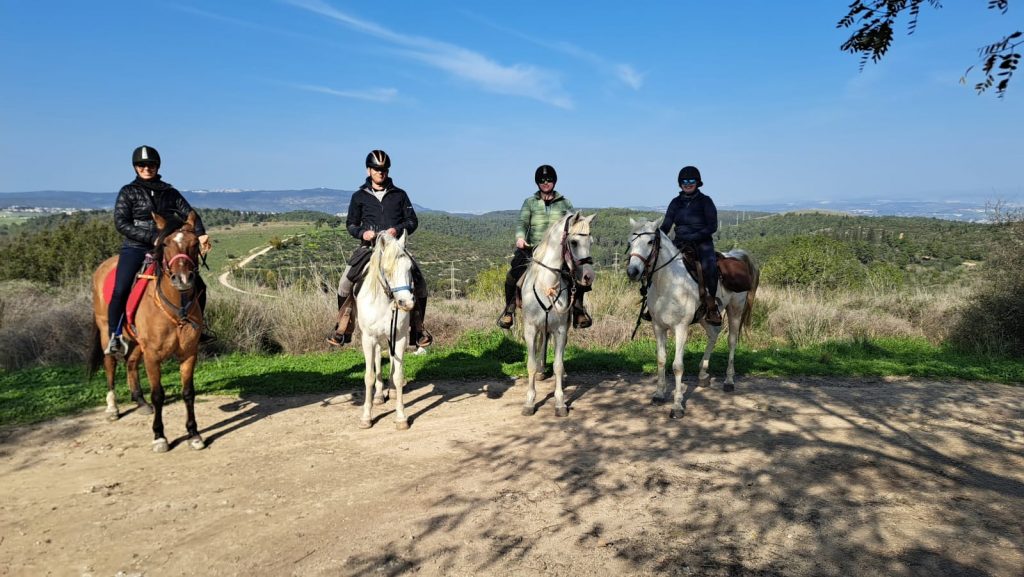
We saw numerous flora and fauna. Foxes, guinea fowl, small antelopes running away from us, and as a sign of winter/spring vivid red and violet Anemones were blossoming on the pastures. It was a beautiful sunny day again and we all were in great spirits.
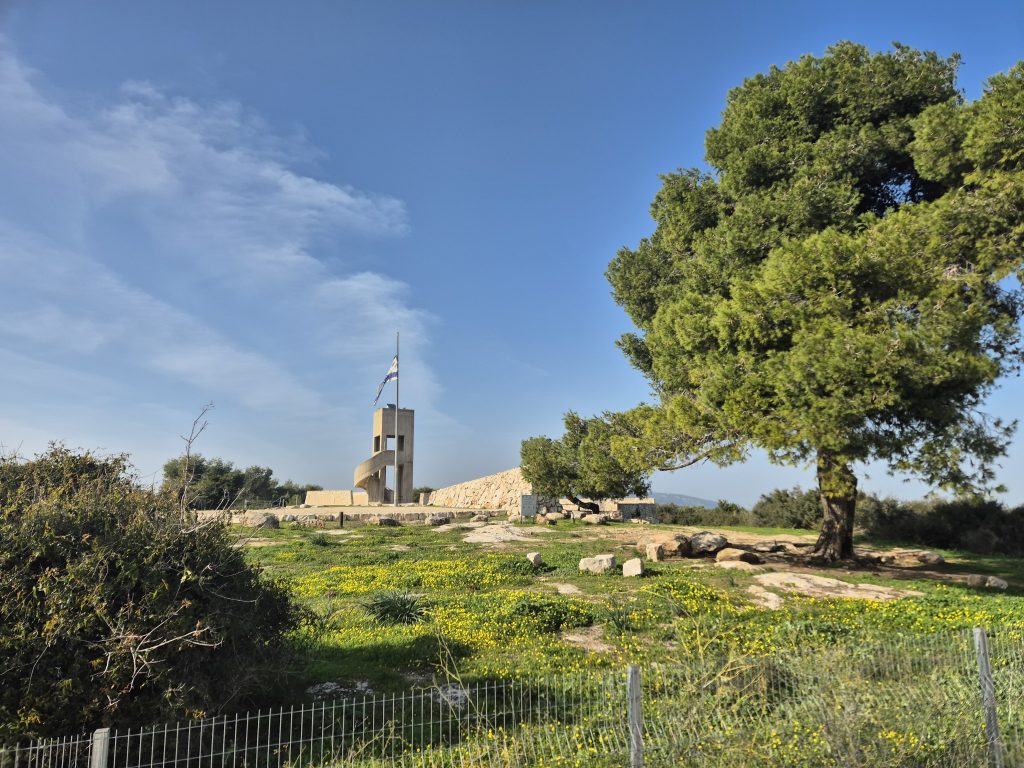
Stopping for a quick break at a fenced memorial dedicated to kibbutz members who fell in Israel’s various wars, we let the horses graze while we visited the site. Kibbutzim have long been disproportionately affected by conflict. Traditionally, they produced some of the country’s most politically engaged and socially active citizens—people who were often among the first to serve, to volunteer, and to lead. Not by chance, several prominent figures in Israeli history emerged from the kibbutz movement, including Moshe Dayan, Ehud Barak, and Golda Meir.
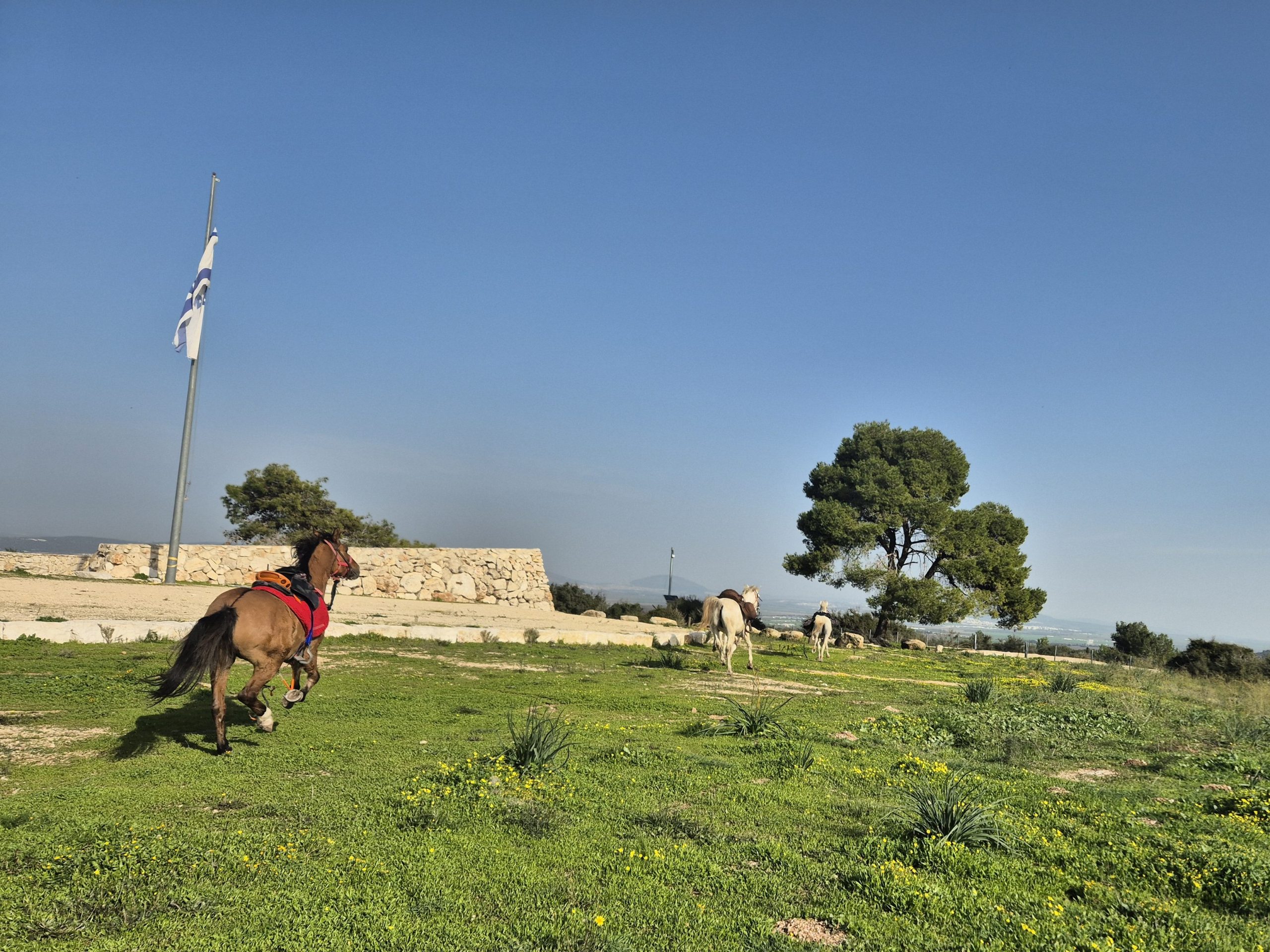
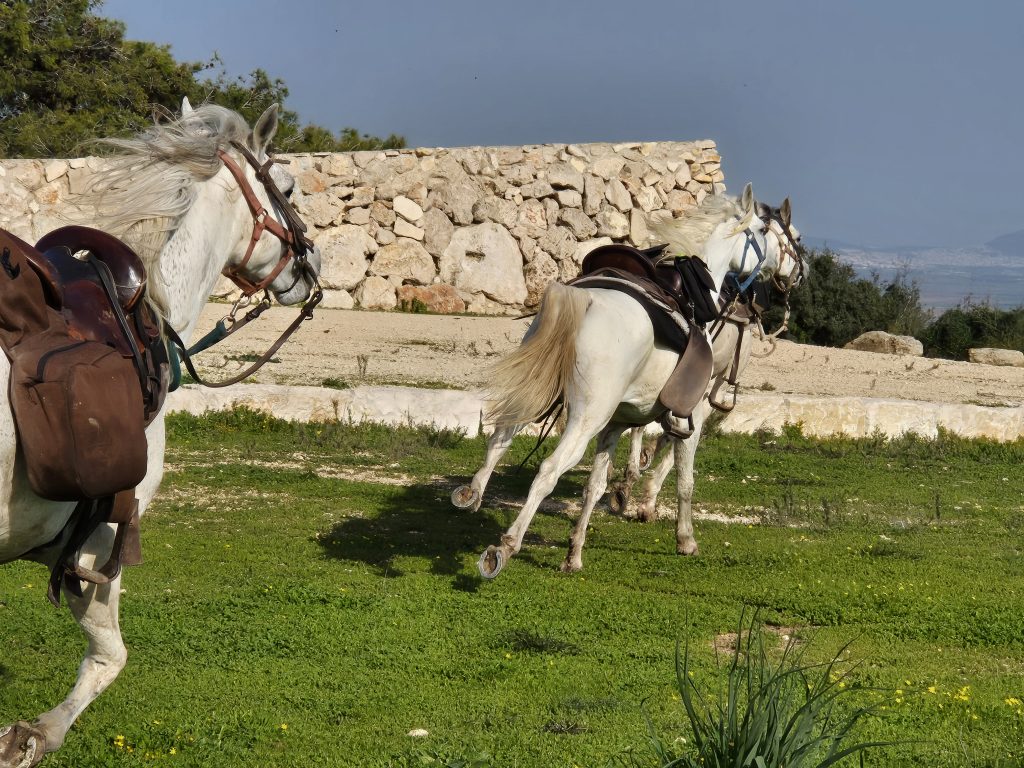
We were without any chance of stopping them and saw ourselves already walking home from the furthest place of the ride. It would have been hours.
Luckily the gate was closed and none of the horses was brave enough to jump it. Yairs horse the chief mischief maker skidded to a stop just in front of the gate, turned around and galopped back where they came from, looking for another way out. The herd followed and all horses galopped the other way around us. Luckily we got them into a corner and they were quickly caught by their trailing lead ropes. How lucky we were! We had a hearty laugh, mounted again and started our way towards home with another gallop this time on top of our horses.
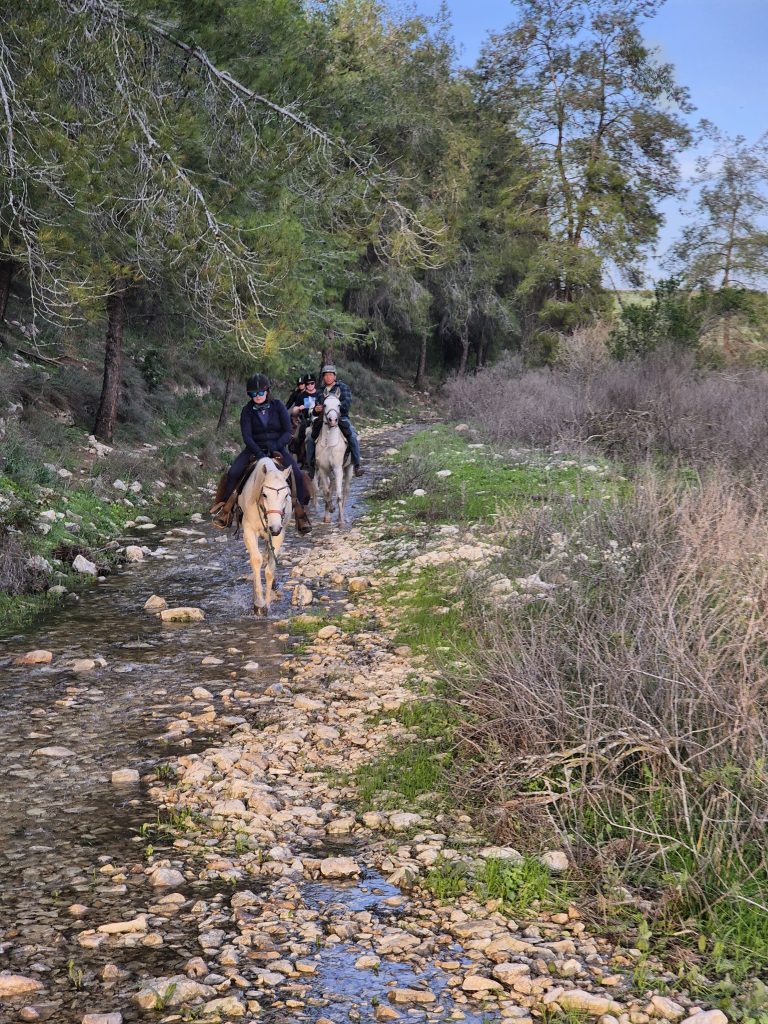
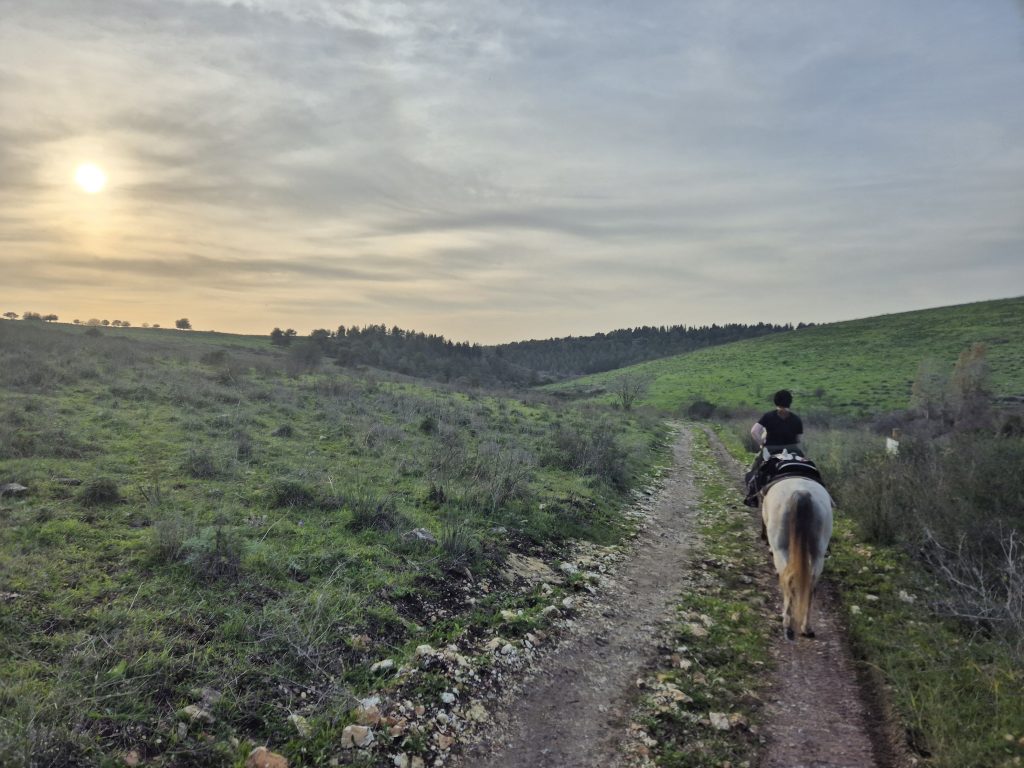
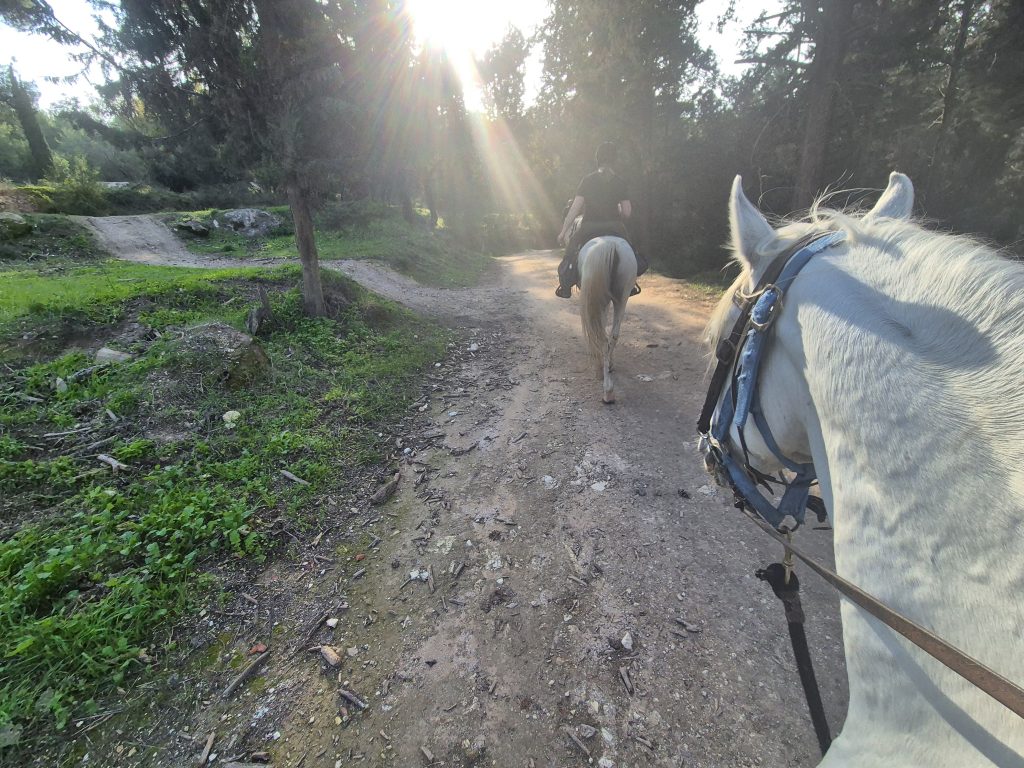
During our ride, we occasionally heard the distant explosions from military training a few kilometers away. We also encountered Israeli special forces moving through the area in Range Rovers—vehicles not typical for the Israel Defense Forces, but often used for low-profile operations in Arab regions. We even came across a team testing a military drone, which Chris found particularly fascinating.
In Israel, one is reminded almost daily of the country’s particular situation—of the need to remain constantly alert and prepared to defend itself. At the same time, the actions and the sheer scale of the Israeli military operation in Gaza is controversial even among some Israelis. It is a deeply charged subject whose full complexity cannot be reflected in a travel blog.
Making our way through forest, streams, and bicycle paths, it was once again 4 p.m. by the time we arrived back at the trailer.
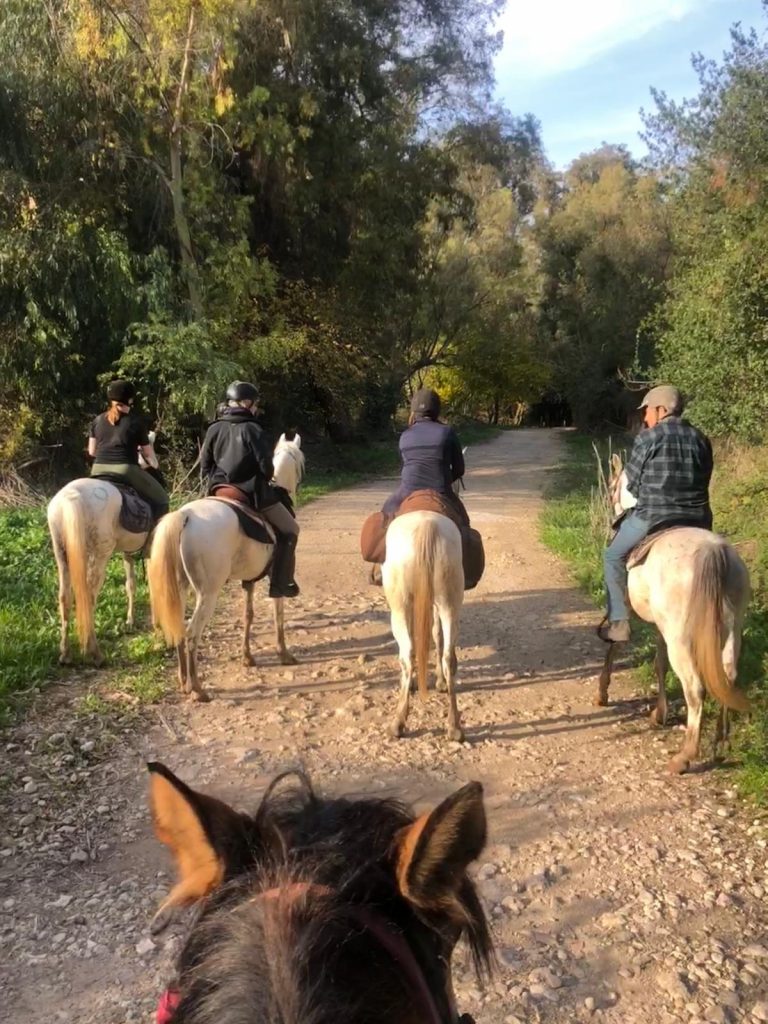
We said a heart felt good bye to Yair, the Australians and our horses and headed to our new hotel in Haifa. Sore from so much time in unfamiliar saddles we were delighted to see that our little Templers Boutique hotel (Shout out to Chris for selecting superb small boutique hotels during our trip!) had a big white lion clawed bathtub in our room.
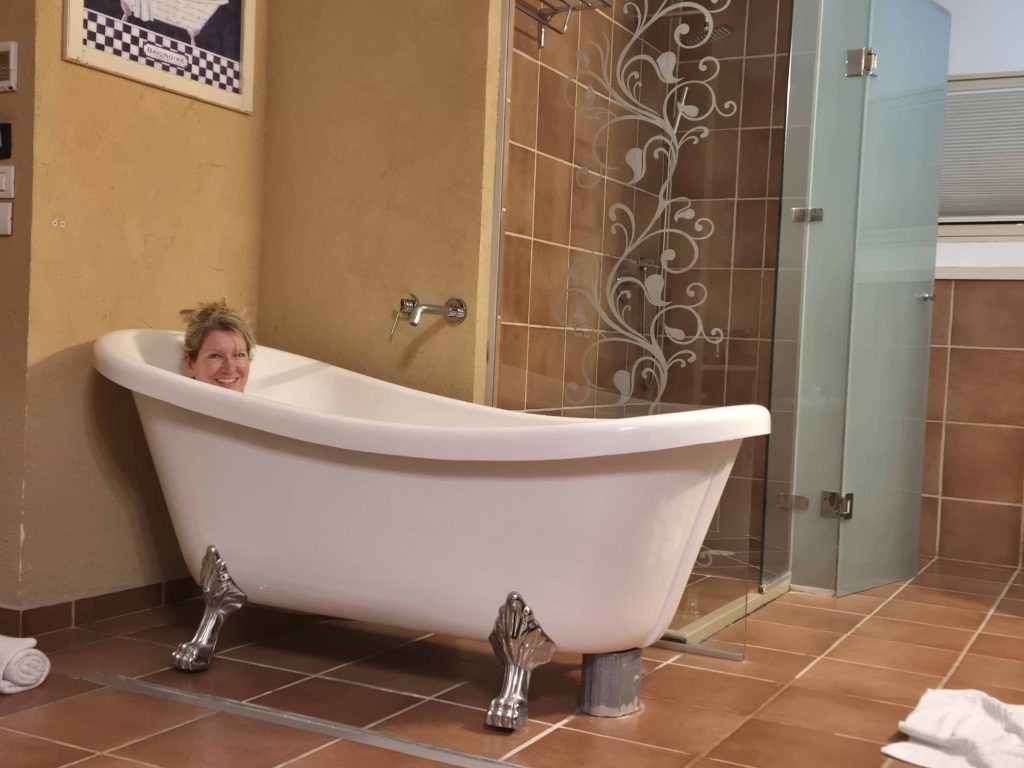
Submerging sore muscles in hot foamy water is what we needed now! Needless to say that we fell asleep at 7 PM.
Our original plan was to arrive in Nazareth on Sunday lunchtime and have the afternoon to explore the various churches and the old town, but due to our mishap with the blocked road to the Dead Sea this did not work out. Neither did adding a half day on the back end of our 2 day stay here, as we’ll elaborate.
Today was day 1 of our two day horse riding trip. Horse riding is always a way to see a country from a different persepctive and we try to fit that in if possible. Sirin Riders had the best recommendation as being a good company, having good horses and offering multi day rides, not just a 1 hr around the bush ones.
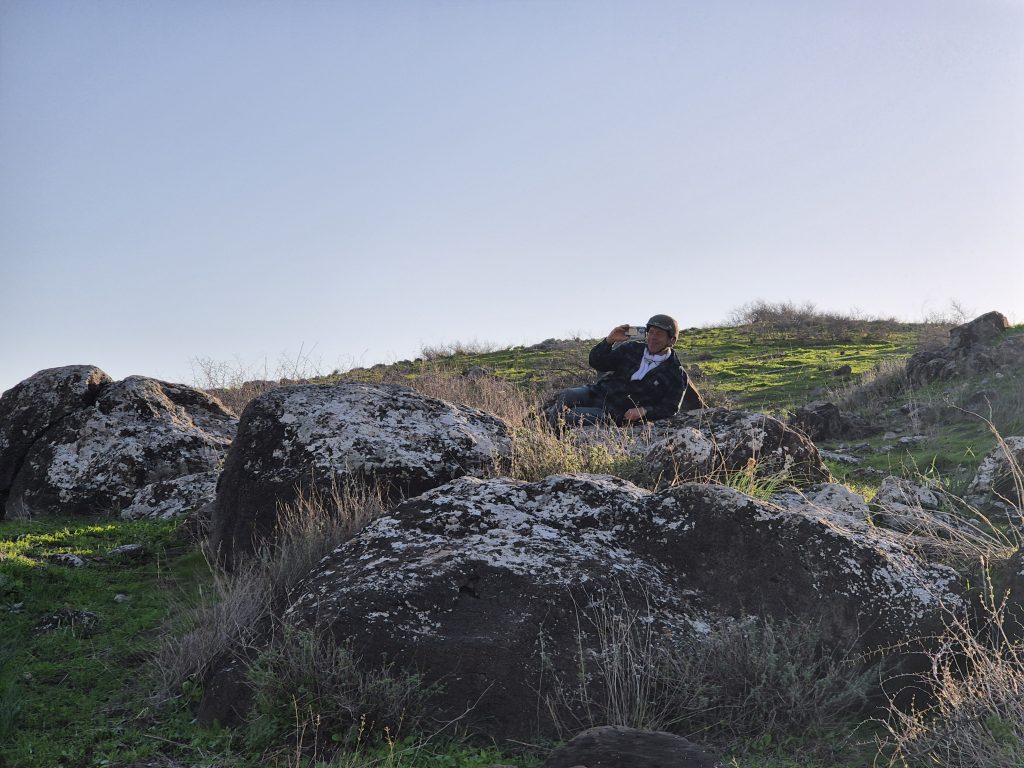
Yair is the owner, a 62 old Israeli who grew up in a Kibbutz in the area. He knows those hills by heart. We drove there quite early through Nazareth rush hour and arrived at some stables where we waited for two more riders to join us. The horses, small Arabian horses and one small quarter horse were tied in their stalls, already saddled up with either western or endurance saddles.
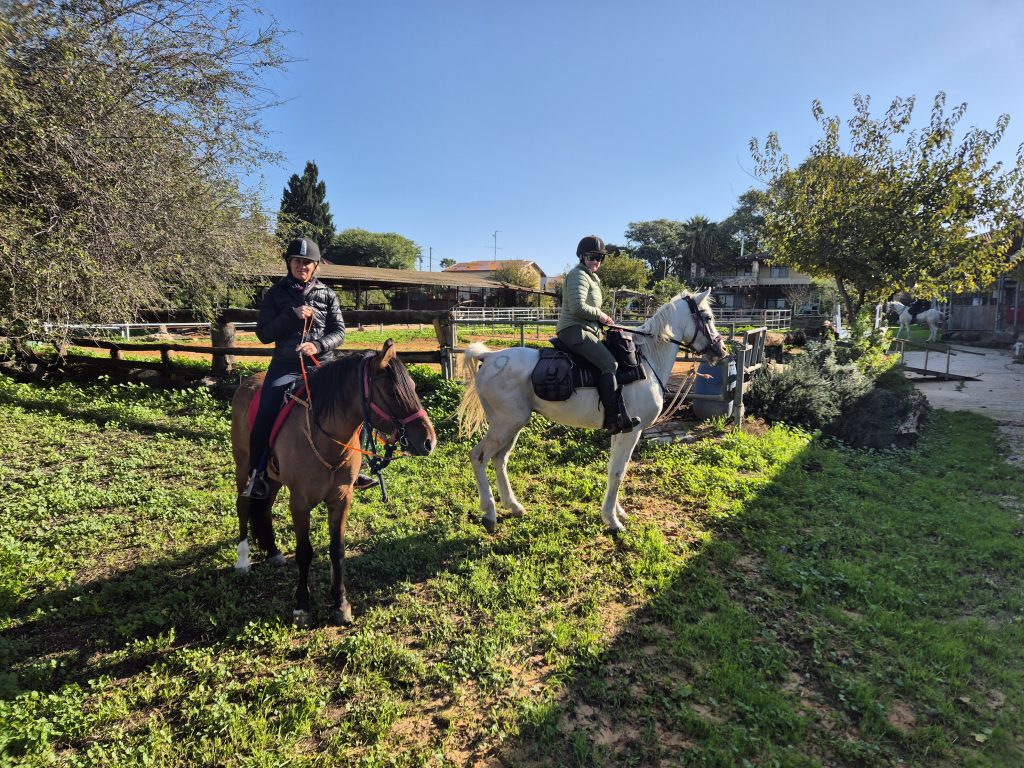
Chris got a feisty Arab wth a Western saddle and as always his stirrups were barely long enough for him… Esther got the small Quarter horse with an endurance saddle.
The two other riders were two Teachers & Farmers from South Australia who had ridden with Yair before and were here for a 3 week vacation combined with volunteer work.
After mounting our six horses, Yair’s twelve-year-old nephew, Sasha, joined us as well. We rode up into the hills toward the Sirin Heights, passing through olive groves and almond trees, and riding past grazing herds of cows.
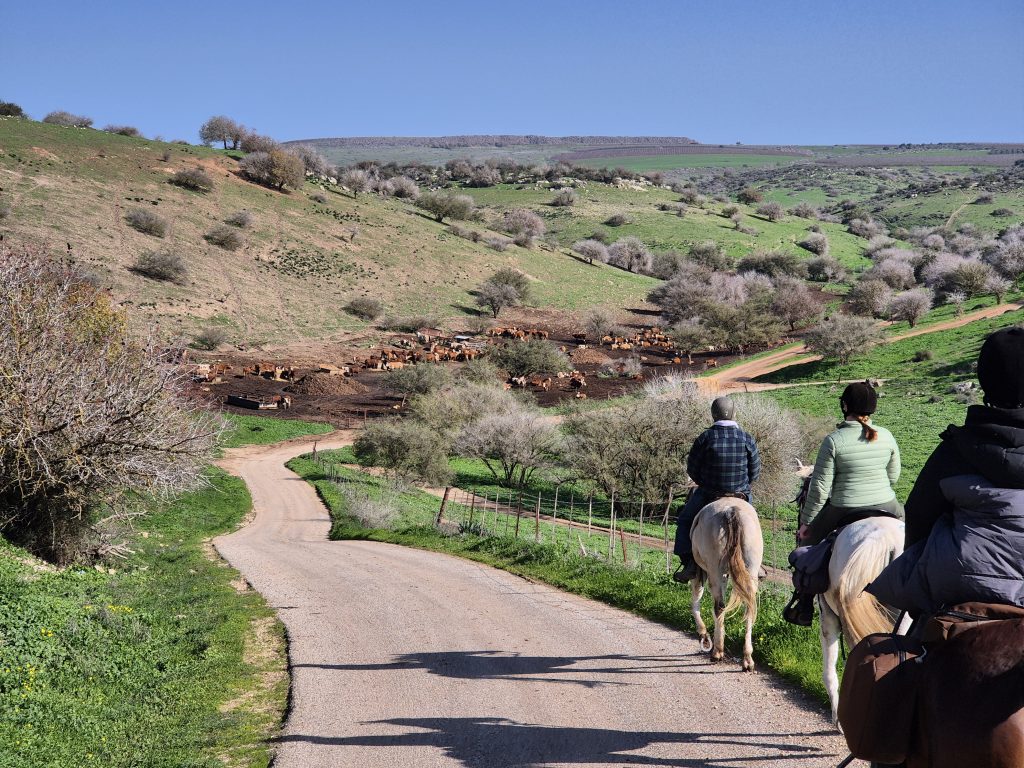
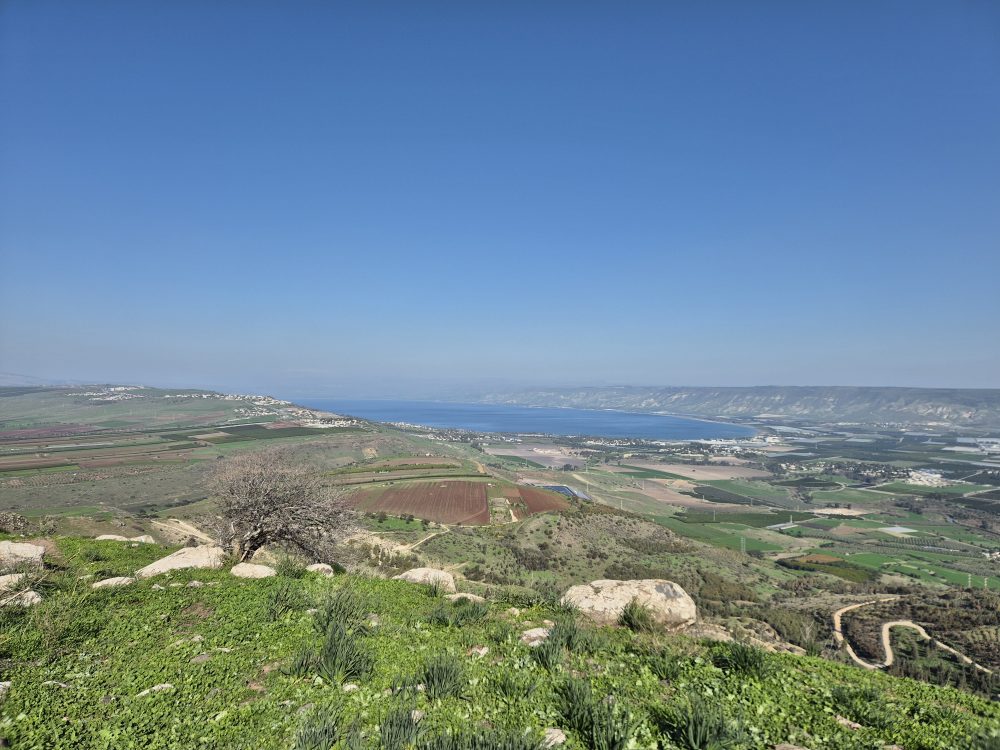
We went from 200 meters above sea level to 400 meters and then down to -200 meters in one 4 hr ride. It was great weather, just a bit windy and the horses were fresh.
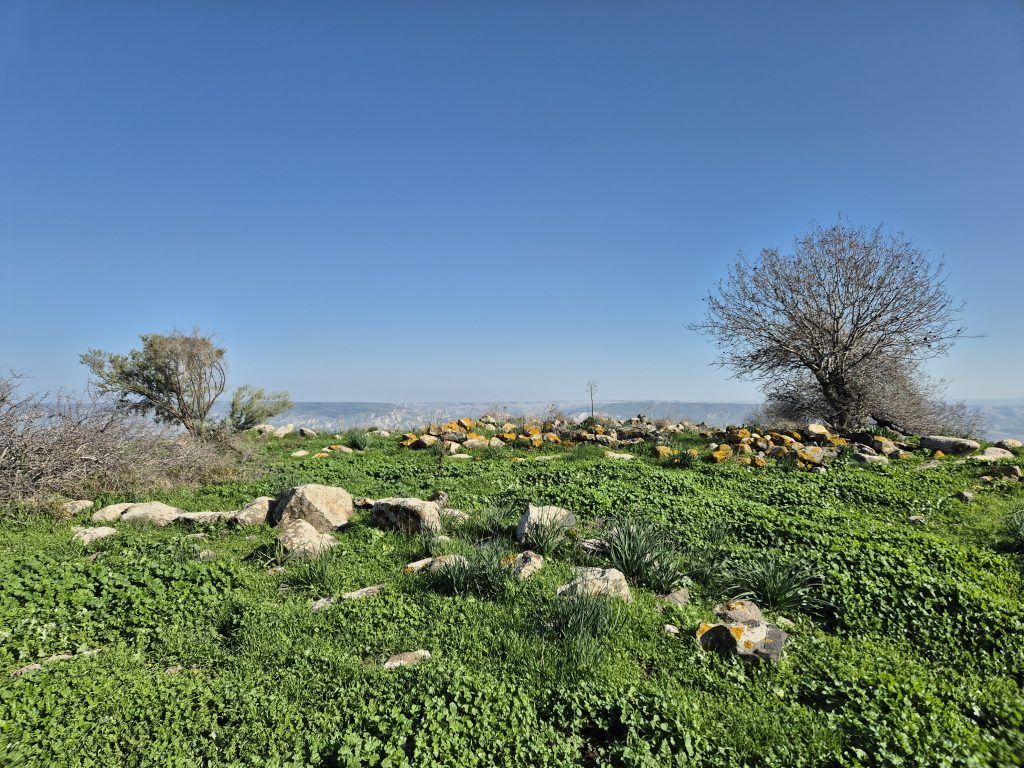
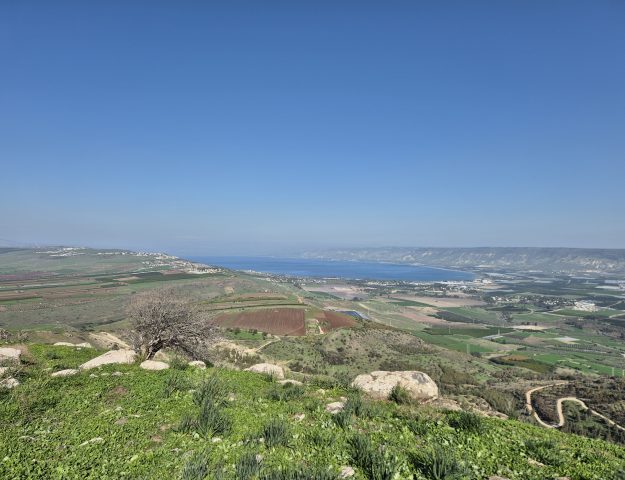
We stopped first for a short coffee break and a snack, and later for a picnic lunch. Along the way, Yair shared stories from his childhood, pointing out places he had grown up around—some of which we reached on horseback. From the final hill, the view was spectacular: the Sea of Galilee and the Jordan Valley stretched out in front of us, with Jordan and the Golan Heights rising on the opposite side. Once again, one is struck by how close everything is here.
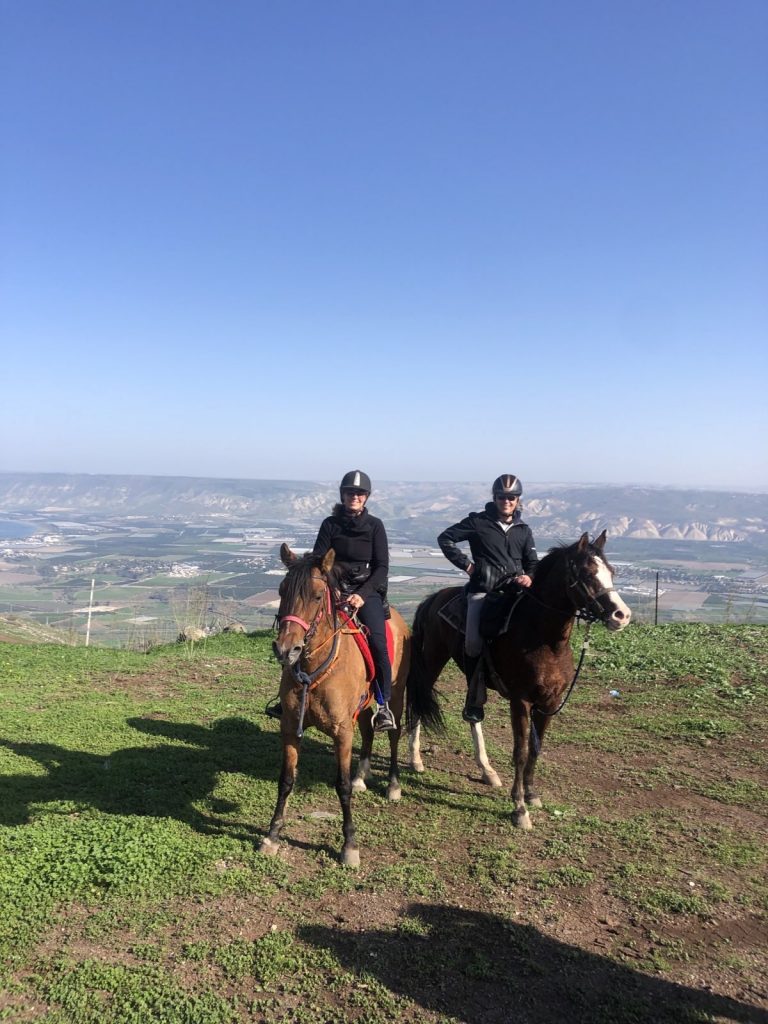
And also by how close the enemies once were. After the proclamation of the State of Israel in 1948, Arab armies attempted to drive the Jewish population out of the region. Around the Sea of Galilee, it was largely the kibbutzim that held the line—often poorly equipped, but strategically positioned and fiercely motivated. Some of these communities had received basic military training during the British Mandate period, while others improvised their defense under fire. Their resistance played a crucial role in preventing a breakthrough in northern Israel during the early phase of the war.
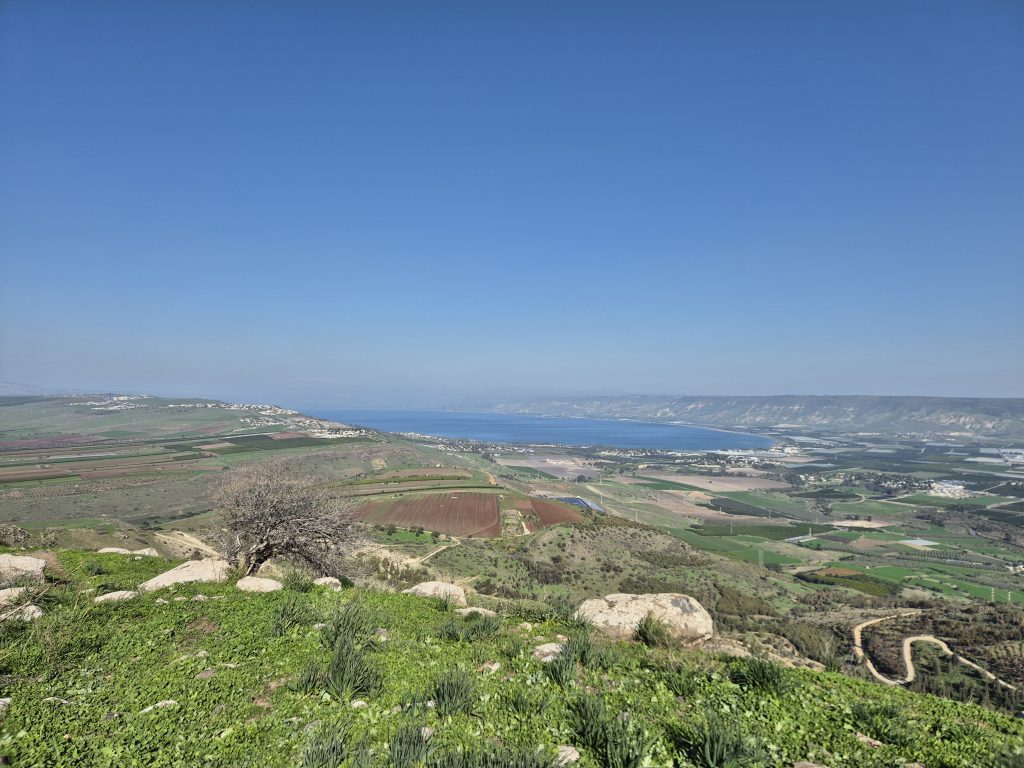
With the help of his younger brother, who had driven the horse trailer down to our destination, Yair was able to complete this route all the way to the Sea of Galilee for the first time in ten years. Especially the past five years have taken a heavy toll on Sirin Rider as a business: first the Covid pandemic, then the brutal Hamas attack on October 7, followed by the Israeli military response in Gaza.
Yair was visibly moved to be riding this long route again—and to be doing so, for the first time since 2020, with a group of international riders. At times, he seemed close to tears. It may also explain why he happily allowed himself one or two detours along the way, turning our ride into a much longer journey than originally planned.
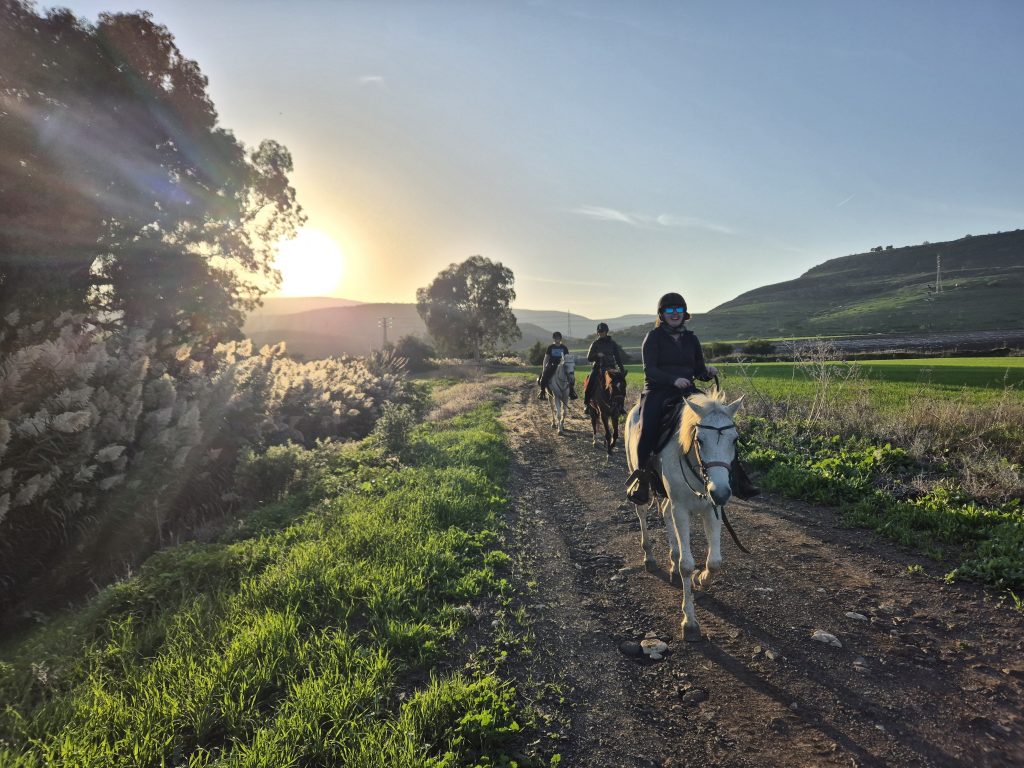
We made our way down some very steep tracks, sometimes walking, sometimes riding, until around 4 p.m. we finally reached the Jordan Valley. This is where the Jordan River flows—at least in theory. In reality, it looked far more modest than its biblical reputation would suggest: more a narrow stream than a mighty river, almost a creek.
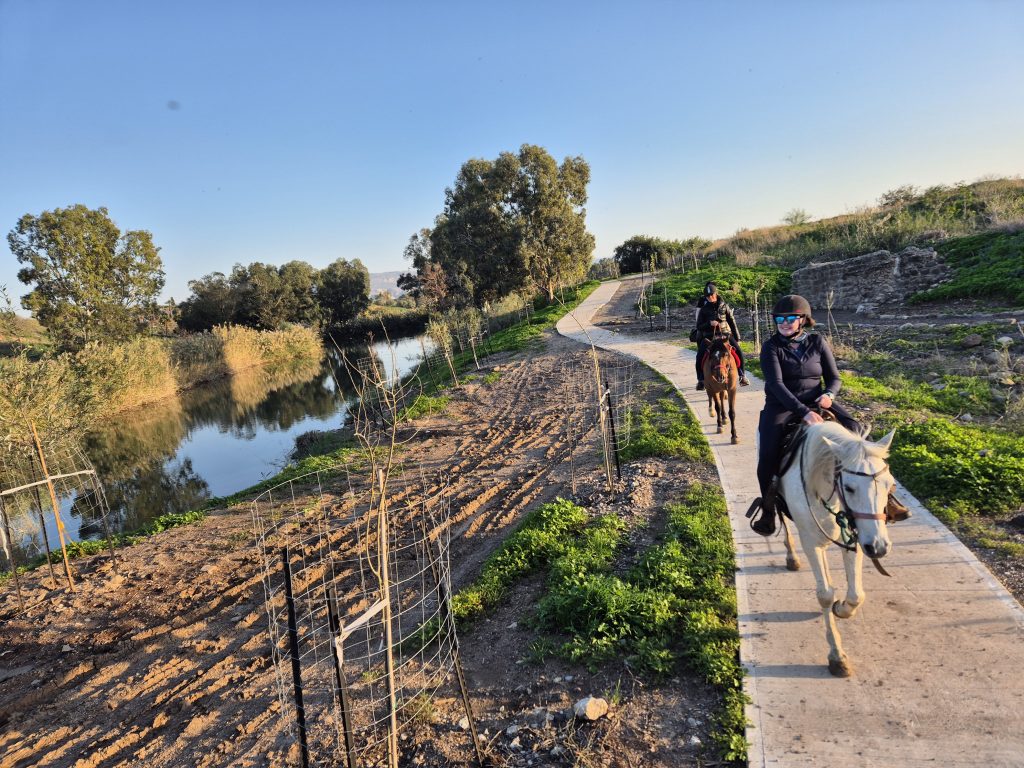
That may well be due to the fact that both Israel and Jordan divert large amounts of its water for agriculture, leaving only a fraction of what once flowed south toward the Dead Sea. Standing there, it was hard to reconcile the river’s outsized place in history and religion with its rather understated appearance today. At the bottom, Yair’s brother was waiting for us with the horse trailer—and, very welcome after the long descent, a hot cup of tea.
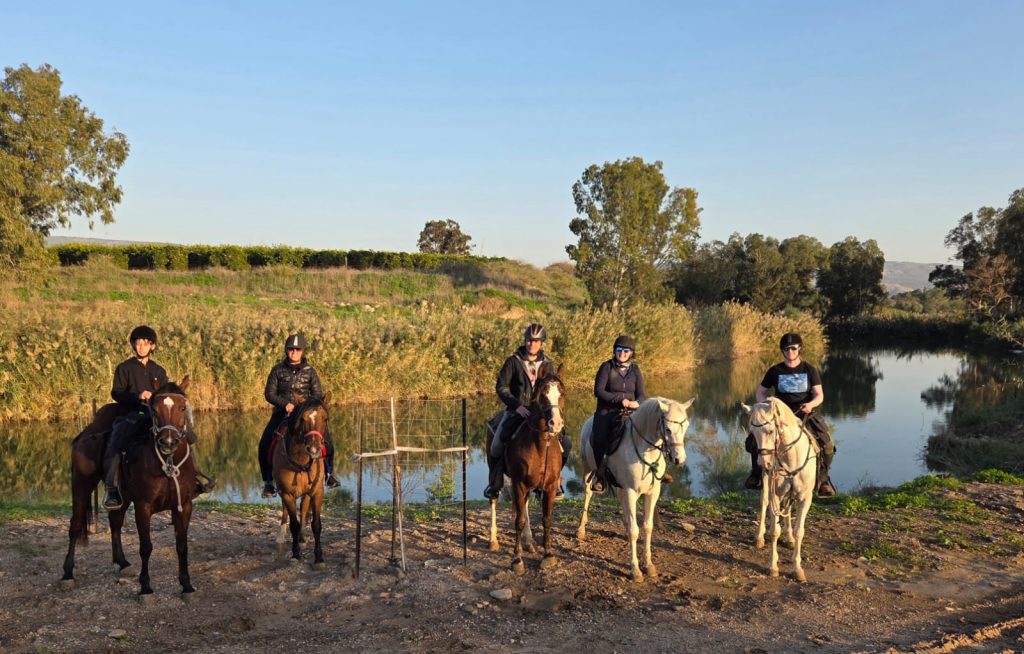
We were all pretty pooped and until we were back in Nazareth to grab a bit to eat it was 7 PM. A full day in fresh air, with horses and some interesting conversations, that’s what vacations should look like… More tomorrow as our plan to see the church of announcination before 6 PM today also did not work out.
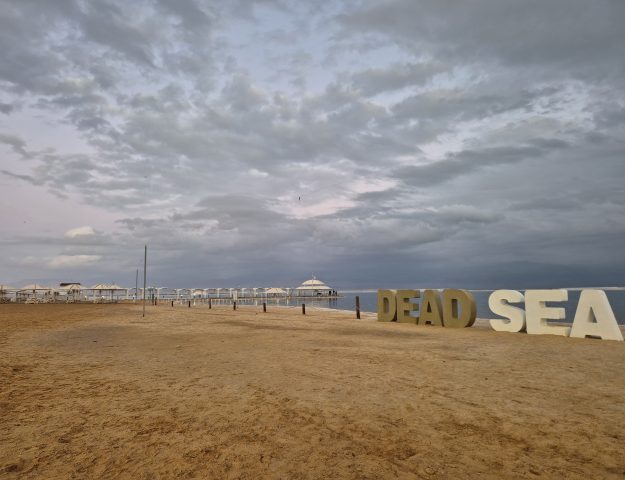
Waking up fairly early Esther decided to g for a quick run on the dead sea shore. It was windy but sunny and the exercise felt good. Chris decided to go and have a last dip in the dead sea before departing. Hungry as we were, we were looking forward to a great breakfast selection.
To our relief the coffee machine was brewing a cappucino again, the toaster was toasting bread again and the cook at the cooking station made us fresh eggs sunny side up. Nothing had changed but the fact that it was Sunday today. Shabbat was over. Life could go on as normal. As a side note, much of the hotel staff spoke only Hebrew. With tourism still low, Ein Bokek felt geared almost entirely toward Israeli visitors.
After packing everything into our rented Dacia – our small, slightly short-of-breath, somewhat stubborn but ultimately reliable donkey – we set off on the drive to Nazareth, with a stop planned at Masada along the way.
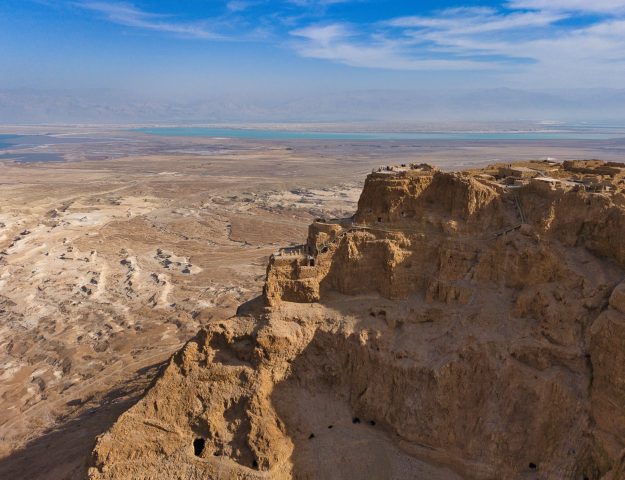
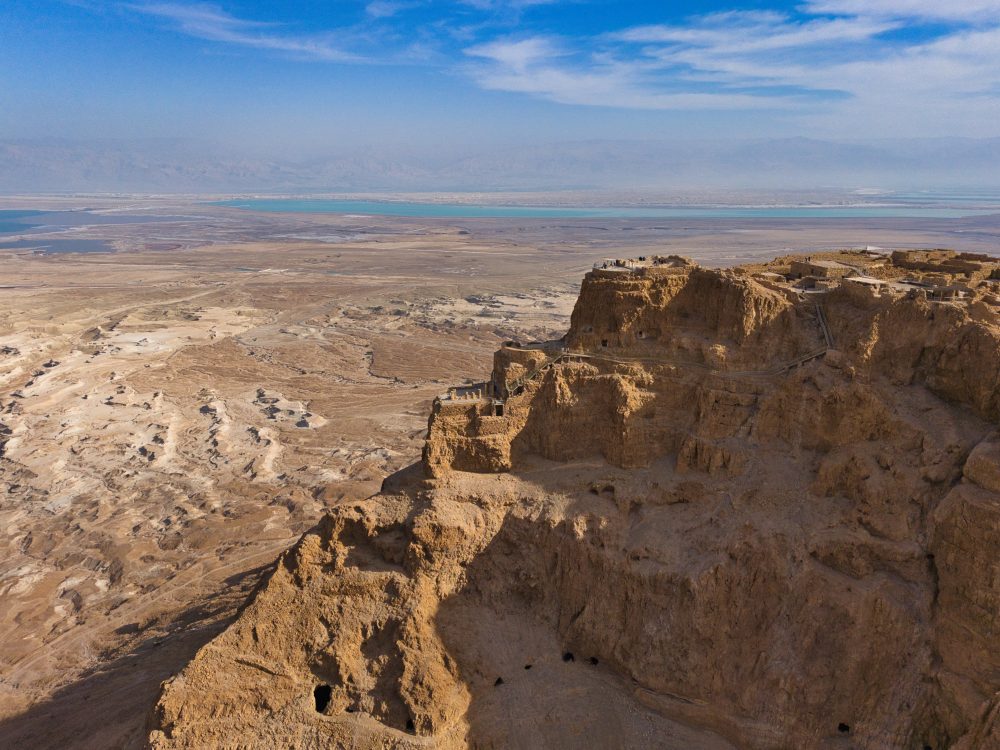
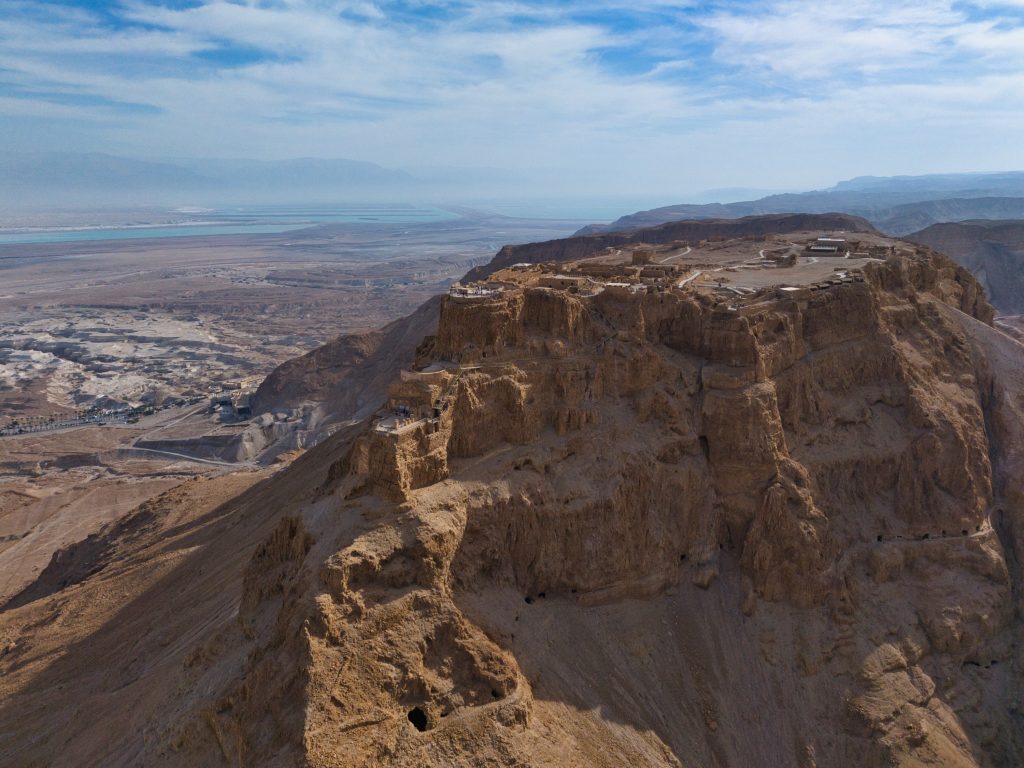
Masada is a mix between a fortress and a village on top of a very steeep and rocky mountain with a flat top. And it is a big thing in Israeli history.
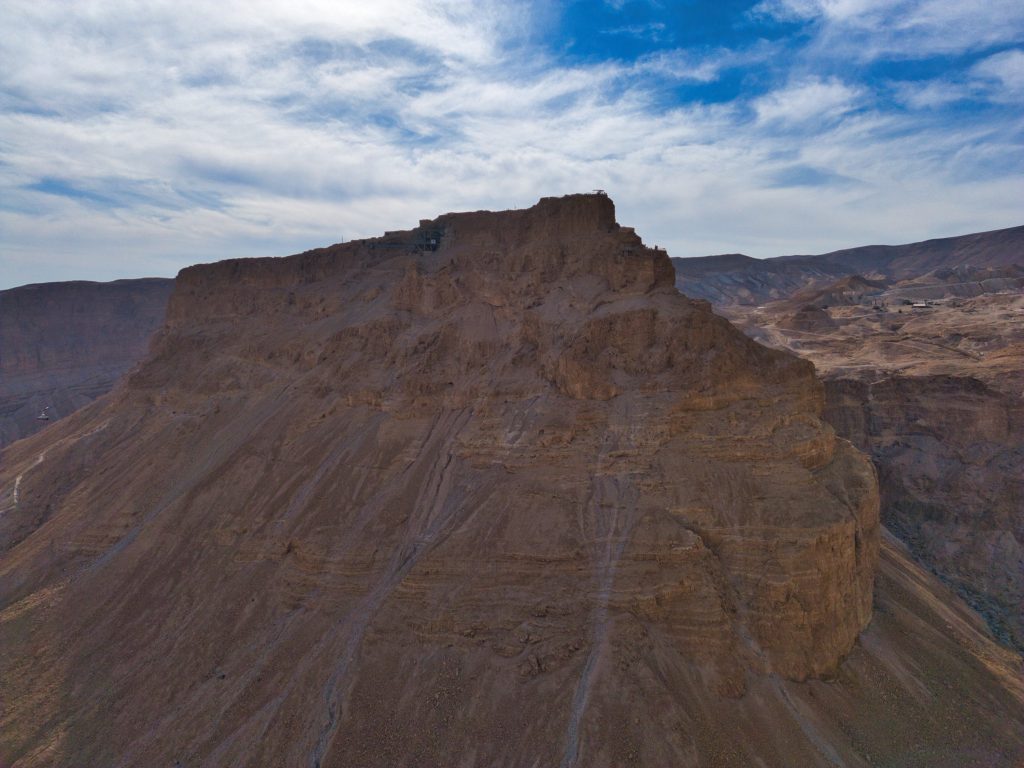
Masada consists of three palaces, several bath complexes, swimming pools, a vast number of storage rooms, and large cisterns designed to collect and store water. At its peak, it could house around 1,000 people—families, warriors, servants and livestock—along with Herod the Great and his entourage. Originally built by Herod, who ruled the region as a Roman client king, Masada was designed with Roman comfort very much in mind. Keen to impress his patrons and live according to Roman standards, Herod ensured that all the amenities expected by Roman elites—from elaborate bathhouses to sophisticated water systems—were carefully provided, even in this remote desert stronghold.
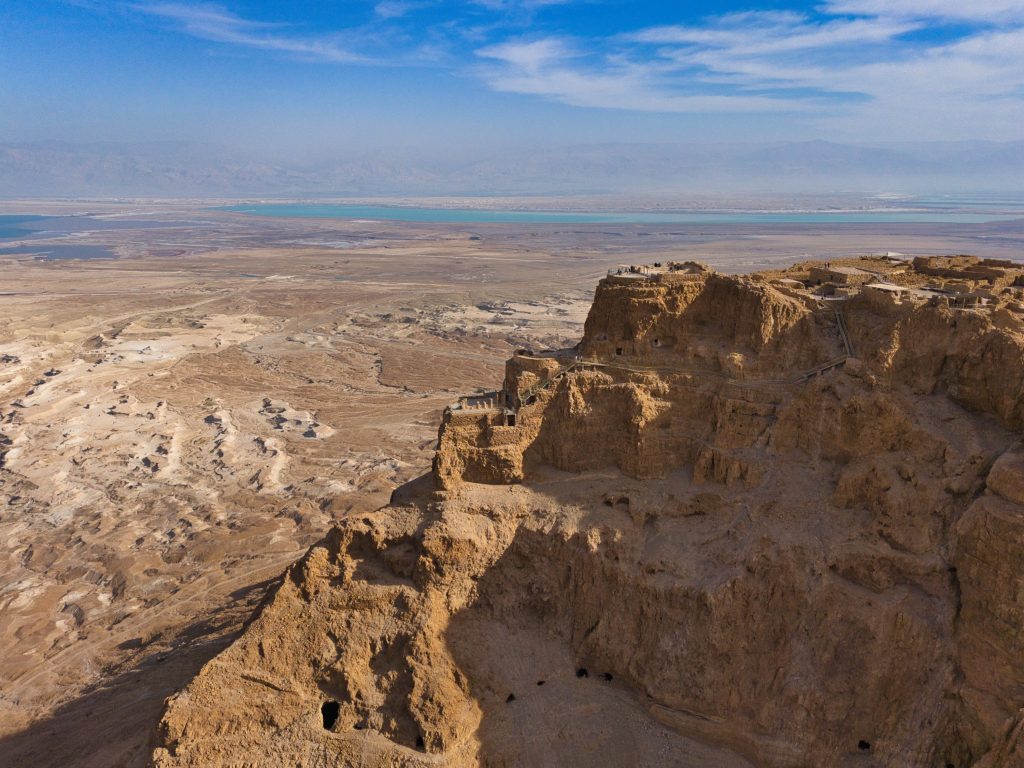
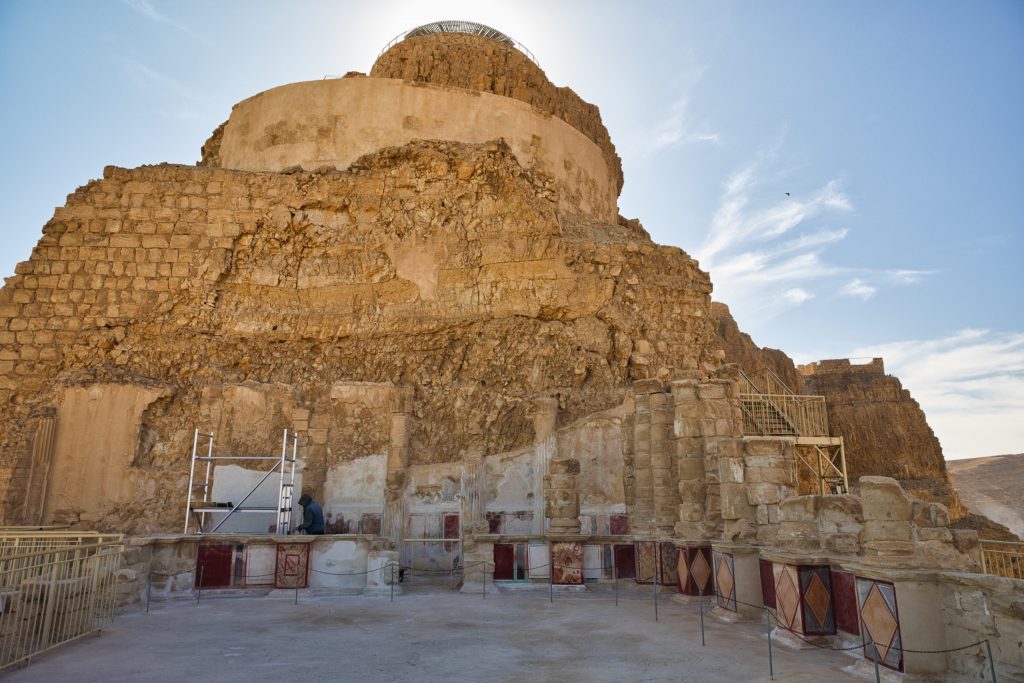
Water was either collected from rain water or brought up by donkeys and camels. There are three gates into Masada but all were only accessible by narrow, very steep and easy to defend paths.
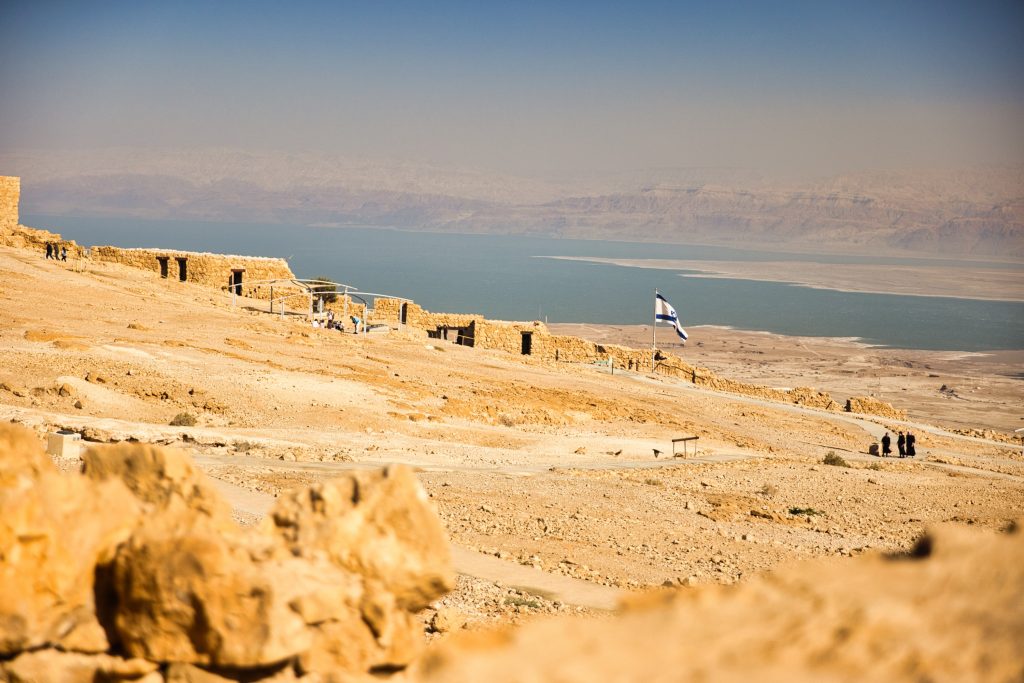
The fortress was considered virtually impregnable, and conquering it would have taken a long time. Masada was exceptionally well equipped to withstand a prolonged siege, with ample water supplies and food stores. Long after Herod the Great’s death—when relations between Jews and Romans had completely broken down—around 1,000 Jewish rebels were living on Masada
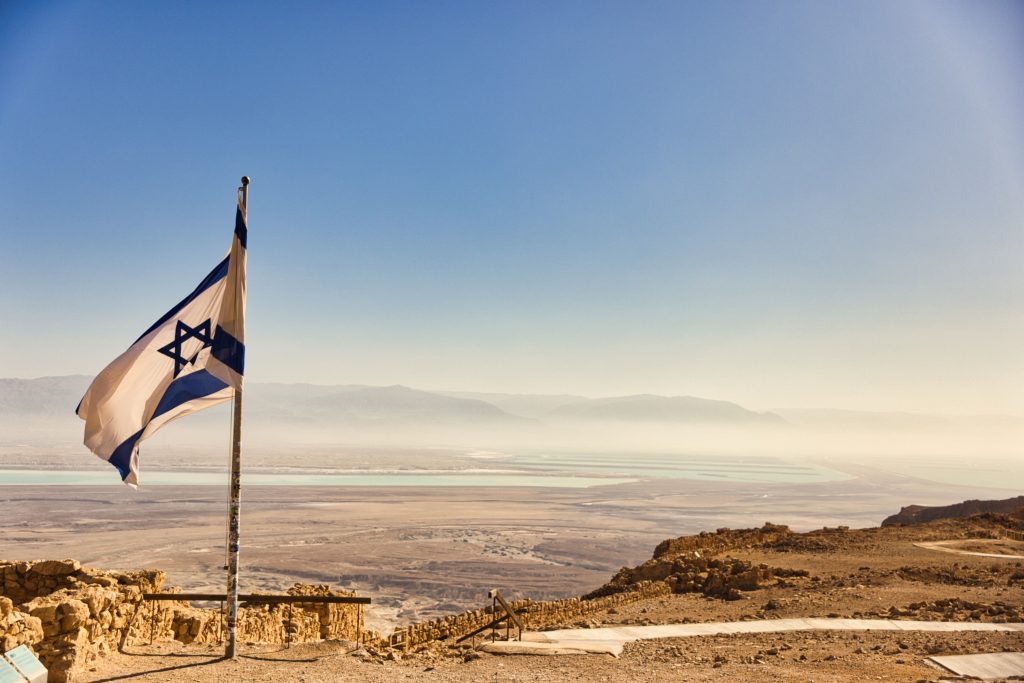
The Roman siege of Masada was a large-scale military operation. In total, an estimated 8,000 to 10,000 Roman soldiers and support personnel were involved, vastly outnumbering the roughly 1,000 Jewish rebels holding the fortress. The Romans first isolated Masada completely, constructing a circumvallation wall about three kilometers long around the mountain, along with eight fortified camps to prevent escape and cut off supplies. When a direct assault proved impossible due to Masada’s sheer cliffs, they embarked on an extraordinary engineering effort: building a massive siege ramp of earth, sand, and stones on the western side, where the natural terrain rose closest to the summit. The construction of the ramp likely took several months, possibly six to eight, under harsh desert conditions. Once completed, the Romans hauled a wooden siege tower, equipped with a battering ram, up the ramp.
According to Jewish history—based largely on the account of the historian Flavius Josephus—on the night before the fortress was due to fall, the inhabitants of Masada chose to take their own lives rather than face enslavement or imprisonment by the Romans. Whether the events unfolded as described is questioned by historians today, but the story itself has become central to Masada’s myth.
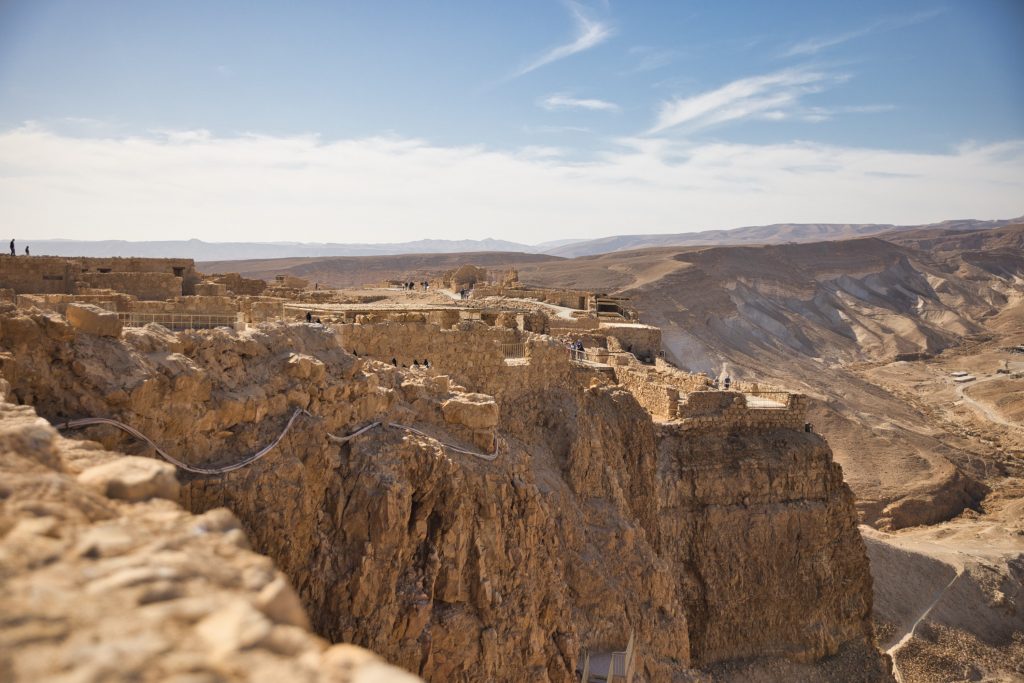
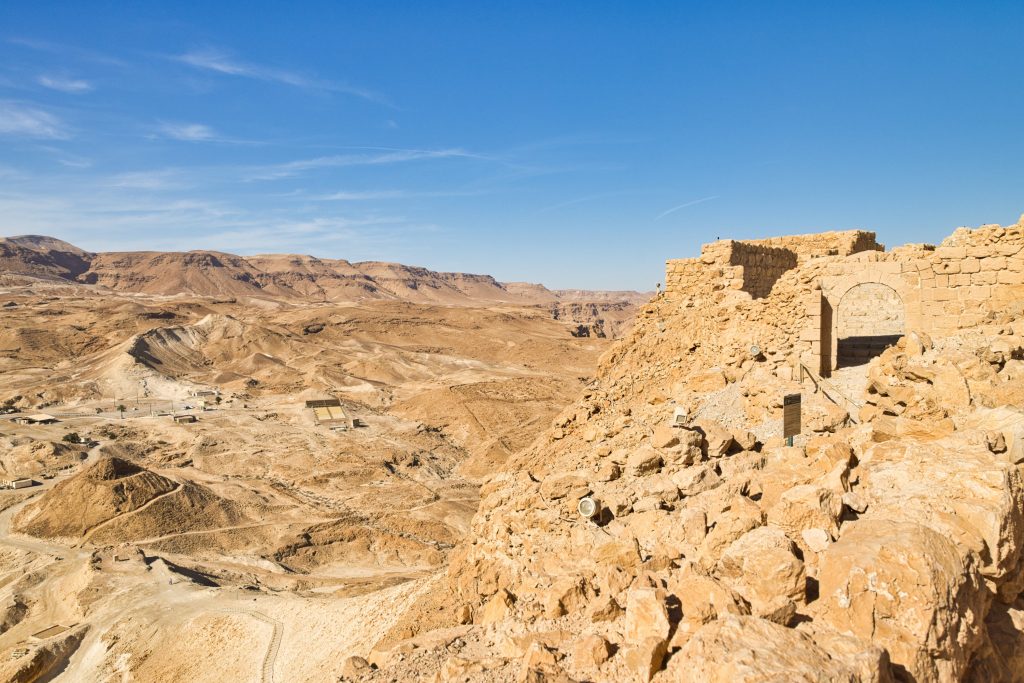
For Israel, Masada stands as a powerful symbol of resistance, determination, and defiance—values often associated with Jewish history and identity to this day. It is considered a must-see site for Israeli school classes, and for decades it has also played a significant role in the education and symbolic tradition of the military, which is why Masada is considered a must-see for schoolchildren and military recruits alike. The slogan “Masada shall not fall again” has become part of the national self-image of the 77-year-old State of Israel, symbolizing resilience, self-defence, and the determination to avoid another historical catastrophe.
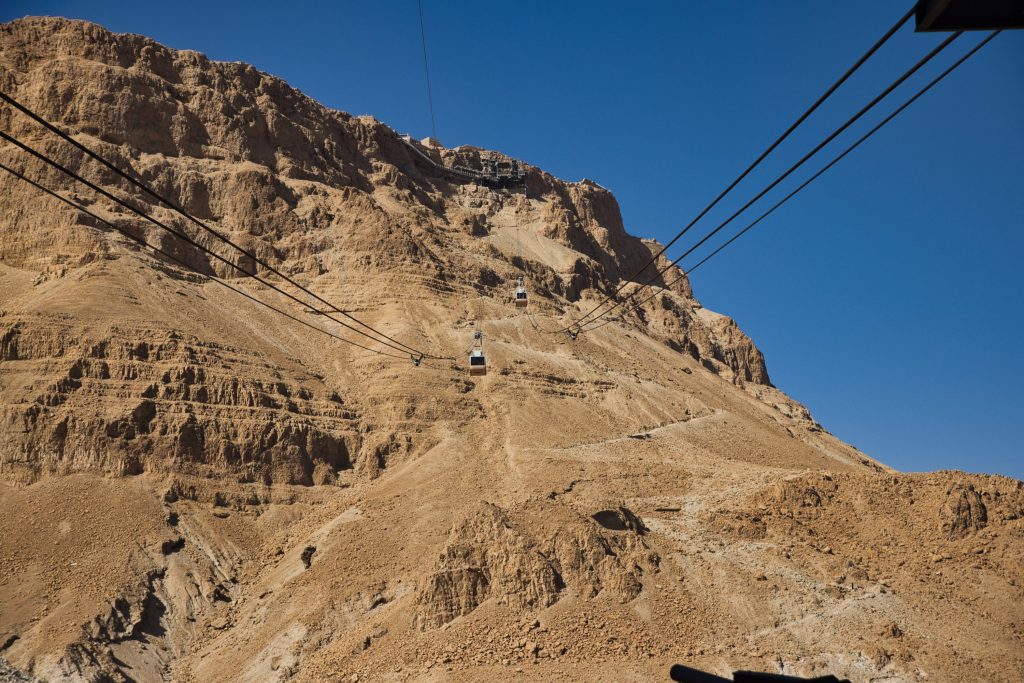
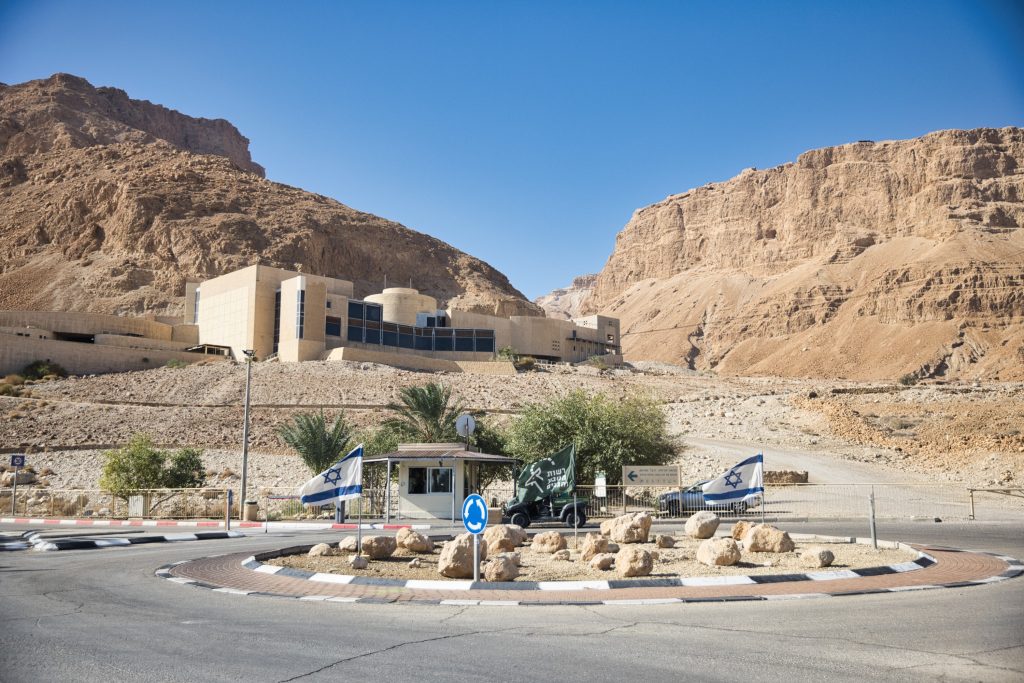
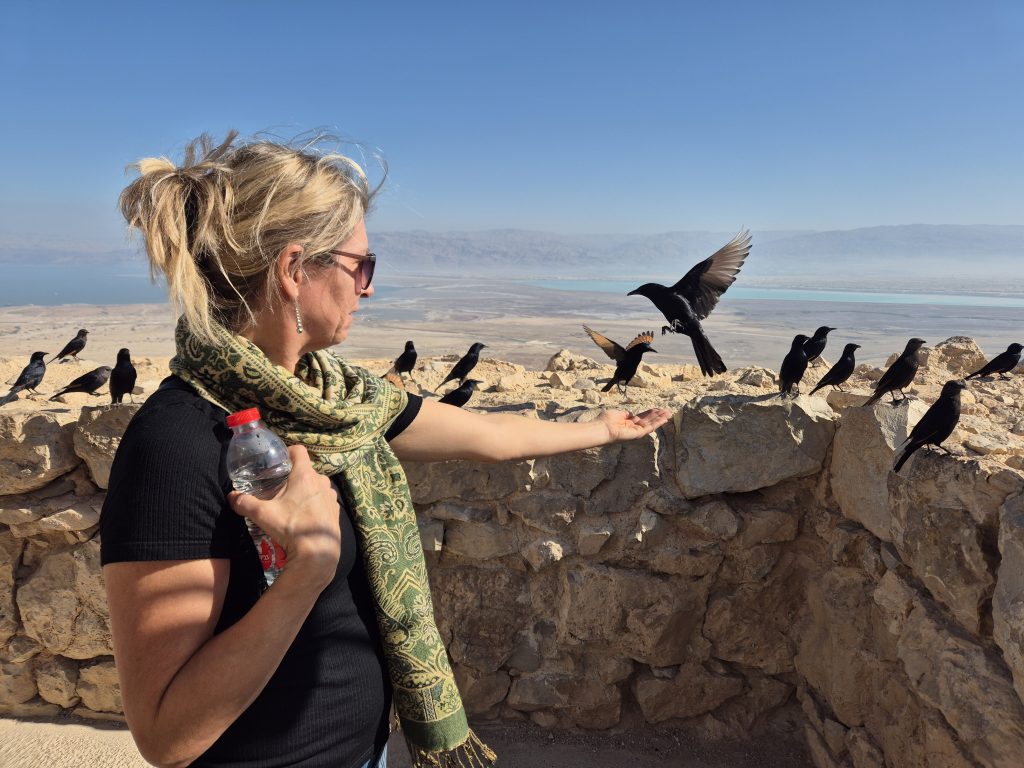
Today rather than taking a long and windy path up by foot with approc. 1,000 steps, we can take a cable car up and down for easy access. As we were on a schedule today, we did just that. And the best part was the stunning 360 degree view from the top. In all directions we could see the mountains, the Dead Sea and the Ein Gedi Oasis. We took a good 2.5 hrs to see all ruins and excavations on top and and admire the views. We did not set out for Nazareth until 2 PM with a 3.5 hr drive in front of us.
We made good mileage and eventually had to decide whether to take the long way around the West Bank to Nazareth—staying entirely on Israeli main roads, which would have added about three and a half hours—or to shave roughly thirty minutes off the journey by driving straight through the Palestinian West Bank. The road is considered Zone C – which means it is controlled by Israel and allowed for our our Rental car. That route would take us past the Jordanian border crossing at the King Hussein Bridge, and through an Israeli security checkpoint along the way.
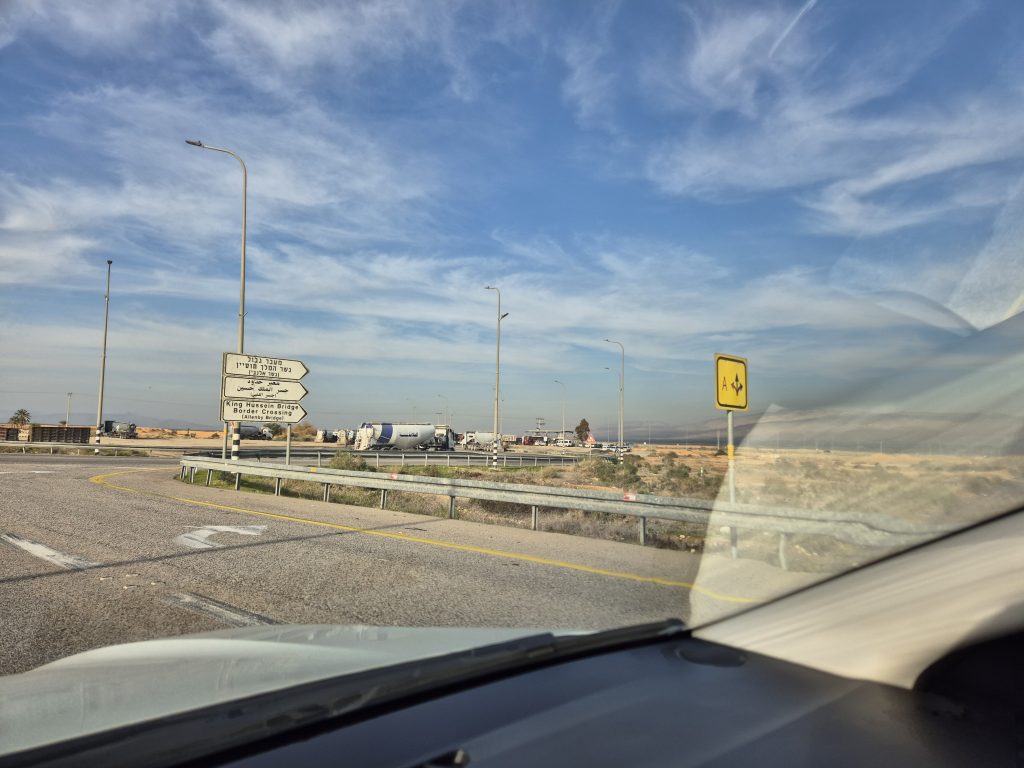
We chose the shorter option. Once again, the drive offered a stark view of how Israeli policies and infrastructure have reshaped areas that were originally Palestinian—an observation that’s hard to avoid when traveling through the region. Under Israeli domestic law, settlements, kibbutzim, and agricultural plantations in this area are considered legal and are administered as part of Israel’s civil system. Under the Oslo Accords, however, much of this land lies in territory that was meant to remain under Palestinian jurisdiction or be subject to negotiated final-status agreements. The resulting legal and political mismatch is written directly into the landscape.
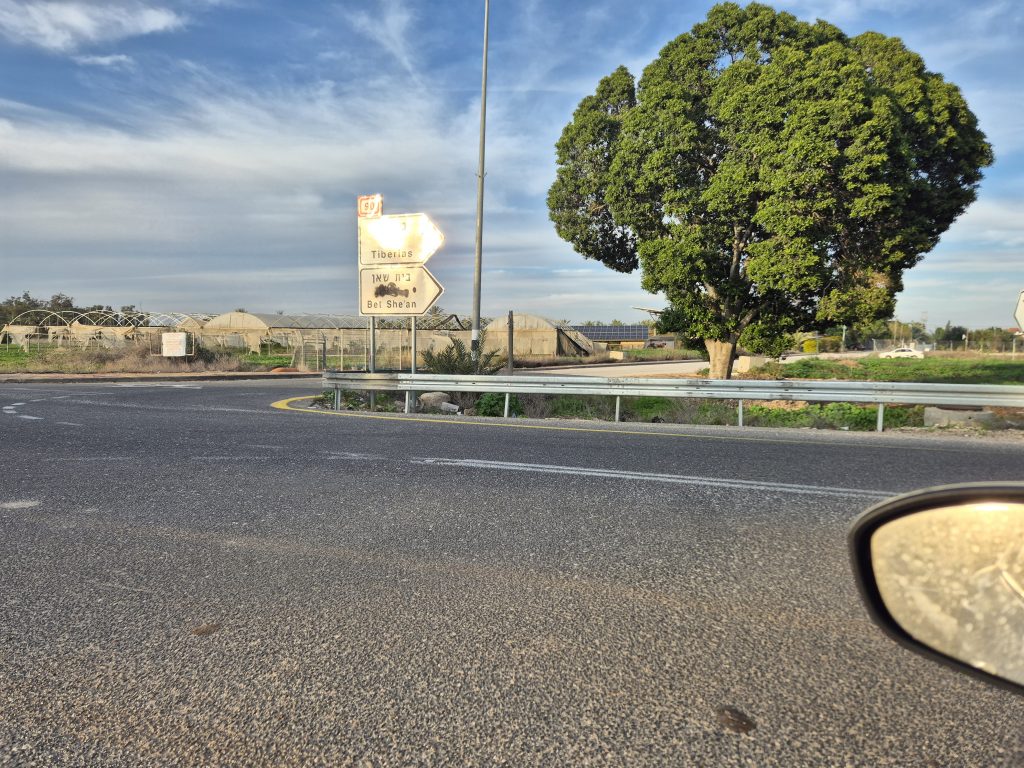
Along the road we were traveling—classified as Area C and under Israeli control—Israeli flags were visible everywhere: on fences, posts, and entry gates. In Area C, the Israeli military controls land use on both sides of the road. Palestinians are still allowed to herd sheep and goats, but the routes for grazing and movement are becoming increasingly restricted. Several times we saw large herds move with fences on one side and the road on the other with barely 10 meters in between for the animals to move.
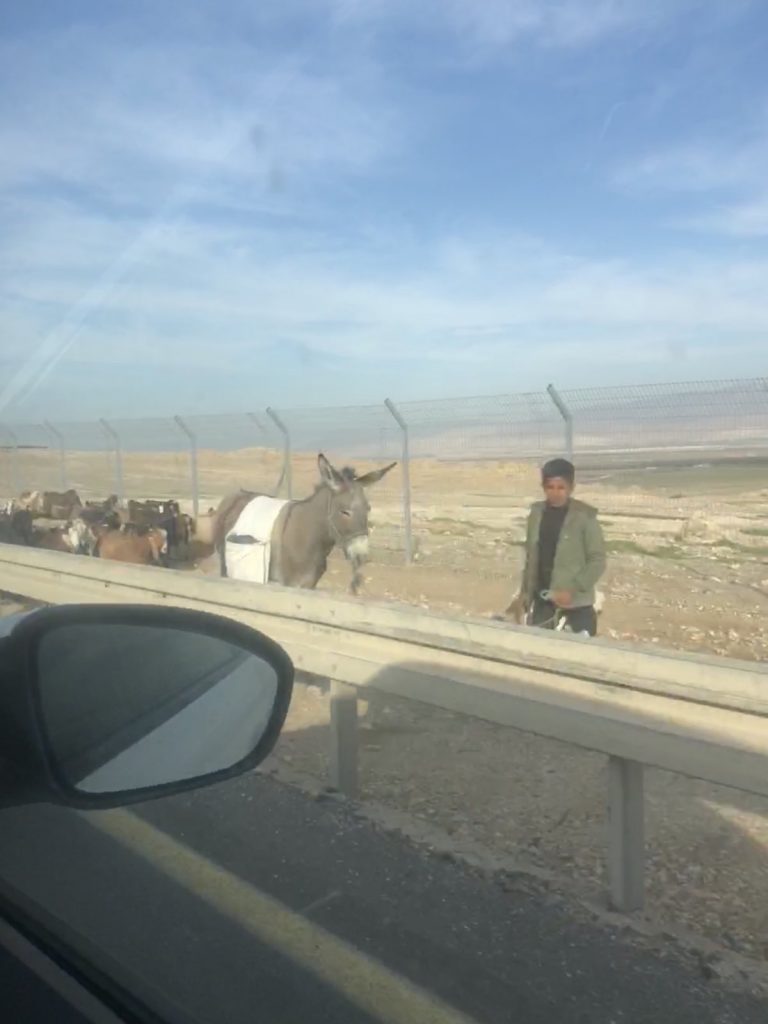
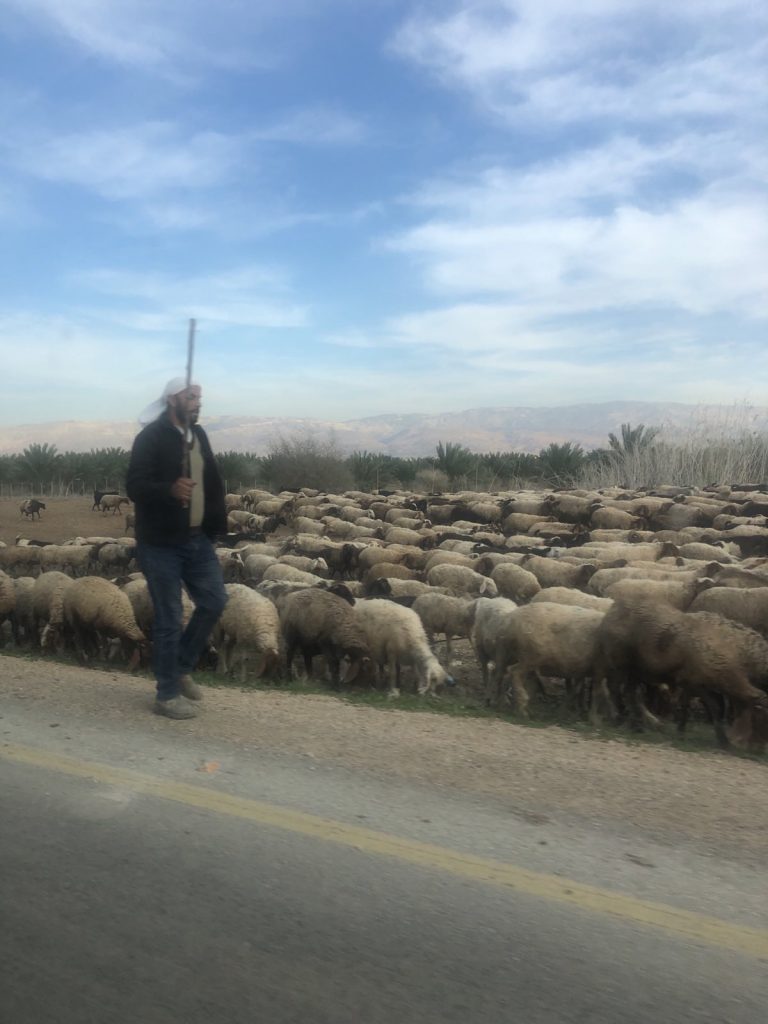
Israeli cars with yellow plates can use most of the Area C road network, but entry into Area A is forbidden. Palestinian Authority vehicles have white plates with green lettering; crossing into Israel is tightly controlled and depends on permits. We haven’t seen one white/green plate in Israel so far.
In Area C, Israeli authorities effectively decide how the land is used—whether for agriculture, industrial zones, settlements, or as military no-go areas. Palestinians living in these areas have little to no influence over these decisions, despite the land often being adjacent to or traditionally used by Palestinian communities. Palestinians are nevertheless employed as laborers on Israeli plantations or in nearby industrial zones.
Seen on the ground, the frequently invoked two-state solution feels increasingly abstract. With so much infrastructure firmly embedded and controlled, it is hard to imagine it being handed over to a future Palestinian state. How such a hardened conflict can ever be solved peacefully we lack the imagination.
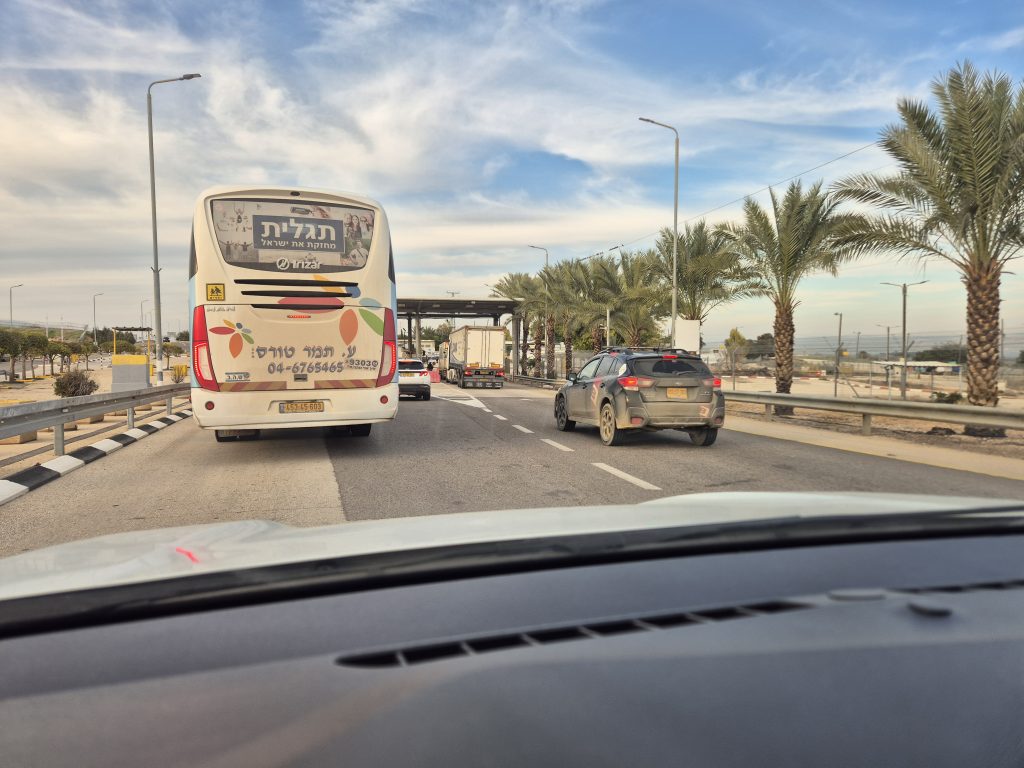
Once we passed the Israeli check point, we were back to normal Israeli territory and made our way to Nazareth without a problem. Nazareth is a majority Israeli Muslim city known for two things: The spot where Mary got the news that she’ll bear God’s son one day, in a grotto where today the church of the Annunciation stands. Hence besides Jerusalem and Bethlehem, Nazareth is a must see for many christian pilgrims visiting Israel. Secondly Nazareth is known for for excellent fusion cuisine bringing oriental and western influences in cooking together. We were happy to try that out and find a restaurant on our first night here.
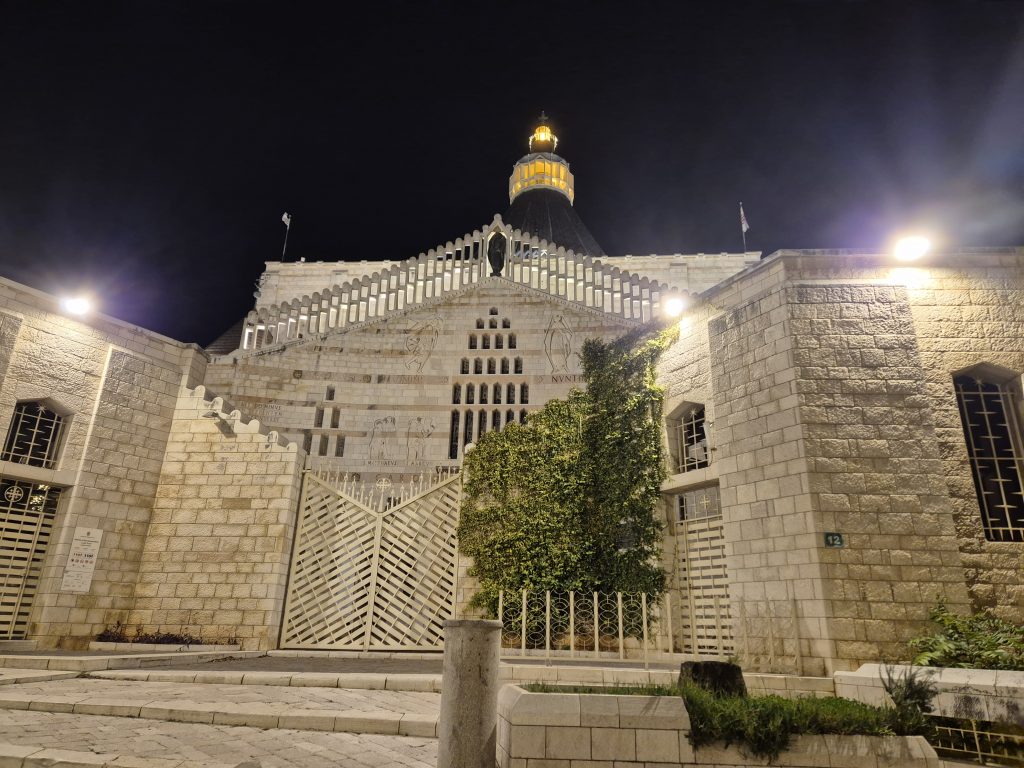
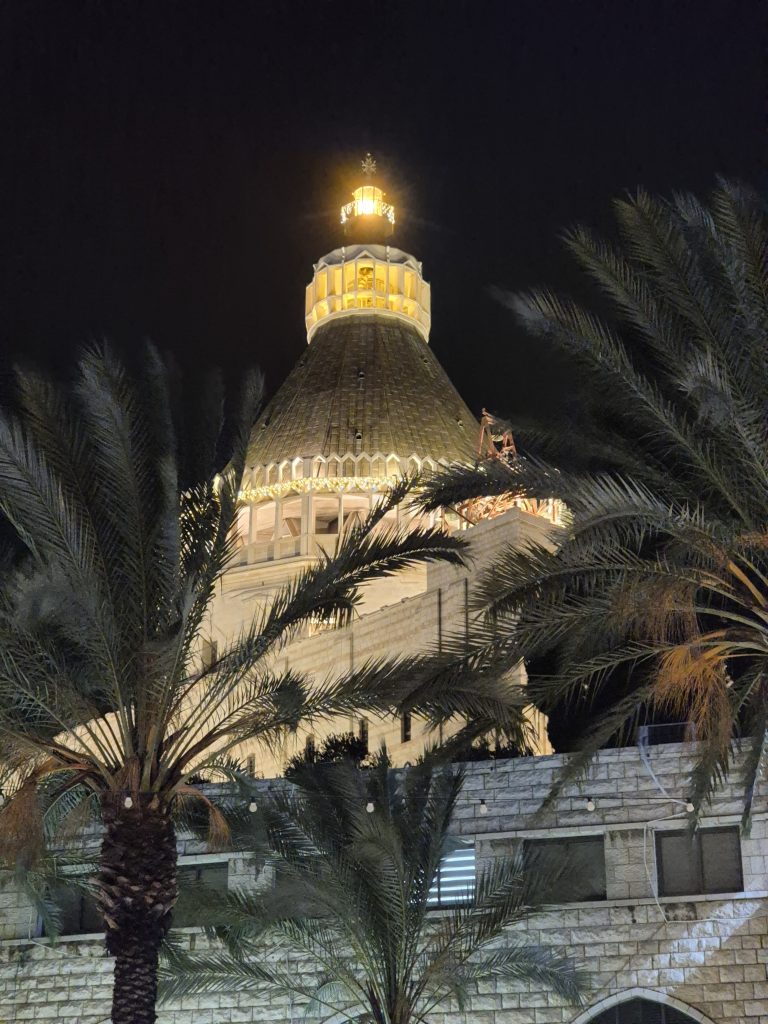
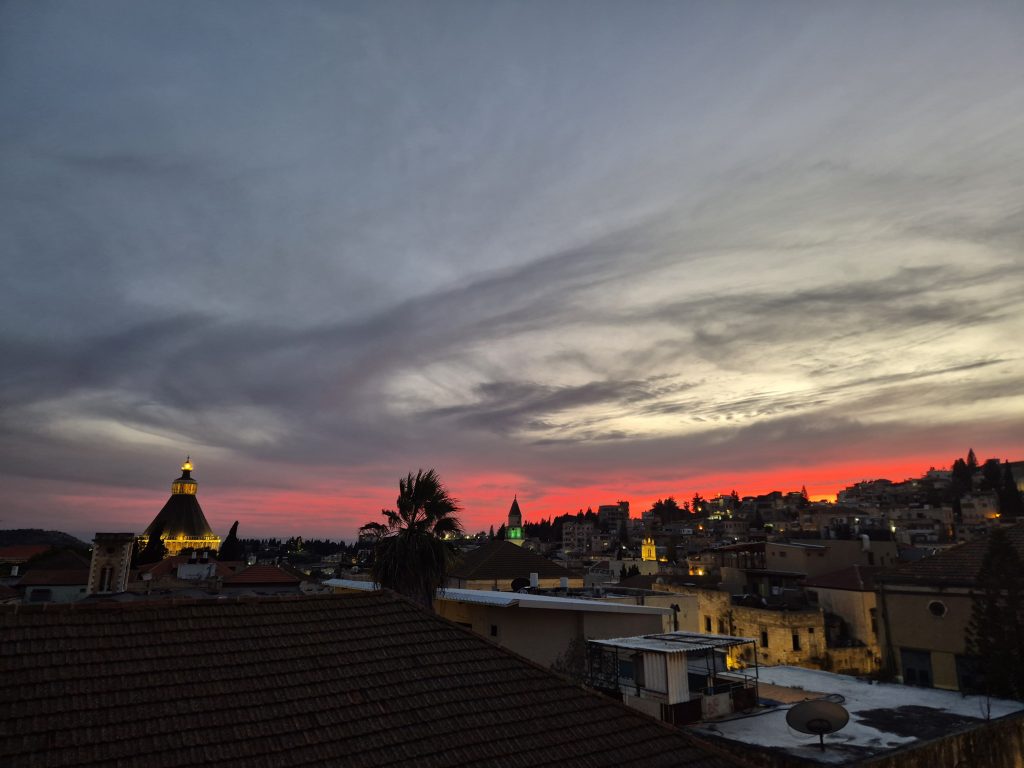
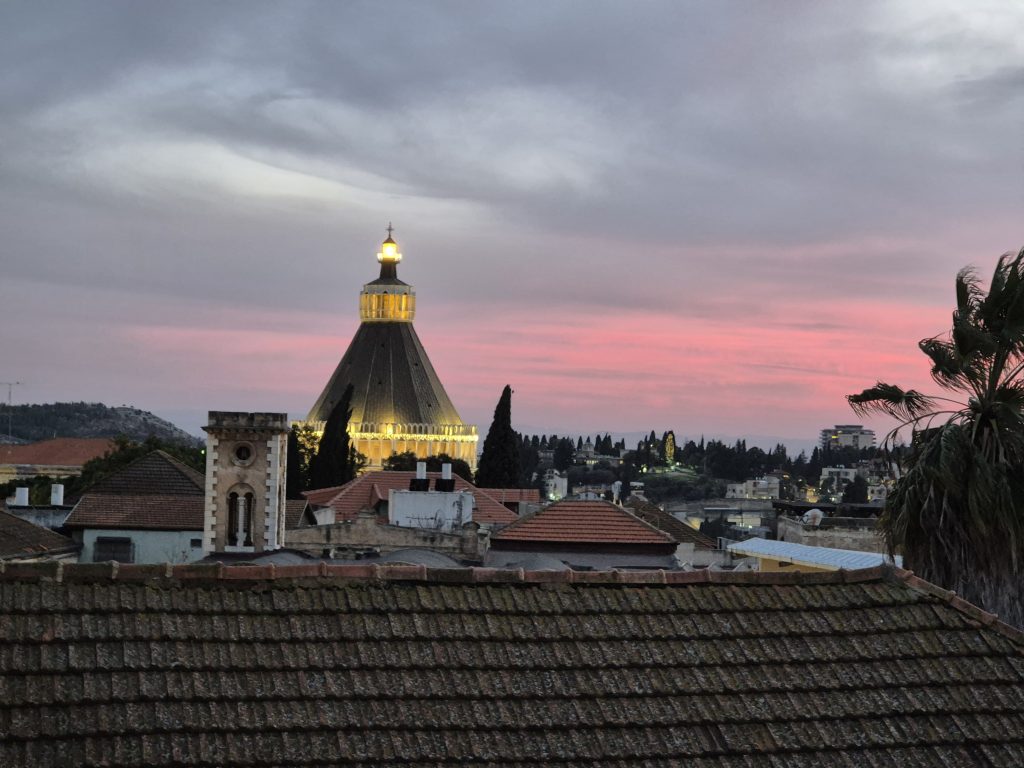
Our hotel Michel House is a nice Boutique hotel in the middle of the old town Nazareth, in walking distance to the announciation Church which we saw in a beautiful sunset from our rooftop terrace.
Hungry as we were, we followed our hosts recommendation to eat at Tishreen, a lebanese fusion Restaurant.
Best meal in Israel so far. Incredibly yummy freshly baked bread, unusual combinations of ingredients and spices, one that we felt we’ll be back to try out different dishes on the menu.
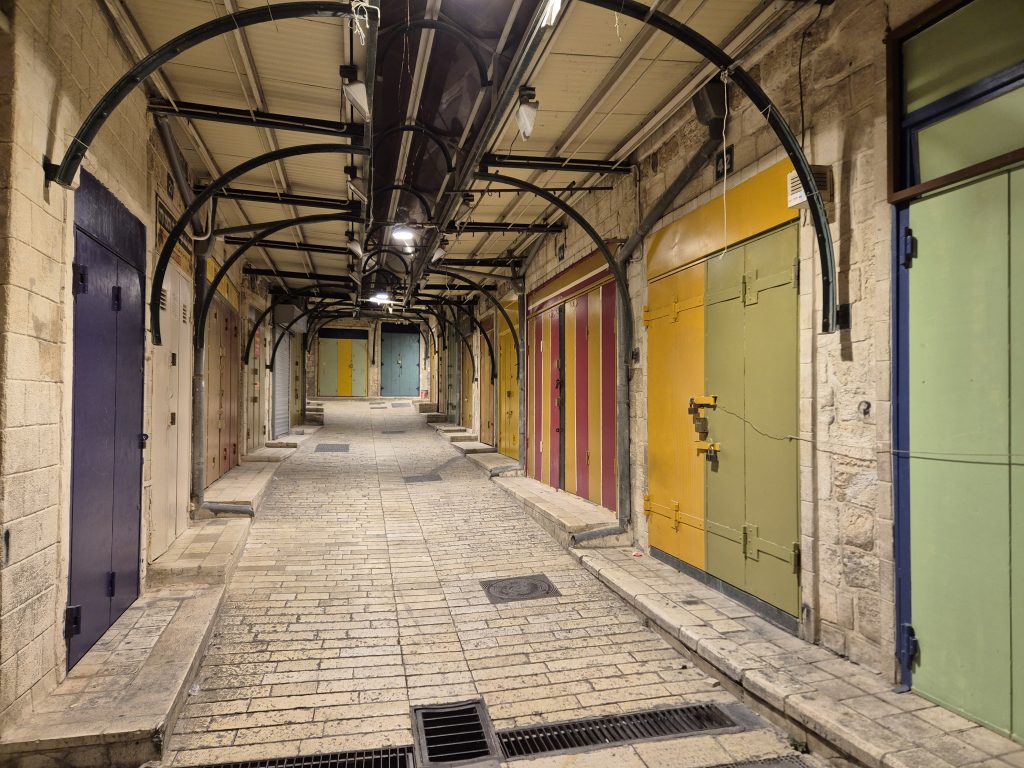
Tired but full we made our way back to the Hotel through the old city with it’s empty market streets, the occasional cat crossing our way. Tomorrow morning it’ll be buzzing with market stalls again and we are looking forward to it.
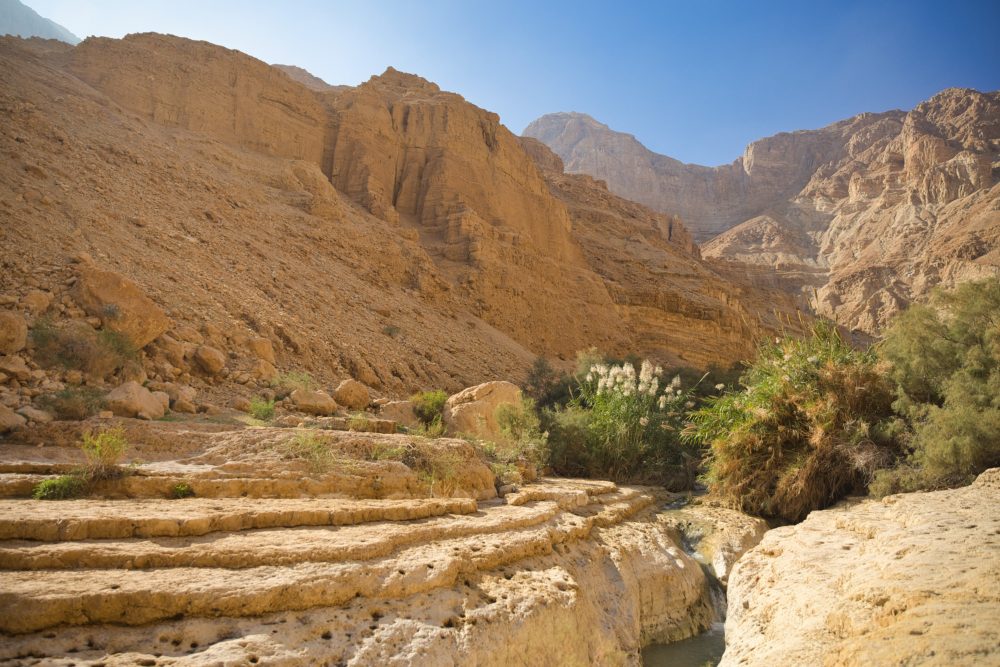
Today it‘s kosher breakfast buffet. As it‘s still shabath/ sabbat here in Israel and our hotel observes it in part, we don‘t get to use the nice coffee machine to make a cappucino. Just filter coffee, as no electrical circuit is allowed to be ignited/ activated. Bread is from yesterday and no toaster is allowed to toast the bread either. But we saw lots of traditional Jewish dishes for breakfast, Chris must have tried all the different sweets. The selection was very large, there is no way we could have tried all the new foods even if we wanted to.
After some (for us) unconventional breakfast we decided to drive to Ein Gedi and do the walk in Wadi David we had planned for yesterday.
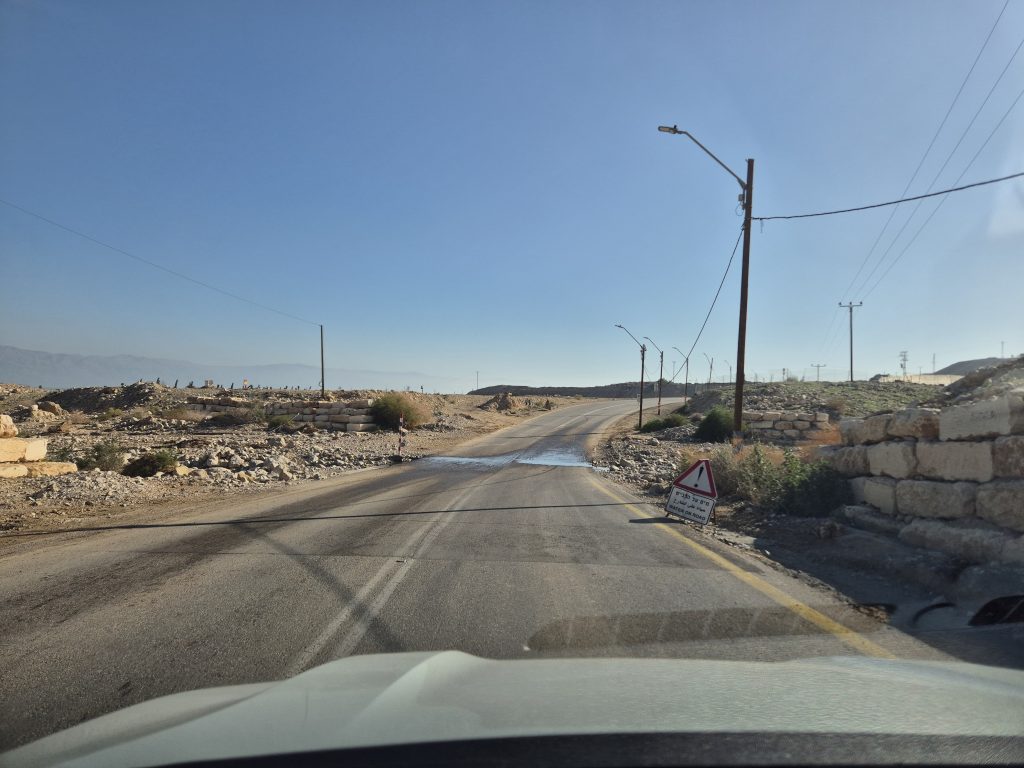
The road was open again and in a mere 20 min (instead of our previous 3 hour drive) we were at Ein Gedi Nature reserve, ready to hike with good shoes, water bottles and nuts/ dried apricots. We bought the tickets online and headed for the entrance.
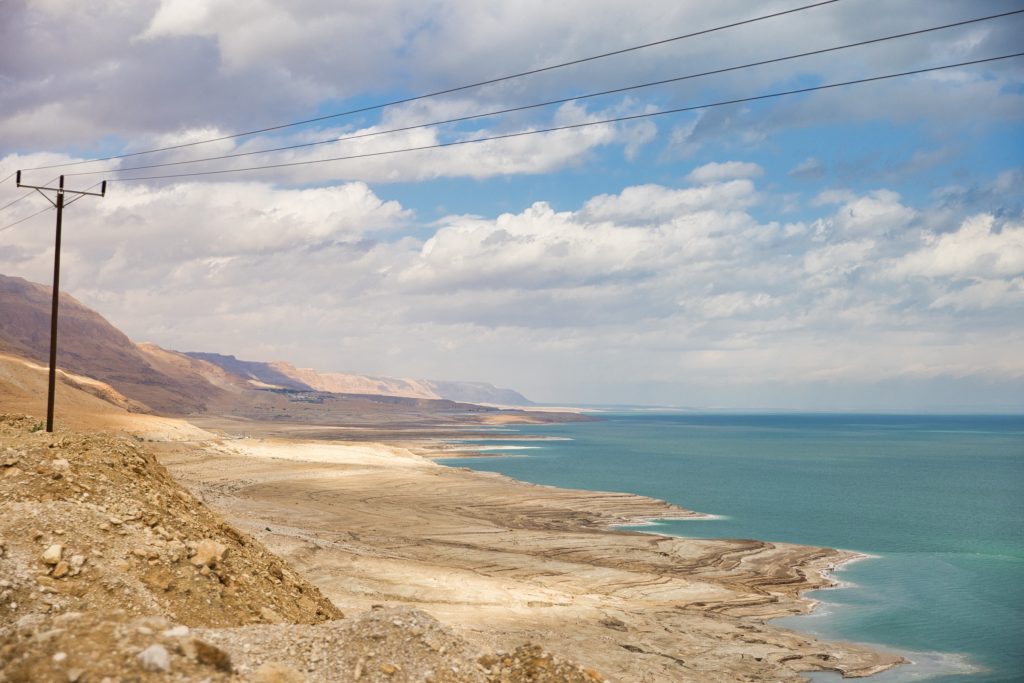
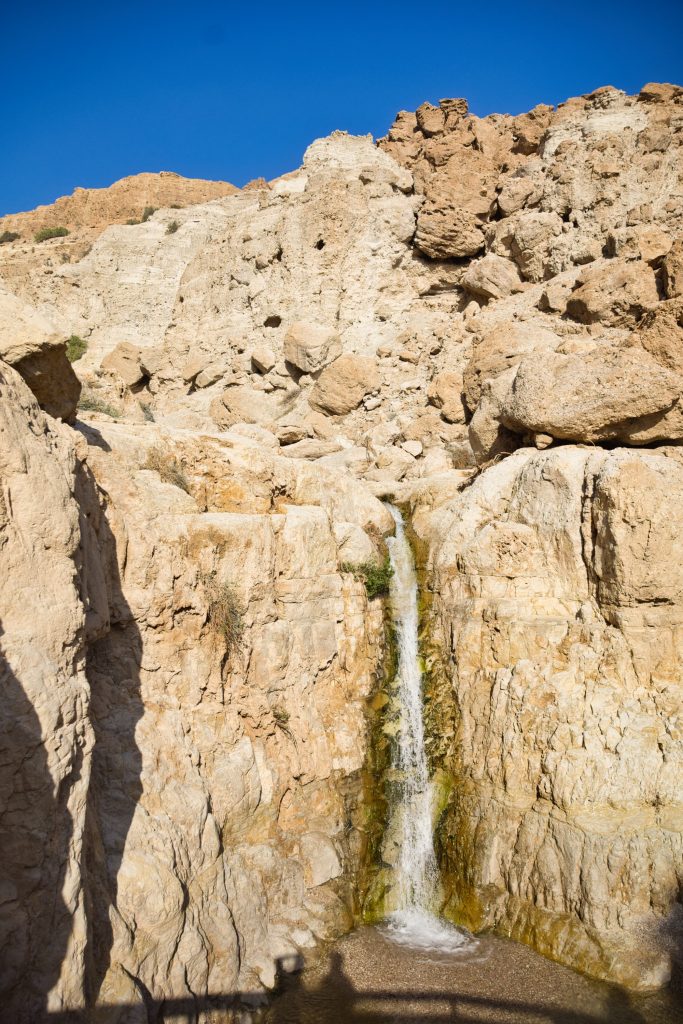
Ein Gedi is known for their picturesque waterfalls and wild life. But then we felt we were victims of the weather again. Only the lower waterfall was accessible, a mere 5 min walk from the front gate. Great! Strong rains back in May had made most of the trail inaccessible and the expected repair time of August 2025 was greatly missed. Despite the bad news, we headed out to the lower falls, while we were here and were a bit underwhelmed by the little waterfall at the end of the short path.
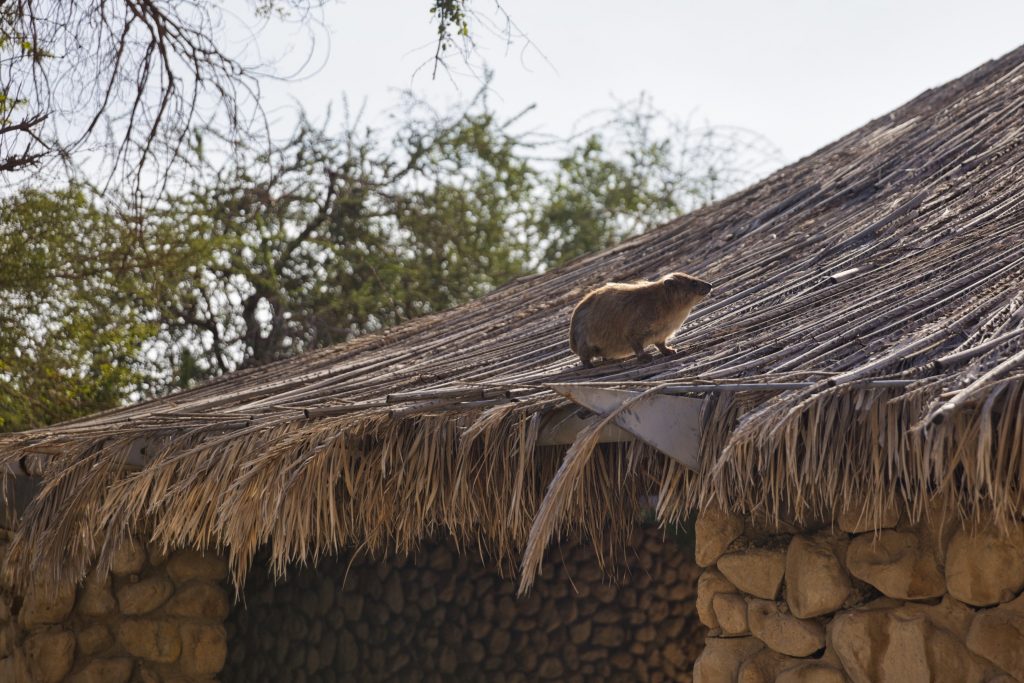
On our way back we at least had a little wildlife sighting… a rock hyrax, a sort of overgrown guniea pig was sun bathing on top of a roof very close to us. We had seen many of those in Zimbabwe, but that was Esther’s first here in Israel.
Luckily there is a second Wadi, Wadi Arogot, that was also part of the Ein Gedi Nature reserve just a few kimolmeters drive away and that one seemed to be open for a longer hike.
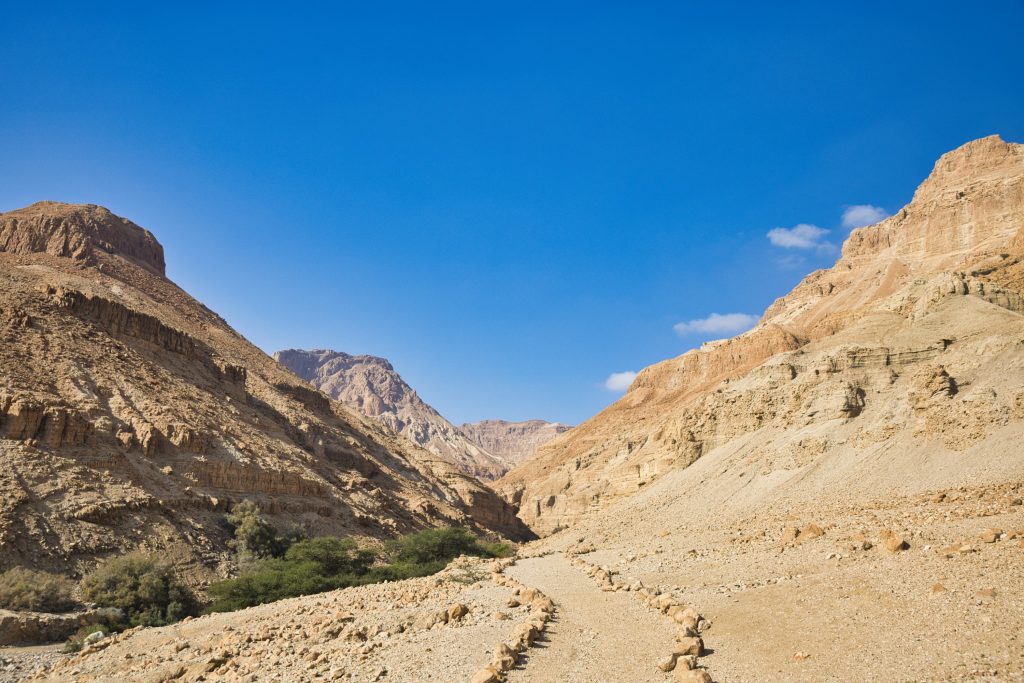
What nobody had told us—and what no guidebook mentioned either—was that there are two alternative routes to reach the upper pools. One follows the mountainside in full sunlight; the other means literally climbing up the riverbed, through mud and pools of water. We also hadn’t known that an online reservation is required in advance. Luckily, the woman at the entrance gate sorted this out for us on the spot—tourist numbers are still very low—and warned us that we should be prepared for hip-deep water and getting wet. We thought it was a joke.
Wandering up about 20 minutes, we hit the first intersection of those two paths and saw a family in full swimming gear making their way through the stream and the pools that came to chest high. No joke.
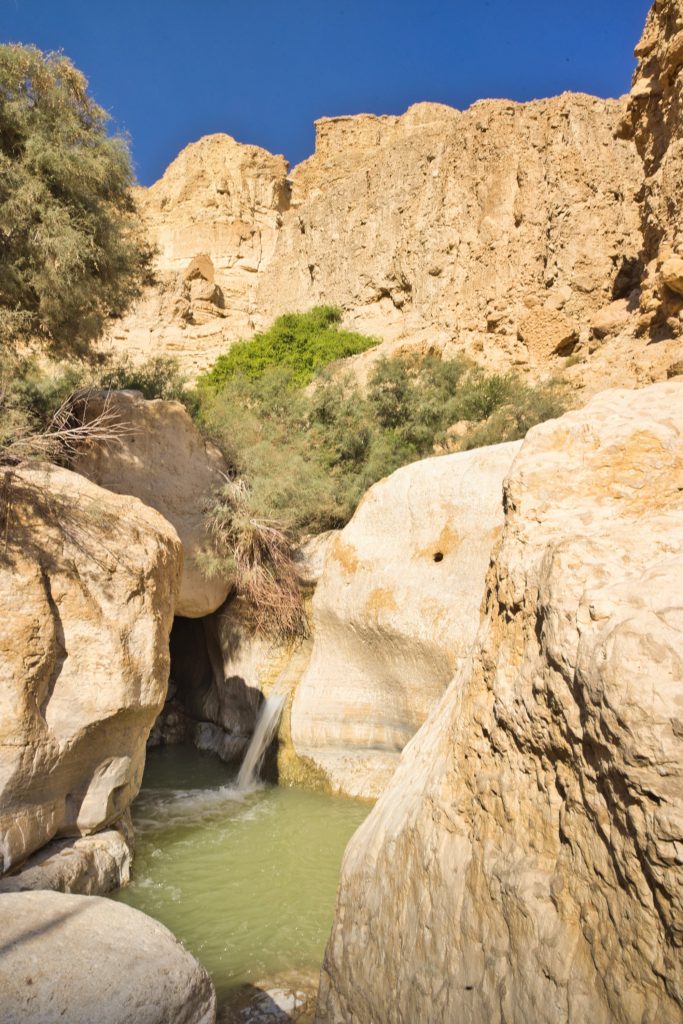
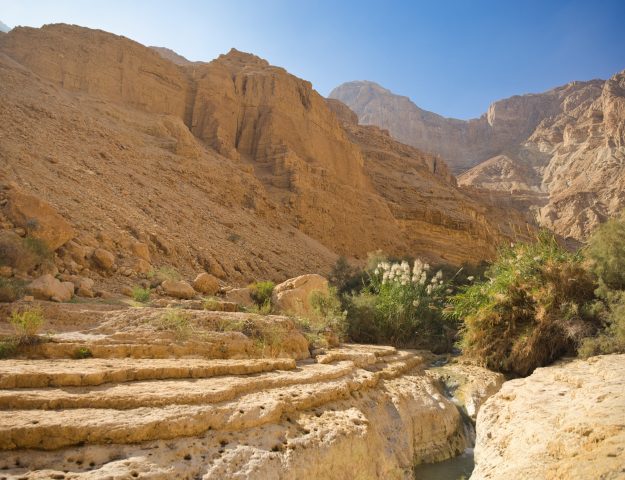
We decided to give this a pass and continued on the sunny mountainside path. We were not equipped to wade through hip deep pools. The next occasion of the two paths crossing looked more manageable, the riverbed shallow and it stated that there was a hidden waterfall in the gorge. Down we went, hopping across rocks in the riverbed and arriving nearly dry at a picturesque little waterfall, that was only visible from down here. Very pretty canyon and waterfall indeed, lush greenery by the waterside. While the steep canyon walls were brownisch bare and looked like rocks could fall off any time. Apart form a few acacia trees there was no green, all was very dry and arid.
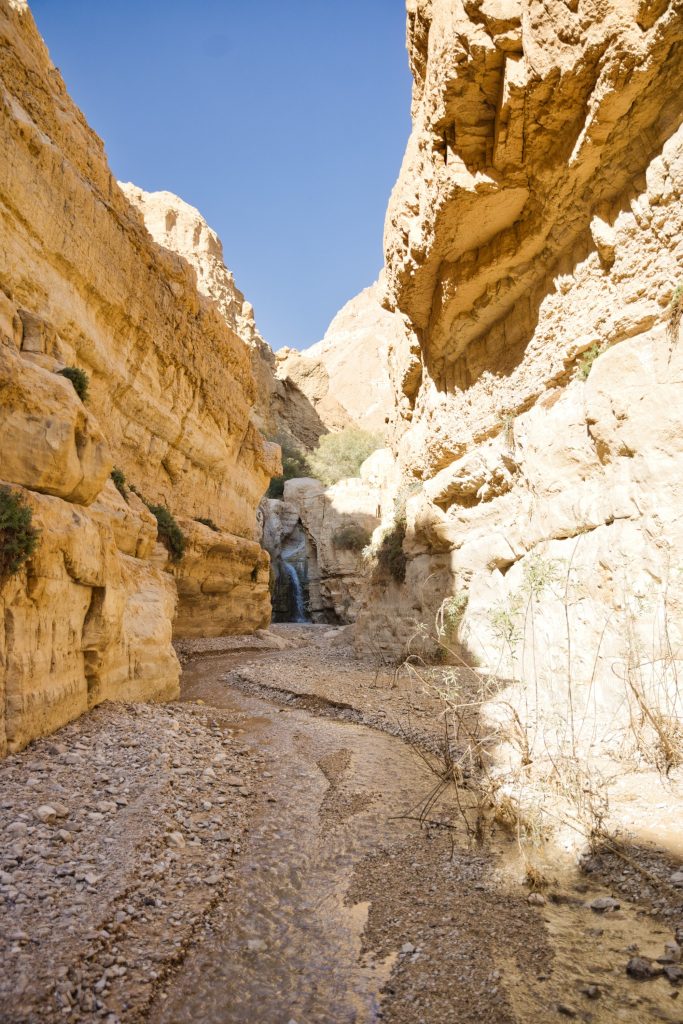
This was our half way point on our way up. we went the upper path again to the beginning of the stream. That took us another 30 min and the last few hundred meters the river bed was the only way up. No more path. Feet got wet a bit, but it was a nice hike to the upper pools to sit down, munching on cashews and apricots. At least we felt that this was a good hike and the weather was perfect. Few people, blue sky, no clouds and not too warm either.
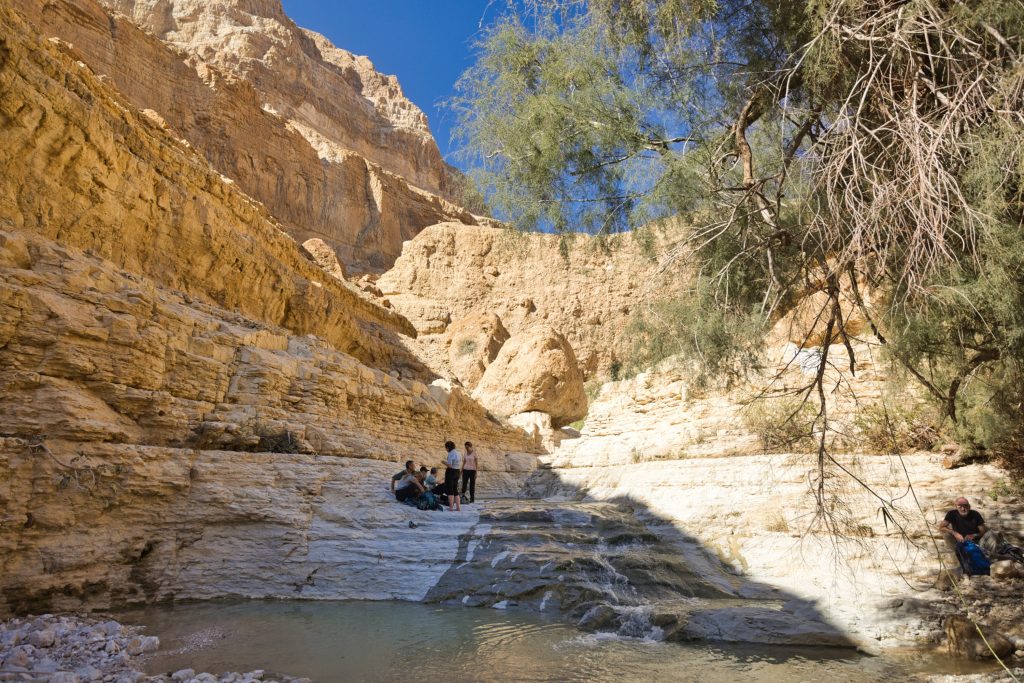
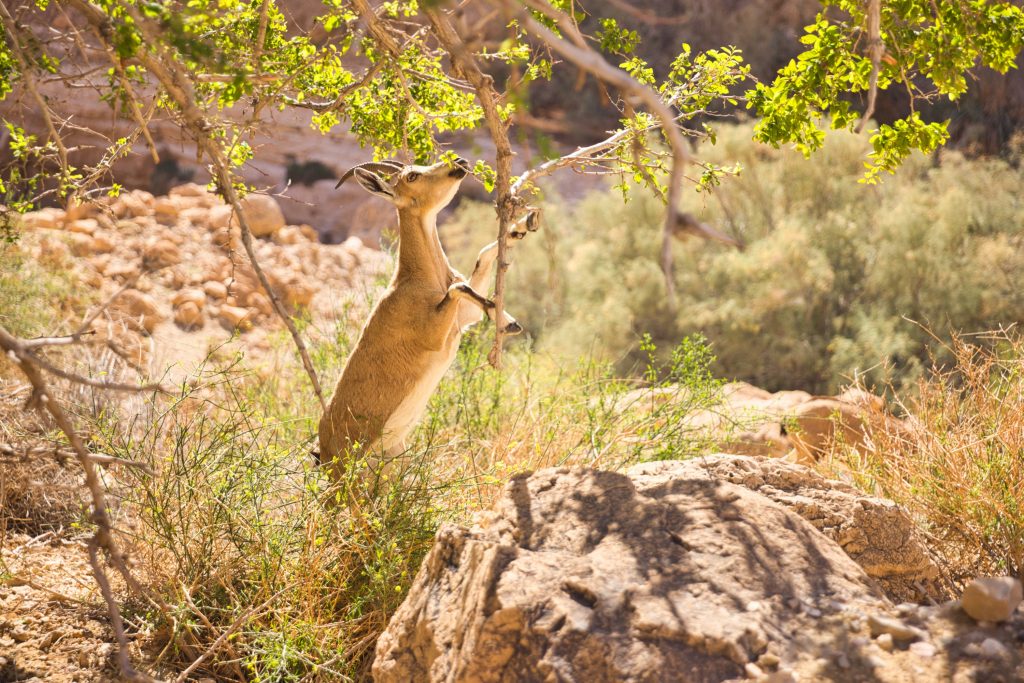
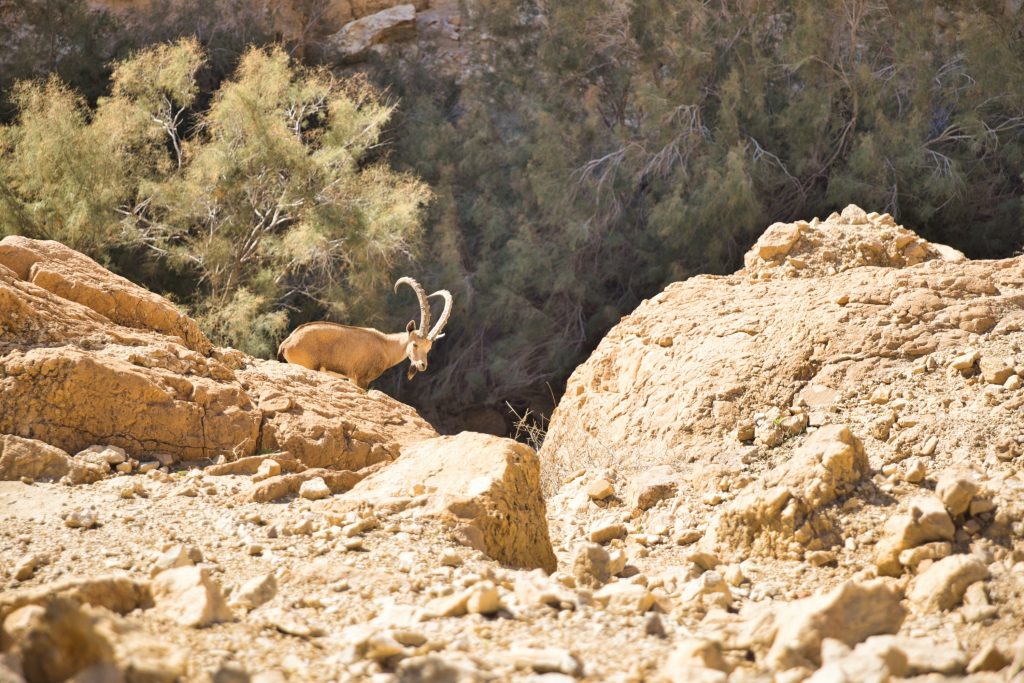
Wildlife here consists mostly of birds and rock hyraxes, both of which we spotted quite frequently while walking up the trail. The further we got, the fewer people we saw, as many families don‘t make it past the first set of pools of the half way waterfall. Walking down again, nature had another treat up her sleeve for us. Rounding a corner, we suddenly found ourselves in the middle of a small herd of ibex. Two males with large, curved horns and four females were all trying to reach the leaves of an acacia tree. They showed no sign of shyness, allowing us to watch them calmly and at close range.
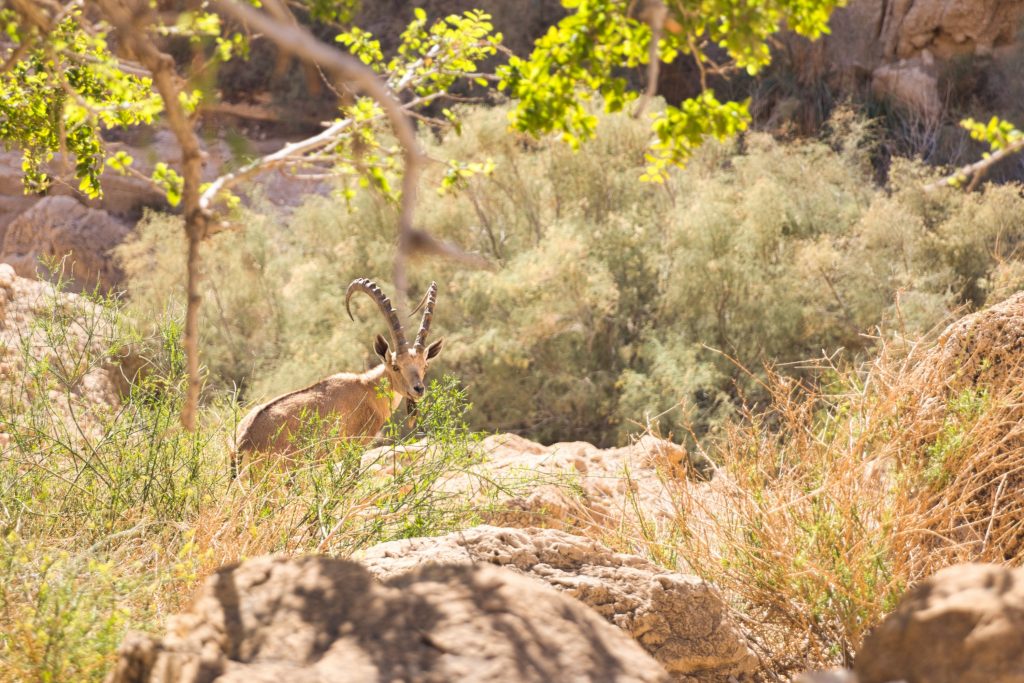
Ibex are found only in this part of Israel, and their numbers are limited. Seeing them this close felt like pure luck.
Back at the parking lot, we were surprised to realize we had spent three hours hiking—but it felt good. We were more than ready for a swim in the Dead Sea.
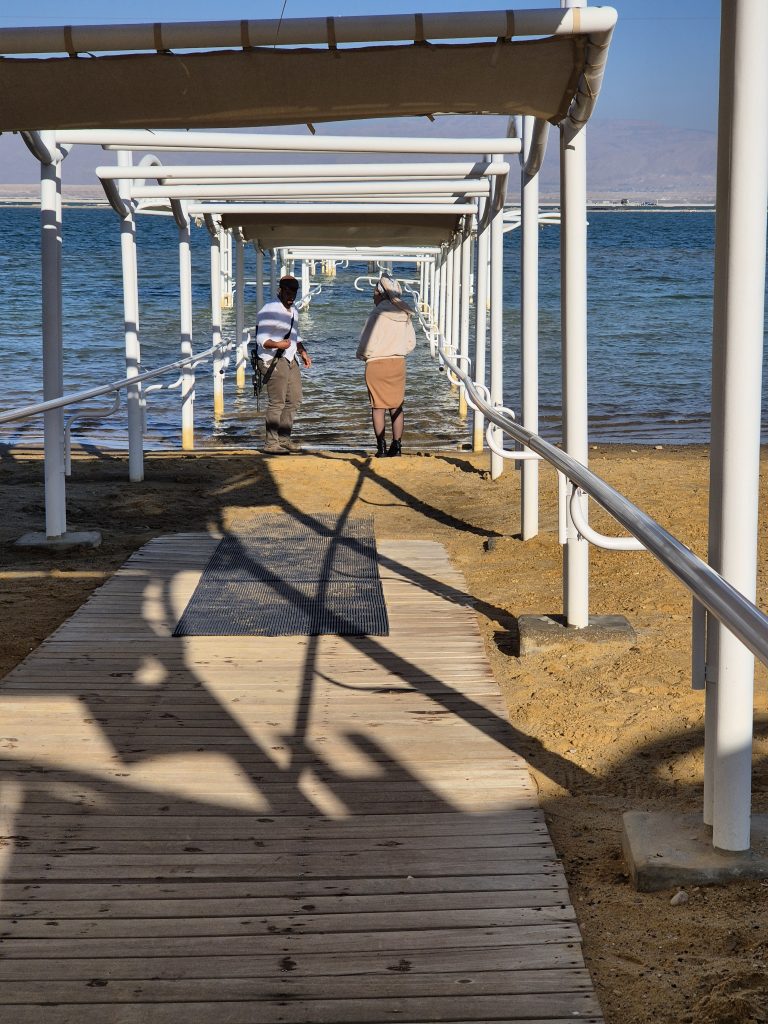
Back at our Greek-themed Milos Hotel, the Sirtaki music was still playing on an endless loop (just as it had the day before). We slipped into our swimwear and headed for the beach. Our hotel borders directly on the Dead Sea—or, more precisely, on a gigantic man-made salt pool beside the Dead Sea. The “beach” of Ein Bokek isn’t natural at all—it’s an engineered salt lagoon, with imported sand and carefully controlled water levels to keep the Dead Sea usable for tourists. The Dead Sea’s natural shoreline consists of sharp salt crystals, hardened salt crusts, mud, and unstable ground prone to sinkholes. Walking there barefoot is very unpleasent as Chris experienced more the 15 years ago, when he stayd at Ein Gedi Kibbuz.
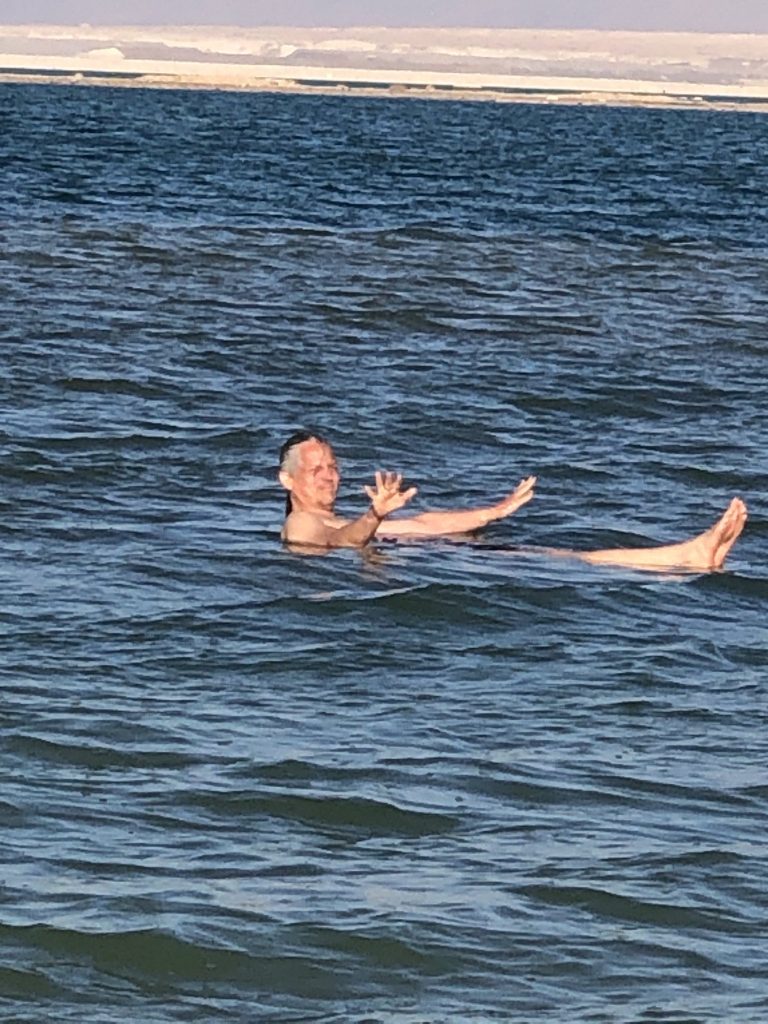
The hotels here carefully regulate the water level and manage the salt, preventing it from accumulating and hardening along the shoreline. The sand there is brought in by truck to make for a pleasant beach experience. Having floated in the dead sea before in Jordan, the feeling was not new but always a bit surprising to bob on the water like a cork…. Impossible to drown. The sand used on the beaches at Ein Bokek is quarried inland and consists of limestone-based sand or finely crushed dolomite. Crucially, this material is chosen to be chemically inert—it does not react with the extremely saline water and does not dissolve, clump, or bind with salt. Ordinary beach sand would quickly turn into a solid, concrete-like mass under Dead Sea conditions. And since the Dead Sea is shrinking by roughly one meter per year and natural shorelines retreat rapidly—leaving behind sinkholes and unstable ground—only this gigantic pool system ensures continuous tourism.
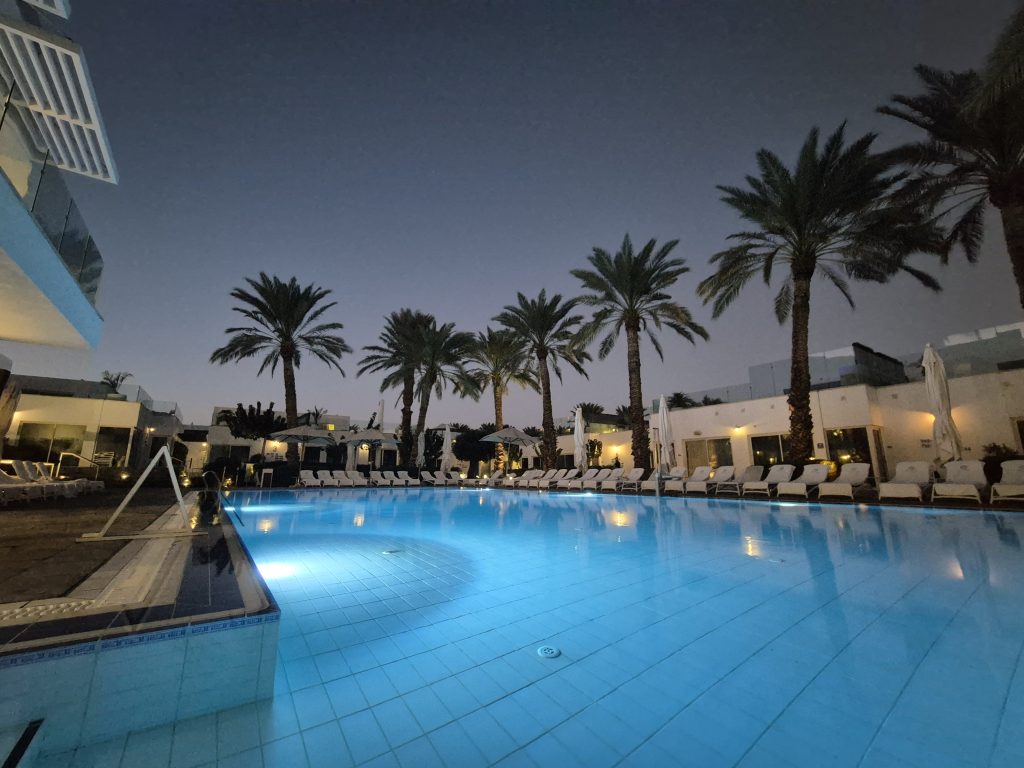
Esther, ever the Warmduscher, still preferred the bathtub-warm, salt-free, chlorine-rich jacuzzi and hotel pool to the itchy saline lake that the Dead Sea really is. And to be fair, the pool here is quite appealing.
After lazing away the rest of the afternoon, dinner became an exercise in compromise. The top three “best-rated” restaurants here offer a limited choice between clubhouse charm, a shopping-mall food court, or a burger joint. Since we had already tried the clubhouse—and had managed to order the last remaining items on the menu, with dishes and drinks running out immediately afterward—we decided to go with burgers this time.
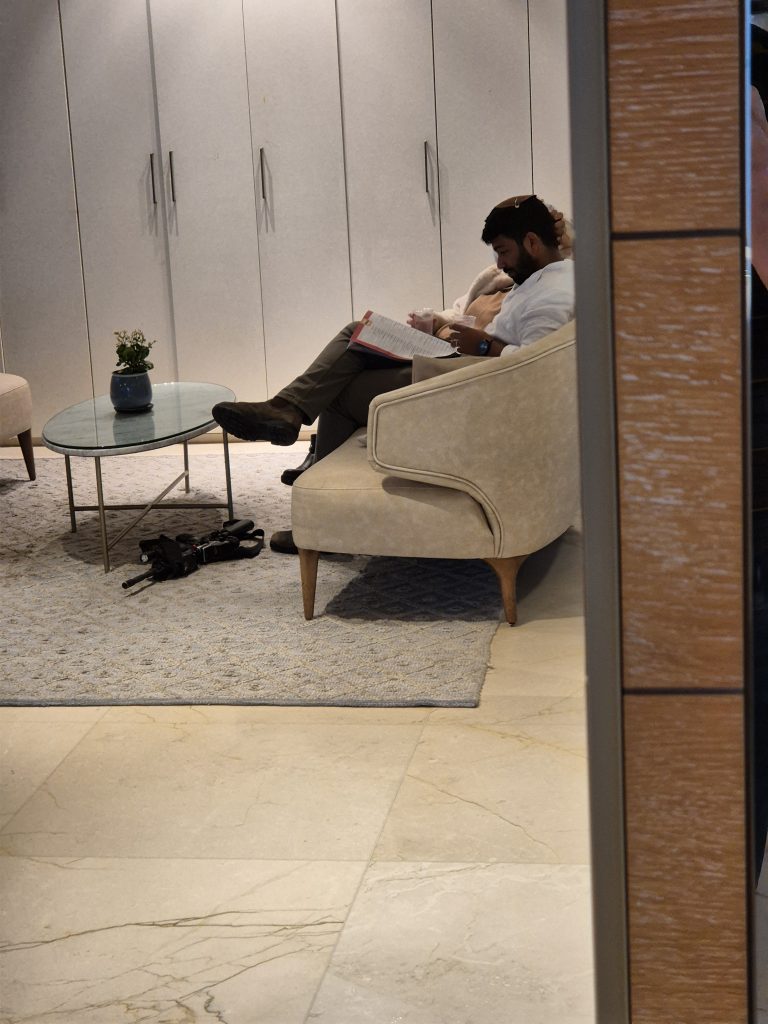
To be fair, Ein Bokek is an assembly of holiday hotels rather than a real village, and with only a handful of Israeli tourists around, options on a Saturday evening were predictably limited. Many guests simply ate take-away food they had brought with them, sitting around the hotel grounds. Some even had their service rifles resting at their feet—an oddly casual reminder of where we are. Dinner done, we retired early, once again accompanied by the hotel’s endlessly looping Sirtaki soundtrack.
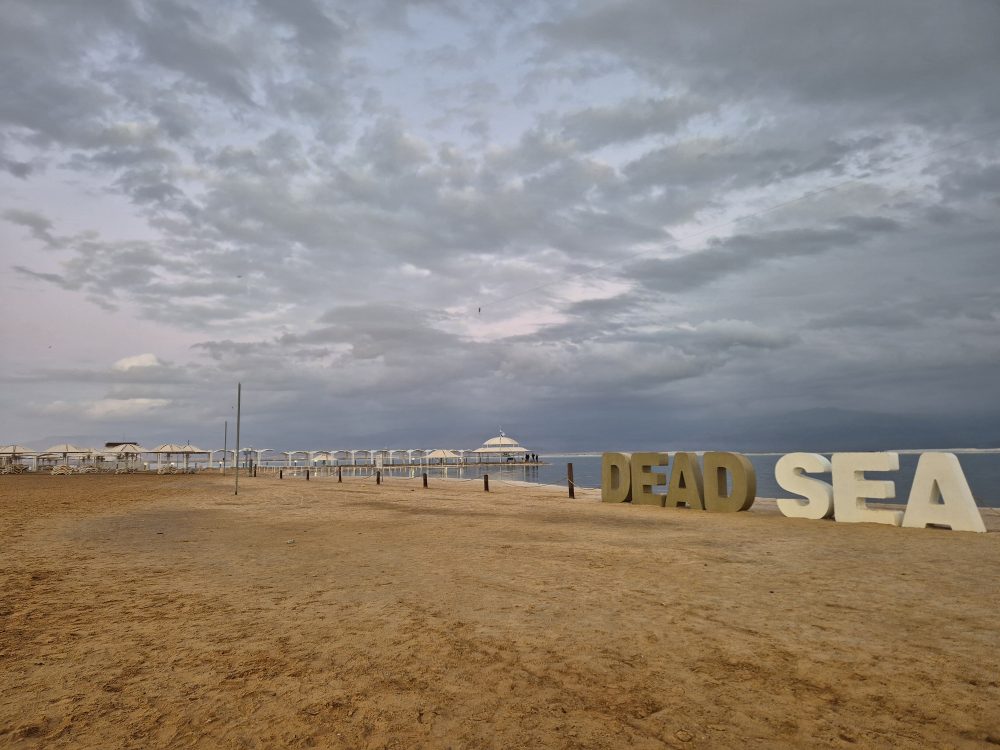
We were bound to leave Jerusalem just as it started to rain…. Perfect timing! We had planned an easy drive to the monastery of St. George near Jericho on our way to the dead sea resort we had booked ourselves into for 2 nights.
On our way we planned to also stop for a leisurely walk in Ein Gedi nature reserve to a beautiful waterfall and then a trip up the Masada Fortress by cable car before checking into our hotel in En Bokek. Apart from the latter, we ended up not doing any of the aforementioned things today. Instead we spent 4+ hours in our car driving through Israel.
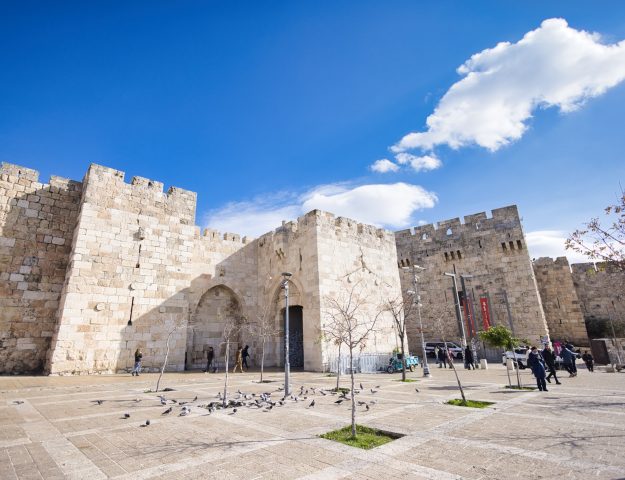
But one thing after another. We left Jerusalem a bit later than we tought. The car was parked across town and Chris went to get it, while Esther wheeled the heavy double bag to the nearest Gate and the gate with the least hills to drag the bag up, which was lion gate. What we overlooked was that it was Friday and many palestinians and muslim Israelis were on their way to the AlAqsa Mosque and the dome of the rock. The closest gate for them is Lion gate. Hence extra heavy security and road blocks were in effect preventing Chris from driving up the the gate. So Esther needed to drag the heavy bag all the way down to the main road where Chris was waiting. Ok not too bad 10.45 AM departure Jerusalem.
Our next stop was meant to be the St. George’s Monastery—a picturesque monastery built directly into the sheer rock face of a canyon, or wadi (see the pictures from Chris last trip here). We turned onto the road leading toward the monastery, only to find ourselves stopped by a lowered barrier and a sign written in Hebrew. No one could tell us why the road was closed. Online, the monastery was still listed as open. Google Translate wasn’t much help, and neither was the woman at the adjacent gas station. A local settler at least confirmed—after checking Google Maps—that this was indeed the correct road to the monastery.
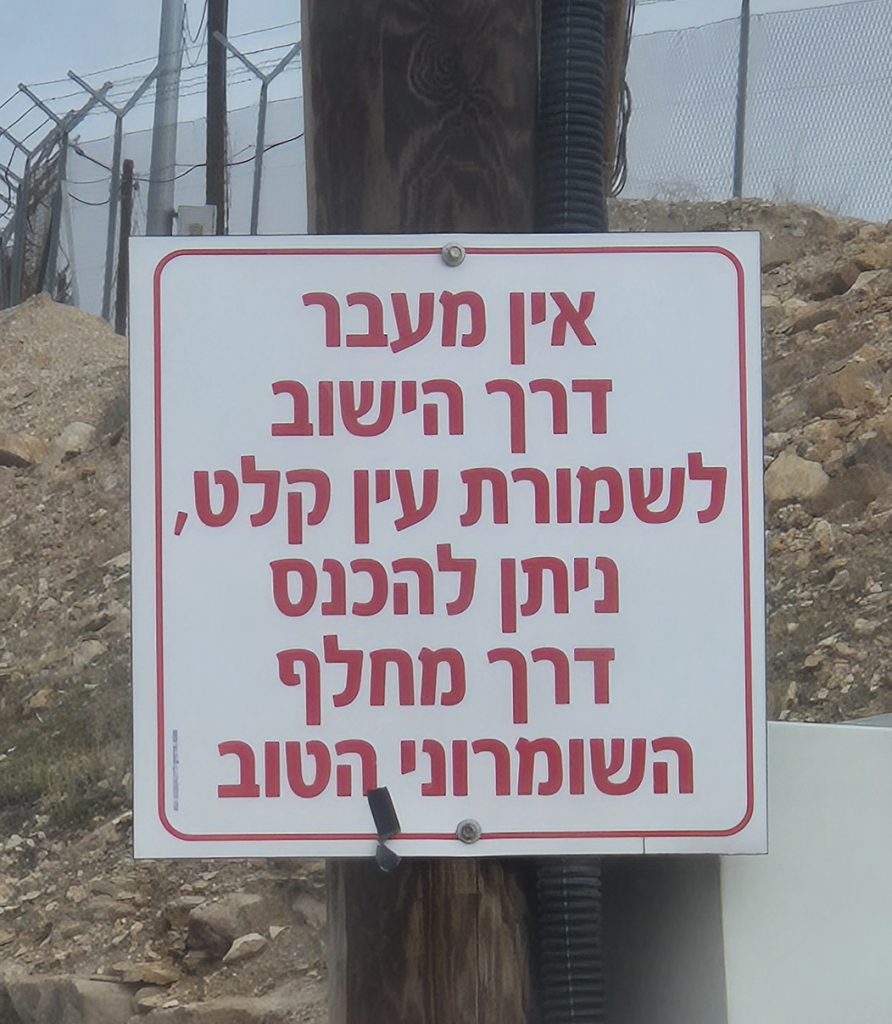
Only later did we learn that settlers had taken control of the access road and were preventing through traffic. Visitors to St. George’s Monastery are now supposed to take the next exit toward Jericho via Route 4570. Since we weren’t entirely sure whether we were allowed to drive there with our Israeli rental car, we eventually abandoned the plan. We’ll discuss tomorrow if we’ll give it another try.
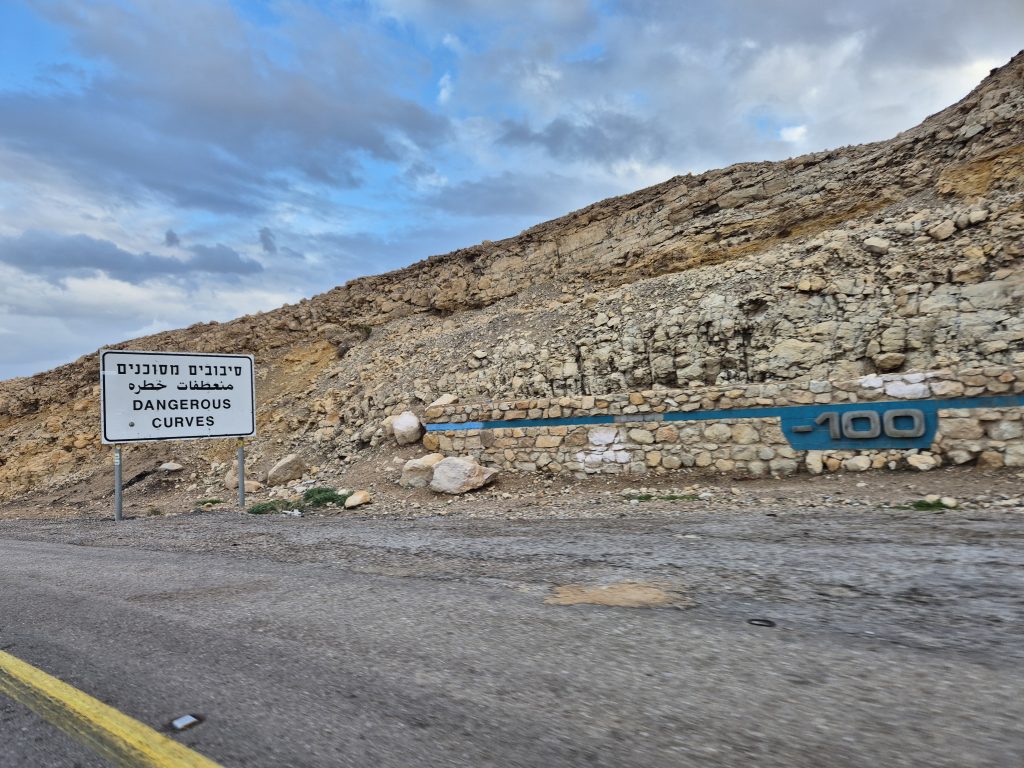
Weird, but a bit disappointed we continued our journey to the dead sea, a winding highway that is marked with altitude markers of a special kind: you are currently 400 meters below sea level. Weird to think that one is at -400 m. Making good progress despite some crazy Israeli driving, our next stop, the Ein Gedi nature reserve. Looking forward to a nice walk and a great waterfall after all this rain, we made our way to the dead sea. After about a hour we were stopped by a security check point telling us that the road to En Bokek was closed due to flooding. It was only open to Ein Gedi Kibbuz.
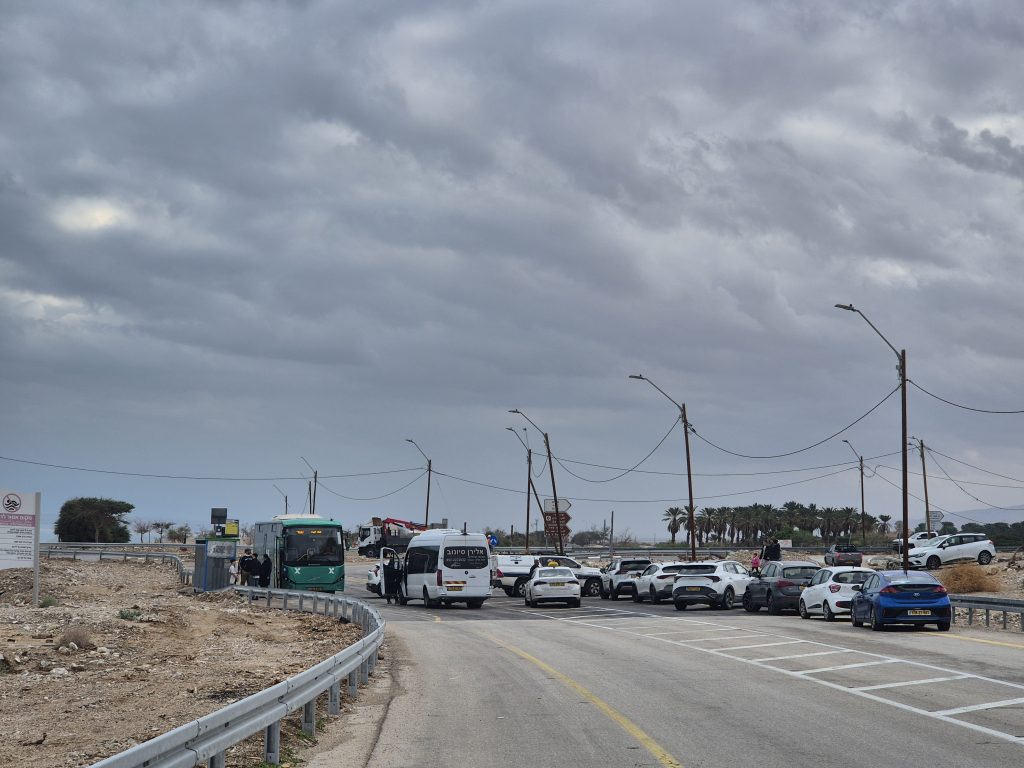
Well that was a bummer. No way to get to our Hotel then, or to Masada and time soon. But at least we could still do our Ein Gedi hike as the road was open until there.
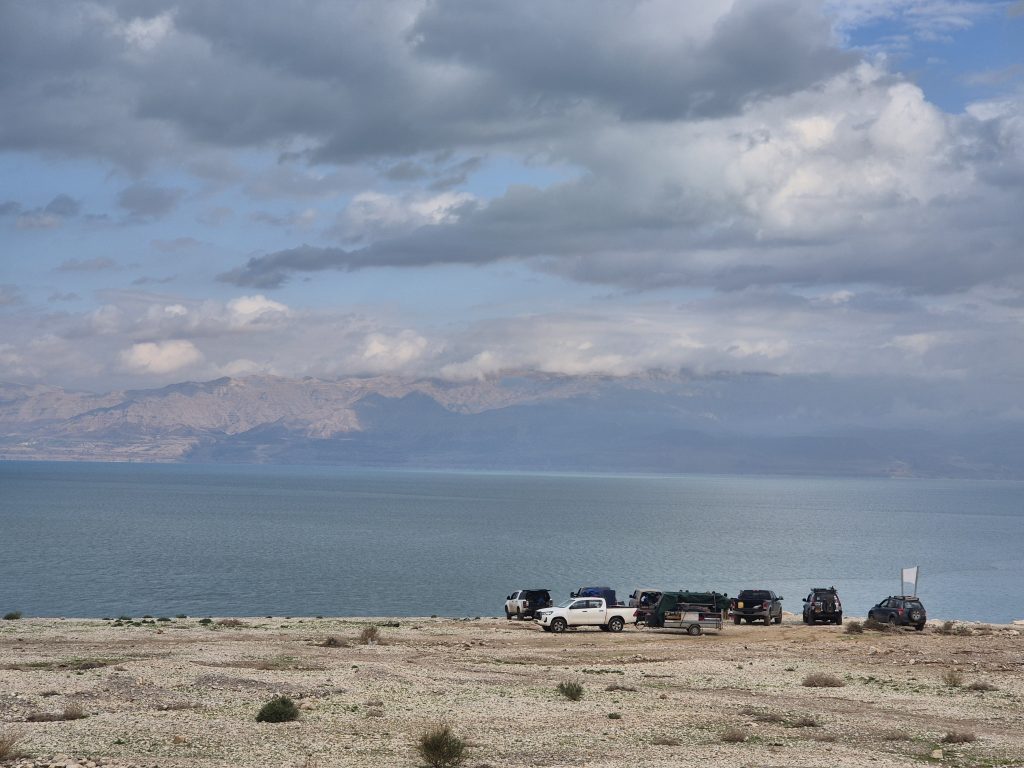
Driving along the Dead Sea, there is only one route, carved into the rocks running North /South . Mounatinous desert on one side and the dead sea on the other. Until we arrived at Ein Gedi it was just after 12 noon. We had water, we had nuts and dried apricots and wanted to set out to hike to the waterfall, and got stopped. Nature reserve closes at 1 PM due to Friday being Sabbat and it being winter time. We were going after te guide book, which stated open until 4 PM, last admittance 1 hr before closing. What a bummer! And now what are we to do?
Wait until the road was unblocked and from then on it would take 30 min to Ein Bokek/ our hotel?
Or turn around, drive all the way back to Jerusalem, and from there through the West bank from Jerusalem to Bethlehem and further South through Palestinian land, which is not allowed by the Israeli rental car companies. So we had to continue even further in direction of Tel Aviv, take a wide circle around the West Bank, loop back to the dead sea from the south and drive to Ein Bokek from the South. A detour of 3.5 hrs. drive. As the security guards could not tell us when the road would be reopened, we felt we really only had one choice as the hotel was already booked: drive all the way around.
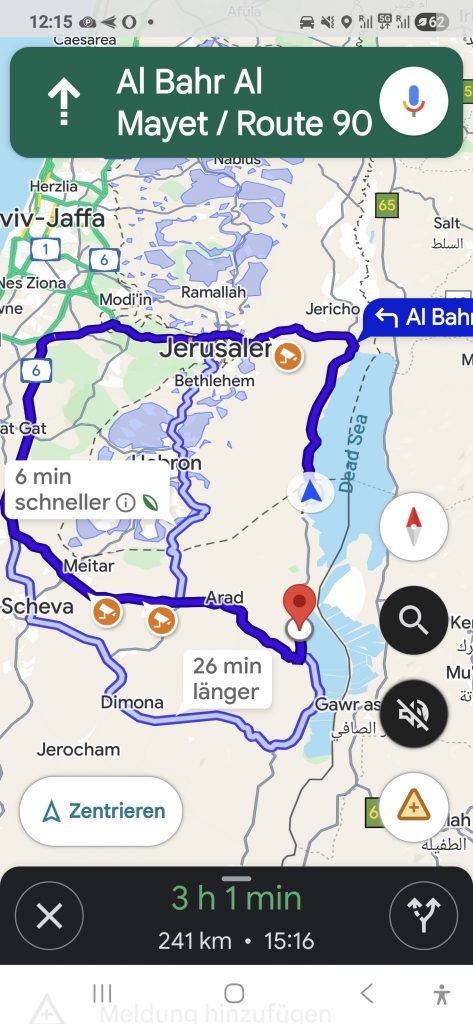
Needless to say that it took us until 4 PM to arrive in Ein Bokek and nothing to show for…
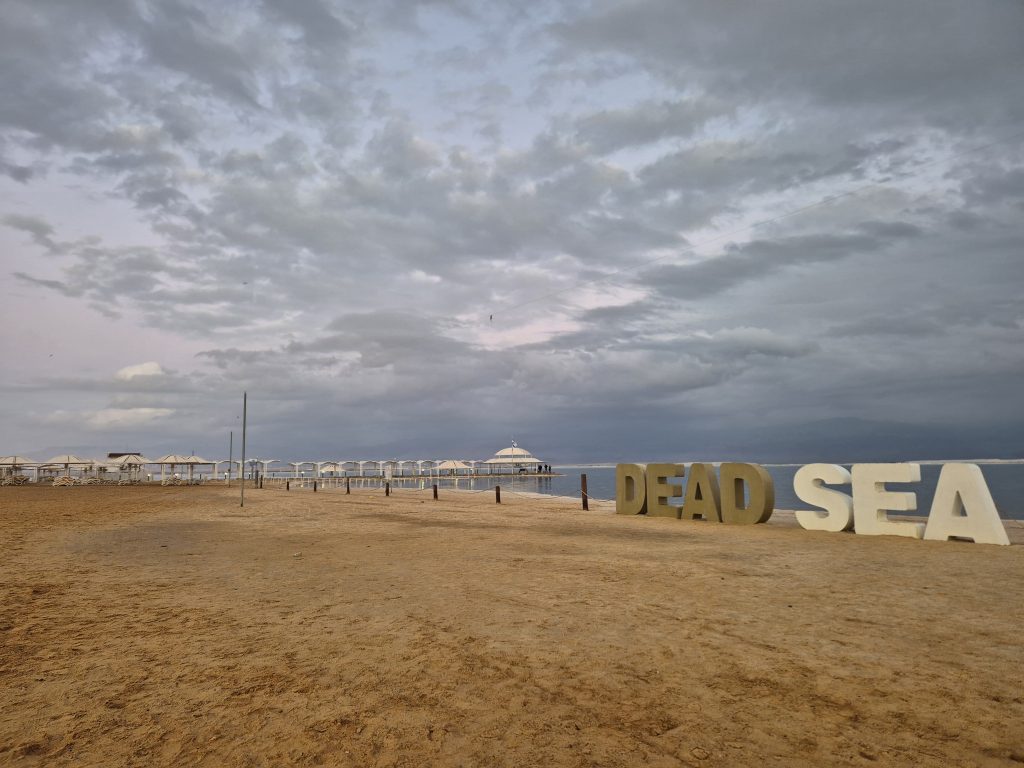
But a nice board walk on the dead sea shore to stretch our legs. I guess we“ll need to recoup some time tomorrow … at least the weather forecast looks good… 18 degrees C and sunny….
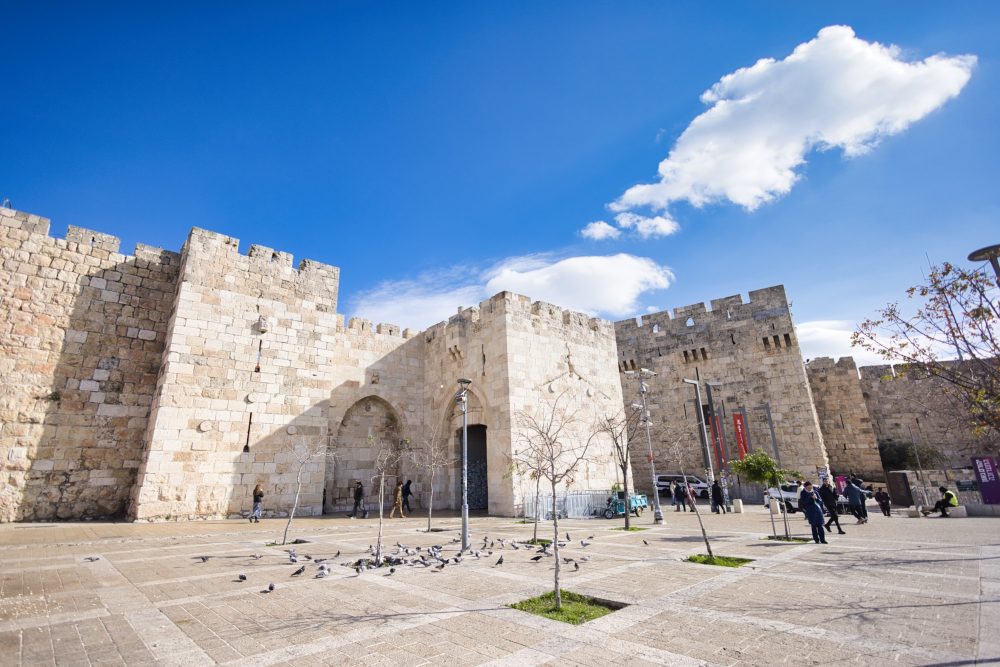
We took a slow start to the day with a long breakfast at our Austrian Hospice, then decided not to rush anything.
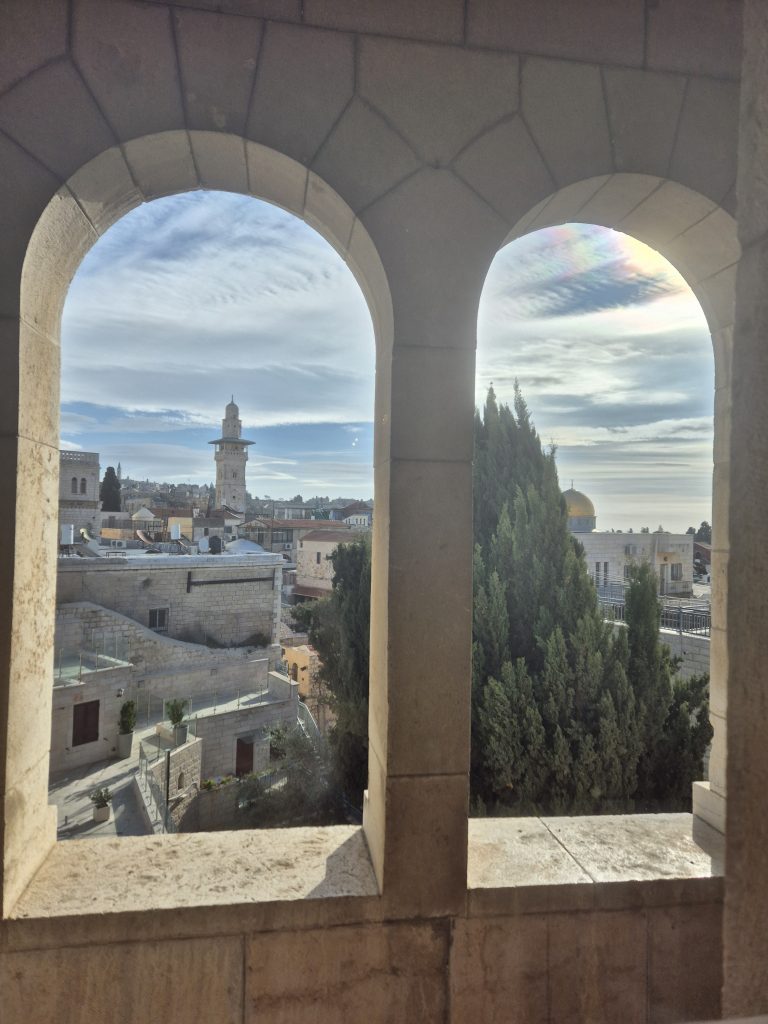
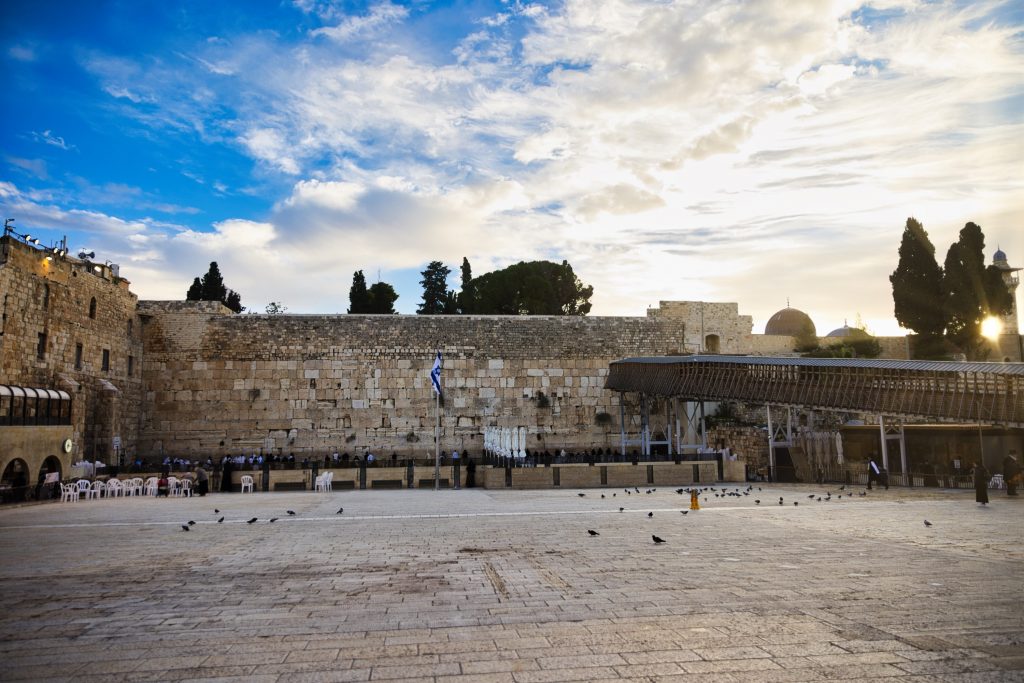
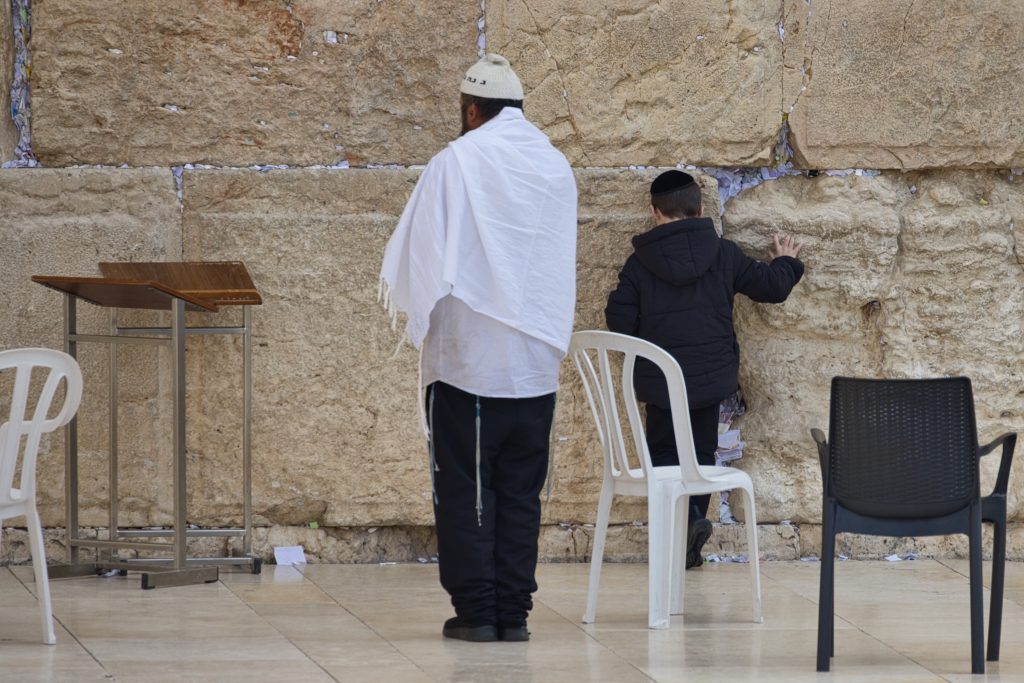
We felt we had already seen most of the main attractions, so we went looking for places that are easier to miss. Today, a large open plaza stretches out in front of the Western Wall. That wasn’t always the case. Before the Six-Day War, buildings stood right up against the wall, leaving a passage barely three to four meters wide. After the war, the Israelis demolished the buildings directly opposite the wall to create space—and security—for worshippers.
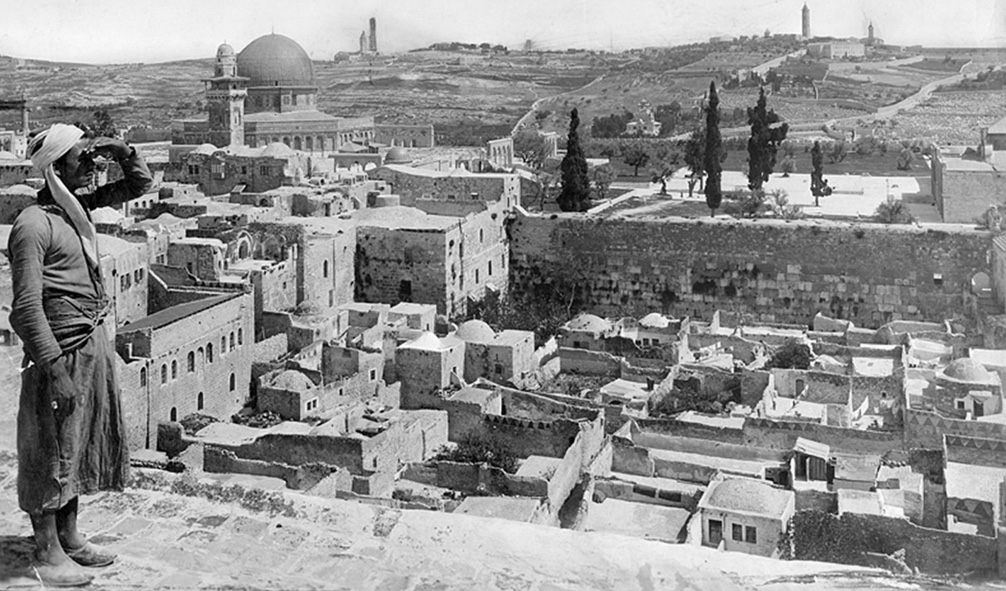
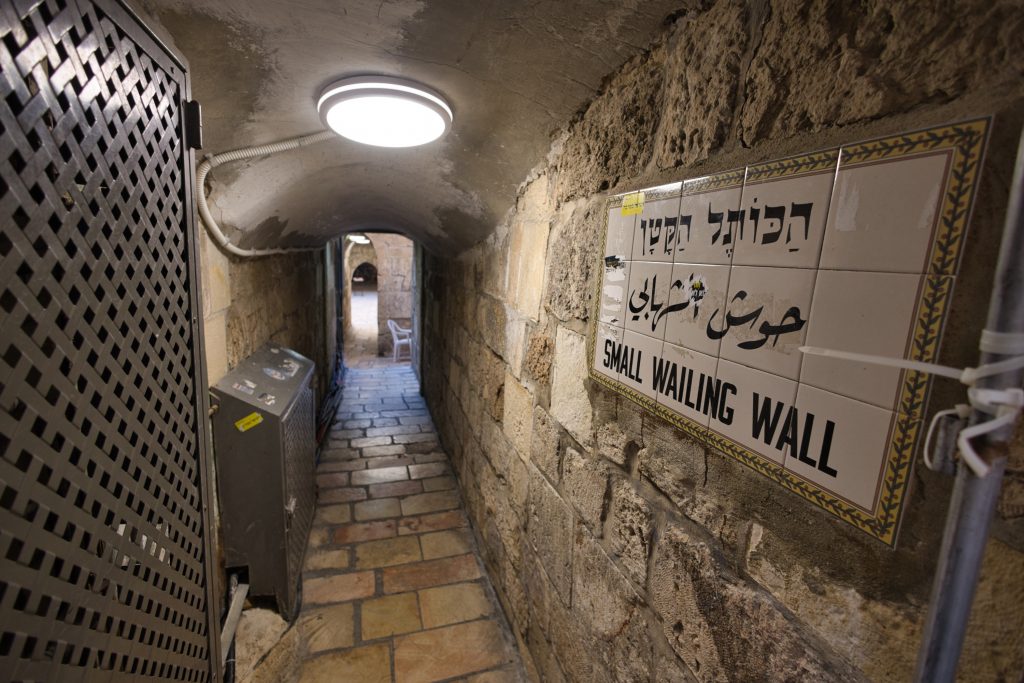
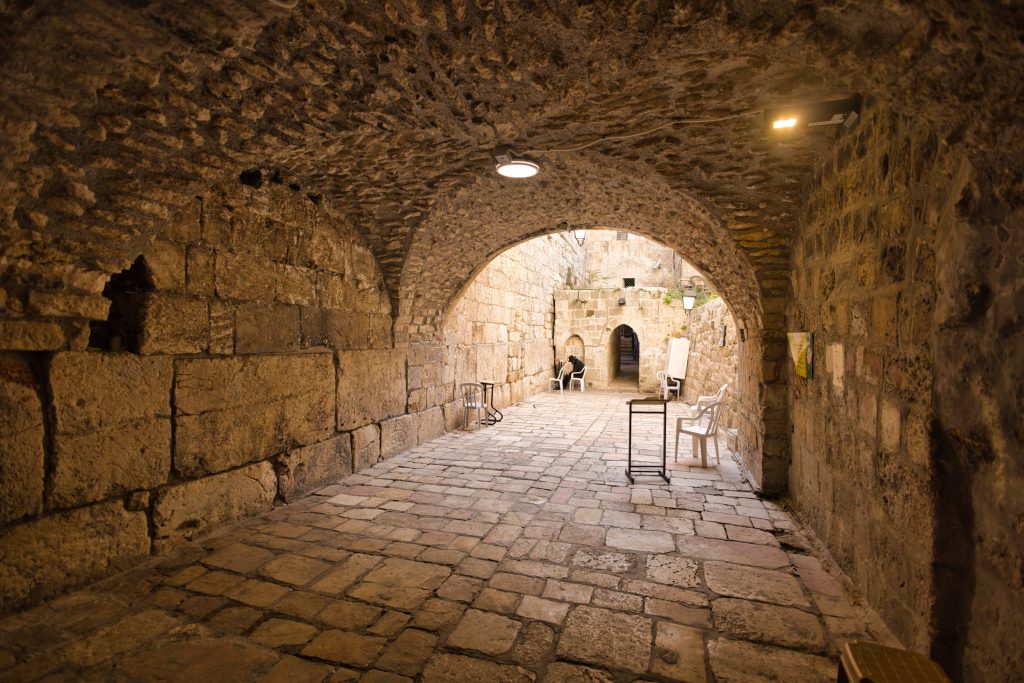
What many visitors don’t know is that a small section of this original setting still exists: the Little Western Wall. Reached through narrow alleyways near the Cotton Merchants’ Gate, a small street leads into a quiet cul-de-sac. On one side stands a portion of the Western Wall itself, with tiny folded prayers tucked between the stones. On the other, buildings rise just a few meters away. This gives one an authentic feeling of what it must have looked like before. Men and women pray together here, not gender separated. A peaceful part of town, tucked away yet so central.
We made our way once more to the holy church of St. Sepulchre to see it again in a different light. Many more tourists were milling about and the Armenian Church section was open today displaying some colorful paintings on the church walls and plenty of gold plating everywhere.
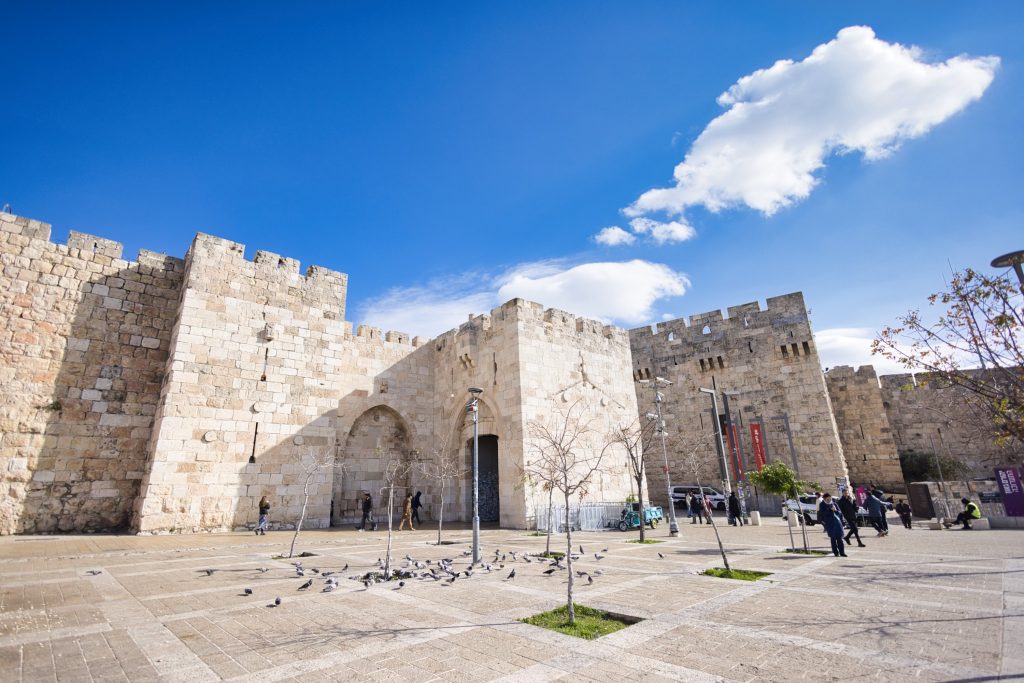
Making our way to Jaffa gate, Esther tried to hunt for a little donkey or horse to add to our collection we try to bring back from every vacation. Thinking that a wooden donkey can“t be difficult to find with so many wooden crib scenes on display. Each had at least one donkey as part of the picture, but no one was wiling to sell the donkey by itself. Only as part of an entire crib scene. And the few little wooden donkeys Esther saw were roughly hewn ones and pretty ugly.
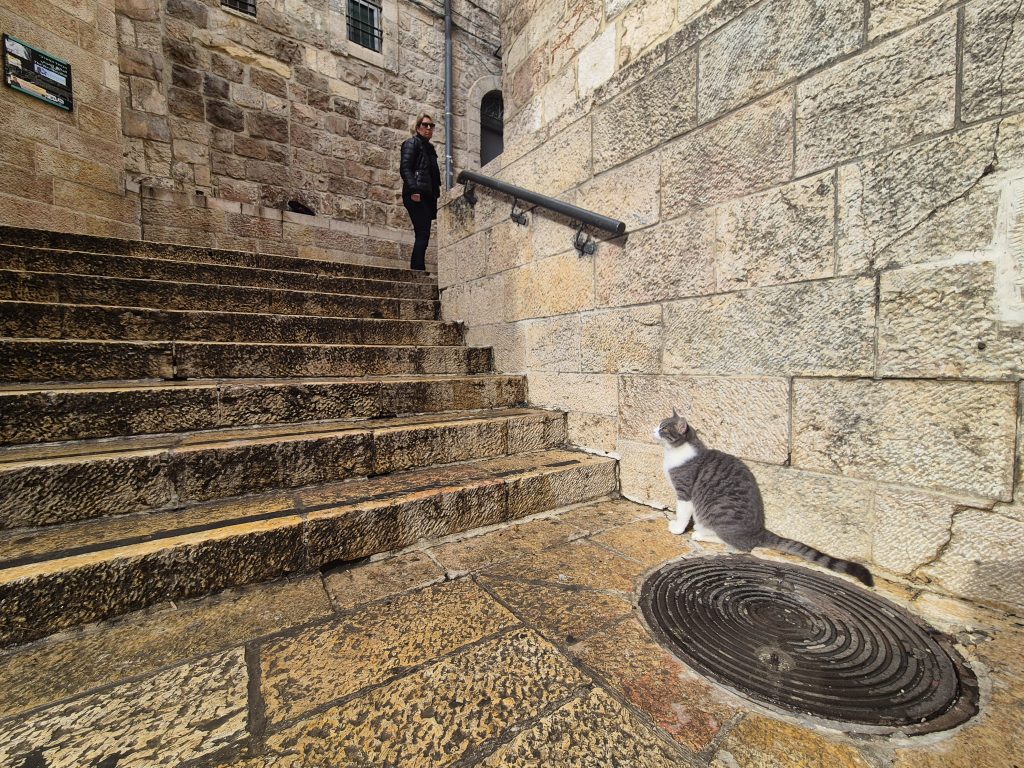
In what felt shop number 22, she finally saw a nicely wood carved little foal. Nice markings , made of olive wood. After some haggling and near walking away we thought both parties got a good deal and so our search concluded for this vacation at least.
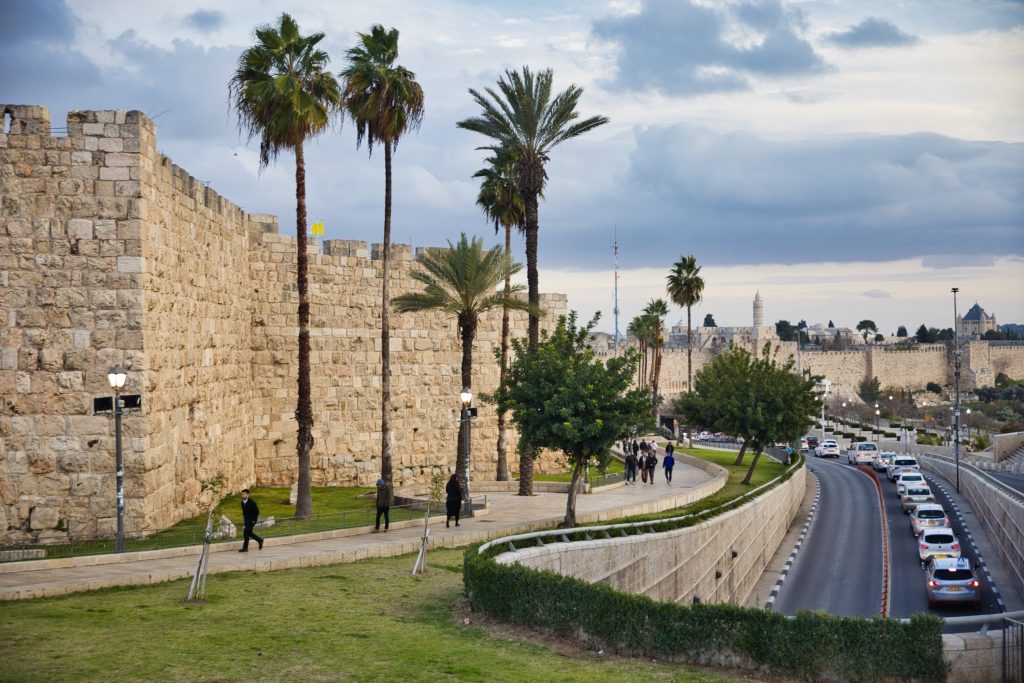
Having ventured across the entire length of the Old City from right to left and from up to down and back, criss crossing through the many souks and little covered bazaars, we felt we needed to see a bit of Jerusalem outside the city walls. As always, walking is our preferred method of exploring a city.
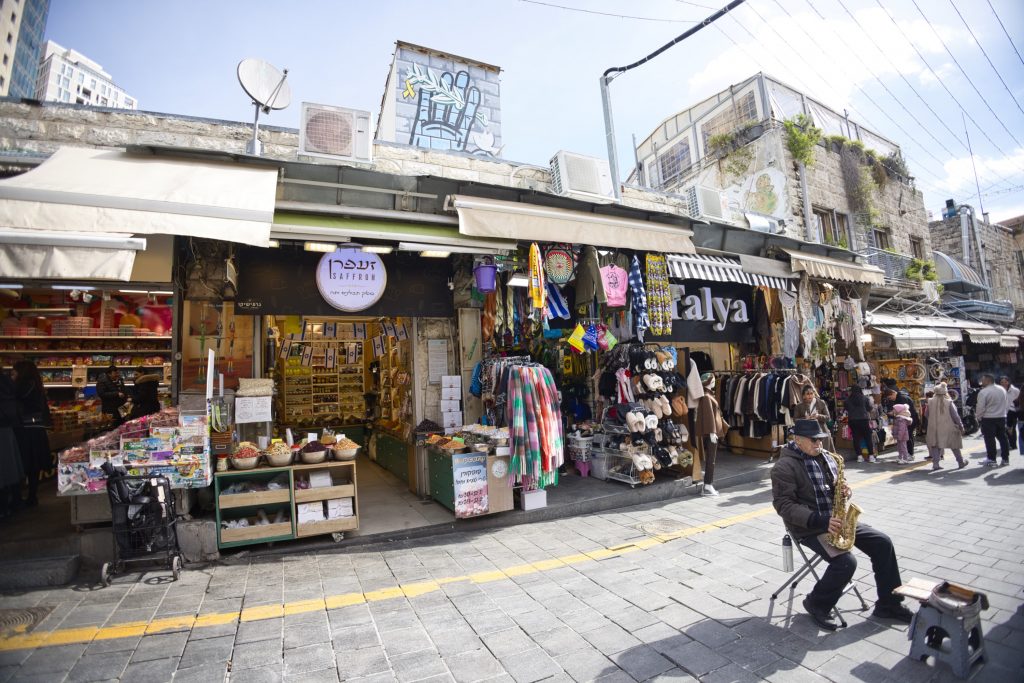
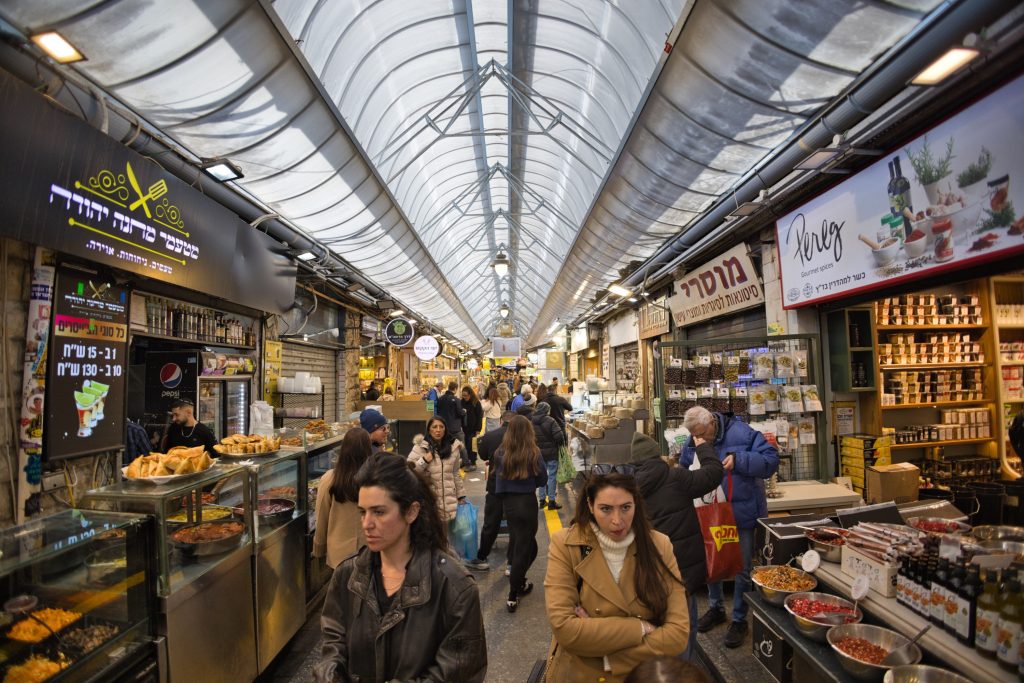
So we walked to Israels largest market, the Mahane Yehuda market or in short: Shuk. Partly covered, partly under open sky, this is a sensory overload for foodies. Any type of fruit, dried nuts, vegetables, meats and sweets are being offered. Everything is proudly displayed artfully in very appealing stacks of goodies. Fresh bakery wares, any type of spice and spreads are being offered. Dozens of different olives, hummus, and cheeses. Each stall specialized in a different produce. We bought roasted cashews, dried apricots and warm edible chesnuts. We were surprised by the prices. They were quite high we found. Chris for example paid 5 EUR for a cup of fresh fruit juice.
Nevertheless we were glad we came as a market always gives you a view into peoples lives. And Israelis definitively like to cook with fresh ingredients, not preprepared, frozen food.
Time for a coffee break we thought but then wandered quite a while before we found a place where it was sunny, not windy and therefore pleasant to sit. Unfortunately while the place met our demands, the coffee did not. They served instant coffee cappucino, to Esthers chagrin… we should have gone back to the Austrian place. Chris had opted for the mint tea.
Taking one more tour around the impressive outer city walls we decided to have an early dinner at an Armenian restaurant. It is not easy to find a good place for food inside the city walls, unless you like hearty street no-frills street food. Unfortunatly the recomended Armenian Restaurant turned out to be closed. Like so many here as tourism is very low, and many shops or restaurants remained closed.
We decided to splash out and have a proper new years dinner to start the year at Happy Fish, which was in walking distance outside the walls and one of the posh restaurants in Jerusalem. Fooled by a 4.5 star rating we settled down expecting gourmet food but found exorbitant prices for OK food. Luckily, we’re not big eaters. Portions were small, but the bill was impressively large. SStill, it beat eating in a little cave under harsh neon lights, at plastic tables with vinyl tablecloths, while bad playlists played through crackling TV speakers—like many of the otherwise tempting places inside the Old City walls.
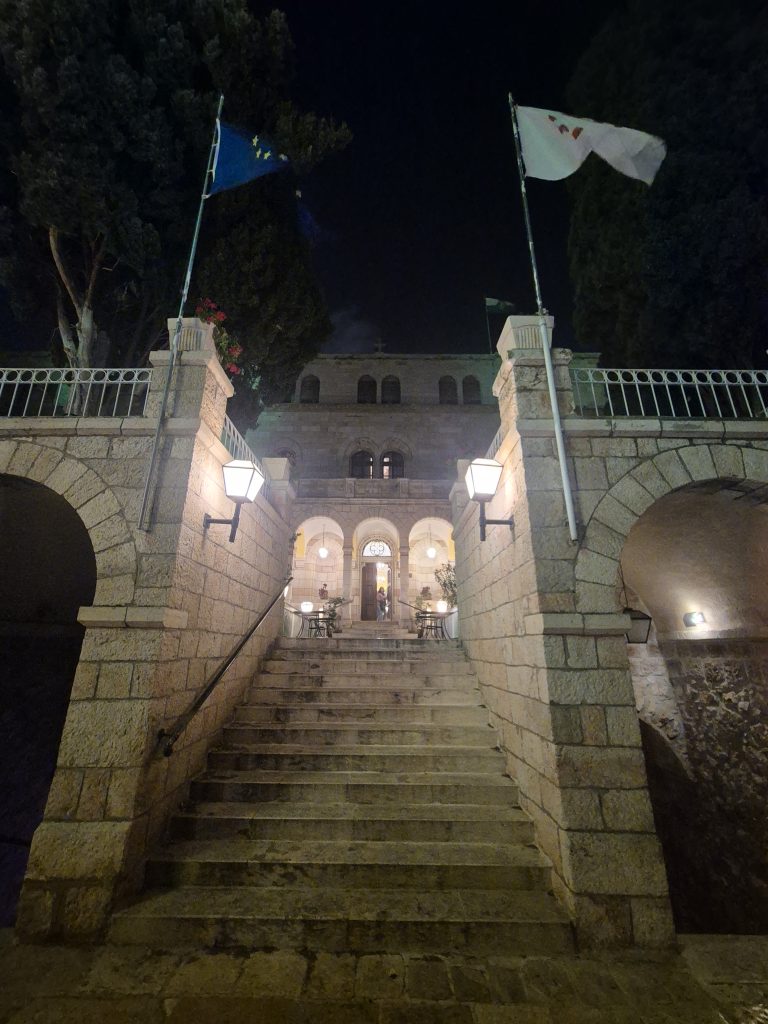
So at our last evening in Jerusalem, we ended the day with a glass of hot mulled wine at the Austrian Hospice and recapped the day for our blog.
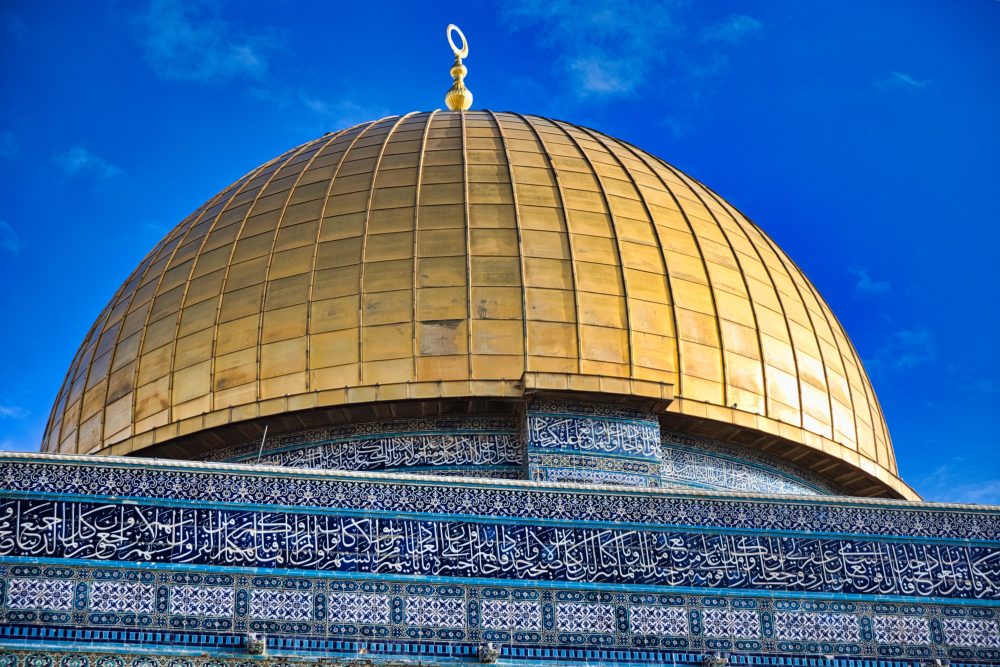
Jerusalem is divided into quarters with each ethnic group claiming a quarter. The muslims, Christians, Jews and Armenians each have their own area inside the old town with their synagogues, mosques and churches.
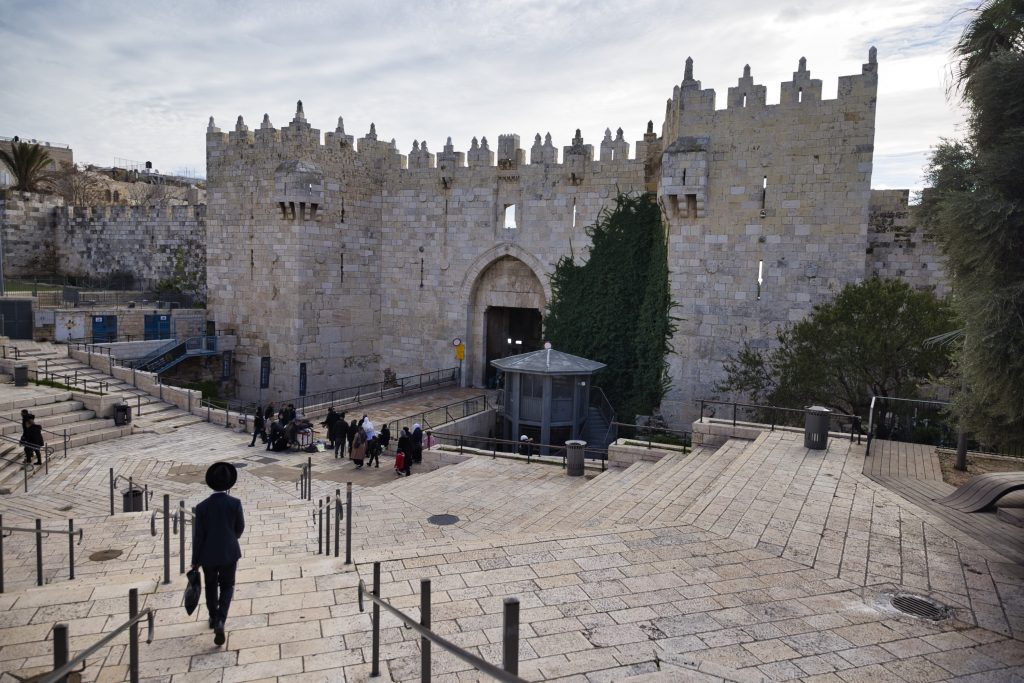
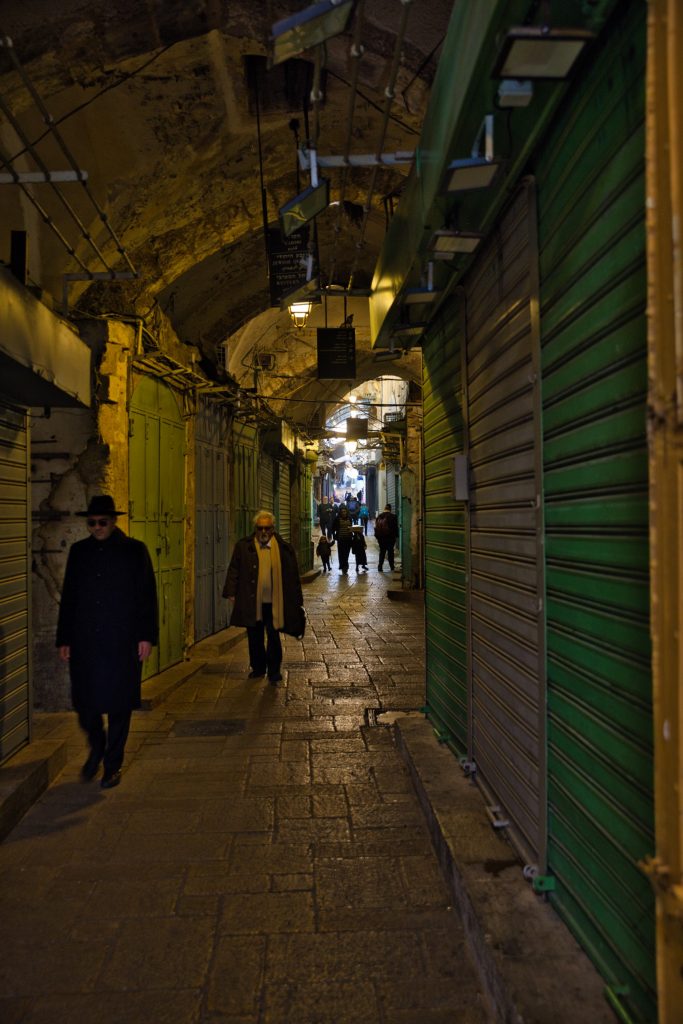
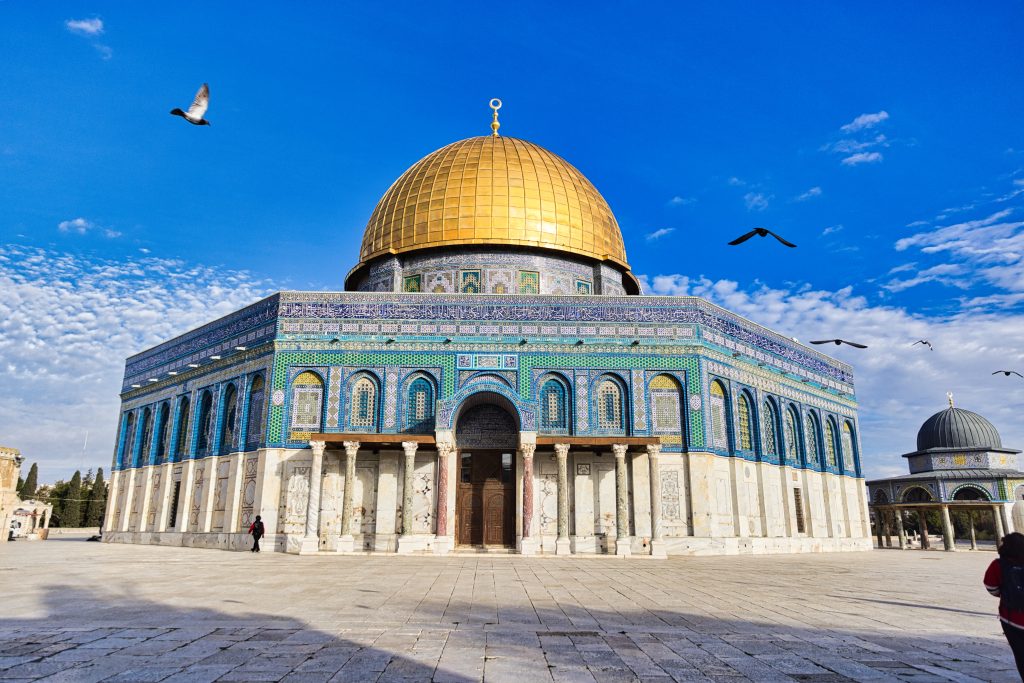
And then there is one vast area that is a holy place for two religions – Judaism and Islam. The temple mount or Dome of the Rock and Al Aksa Mosque.
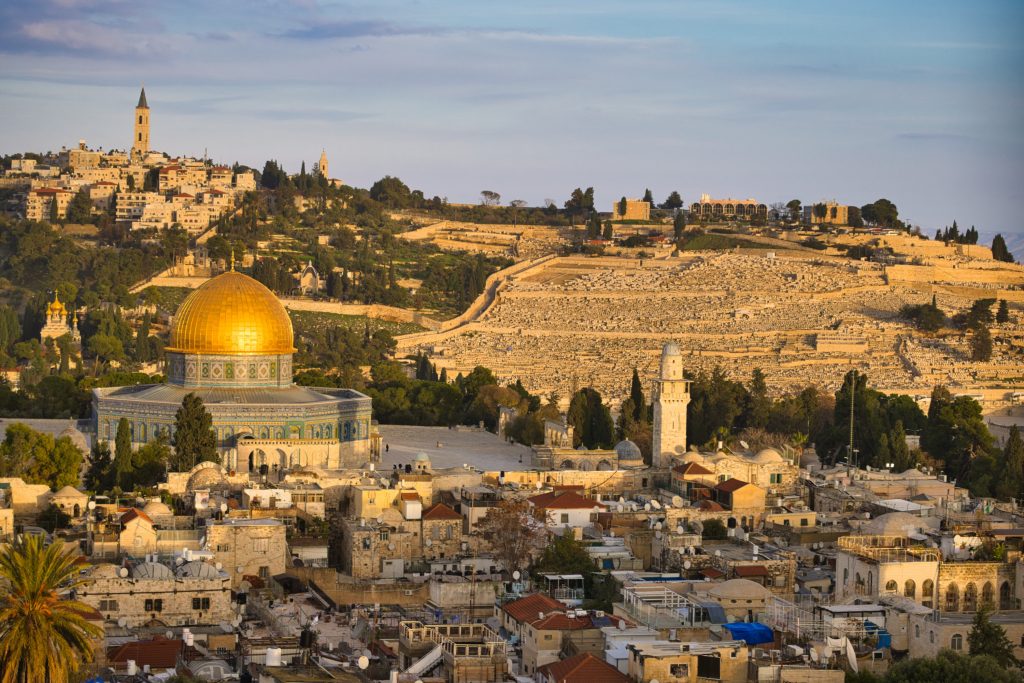
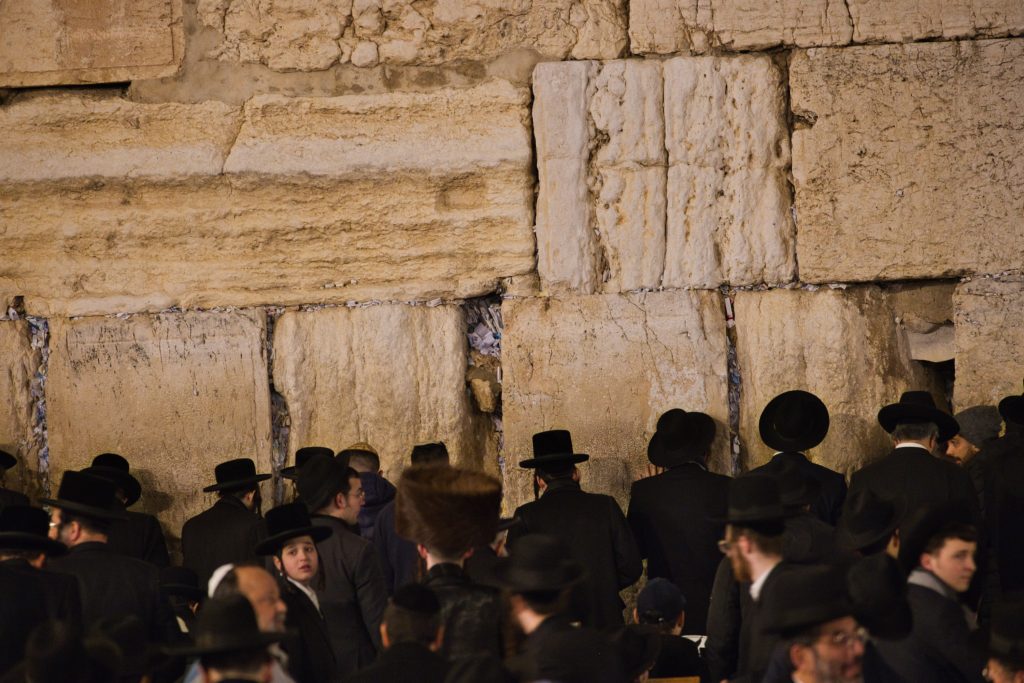
The western wall is right beneath the Al Aksa Mosque, one being the holiest place in the jewish religion the other being the third holiest place after Mekka and Medina. This makes for an explosive situation as each religion claims the right to the same place. Jews claim that on temple mountain is where their two original temples were standing and Muslims claim that Mohammed ascended from the rock that is inside the dome, into the sky. And we“ll never know the truth.
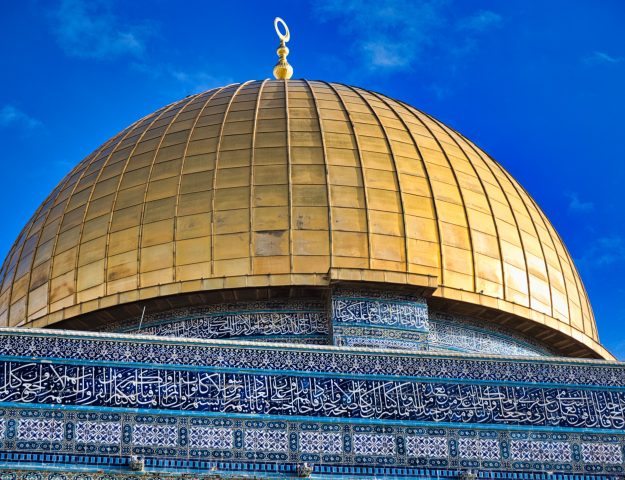
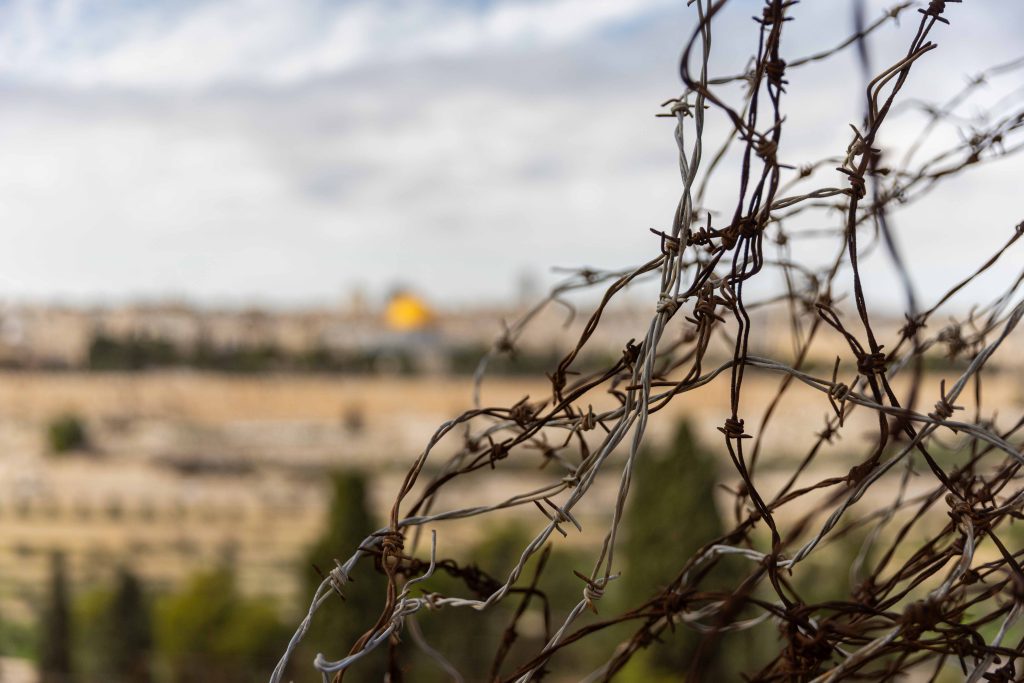
Today the dome of the Rock is a memorial around a rock on thr ground with a golden roof, and pretty colorful tile work all around. Non muslim visitors can only see it from the outside. The best time to visit the dome of the rock and the temple mountain is early morning. Visitors are only allowed to visit at certain times from 7 AM to 11 AM (winter) and one hour in the afternoon. That’s it. And it’s not easy to find. Simply follow the wooden Moroccan Bridge all the way to the end—this is where the security checkpoint is located – to the right of the ones leading to the Western Wall.
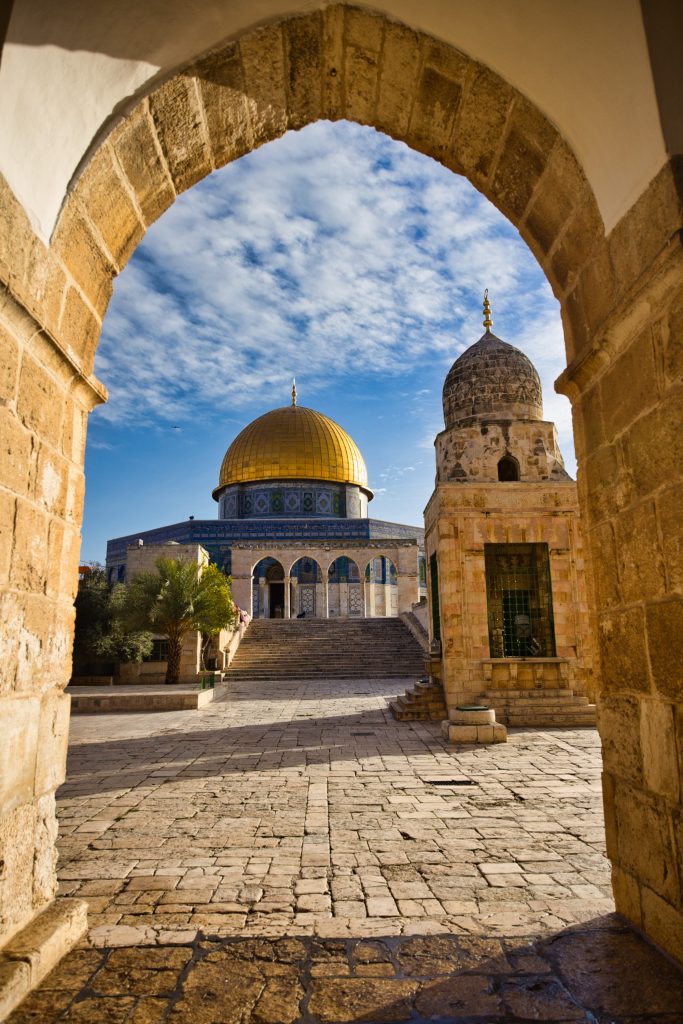
Jews are not supposed to go up on top of the temple mountain at all as they could step on sacred ground where one of the two original temples could have stood. Muslims are allowed to go at any time (if the Israelis don’t block all access) and on Fridays it is literally corwded as the Al Aksa Mosque alone acommodates 5000 people. Visitors are not allowed on Friday afternoons at all.
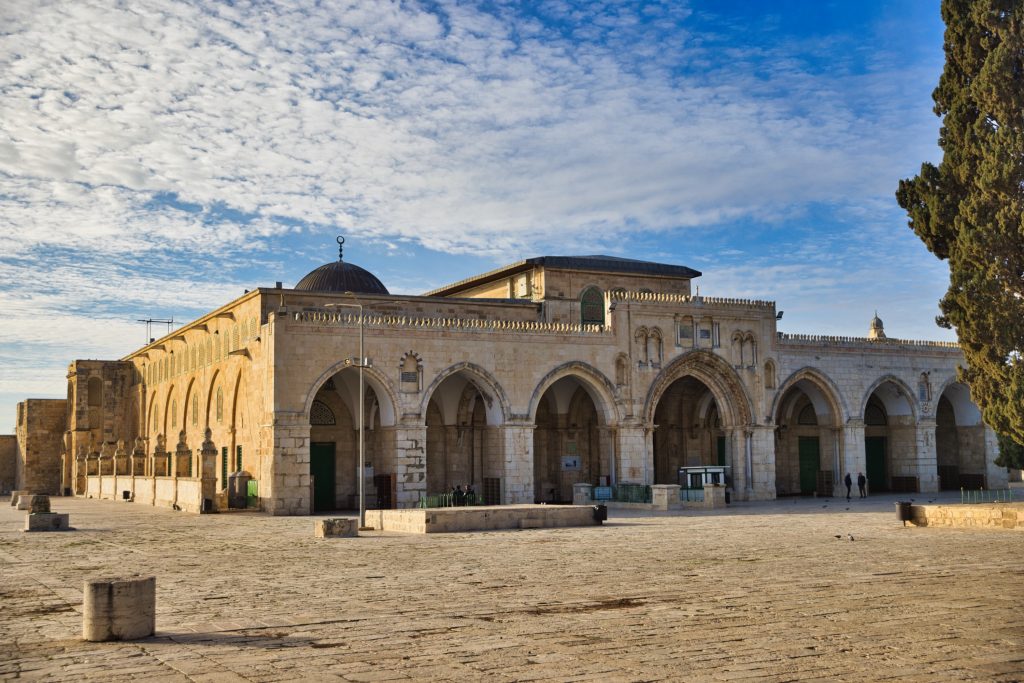
Access for western visitors is only through one of the gates, checked by heavy security and a wooden walk way leading up onto the temple mountain. One is not allowed to bring any sign or religious artefact onto the grounds and while the Israeli police controlls all access gates, the Jordanian military forces control the temple mountain on top. When we were there all looked peaceful but as soon as there are any signs of problems, the Israelis close off temple mountain and if need be Jerusalem.
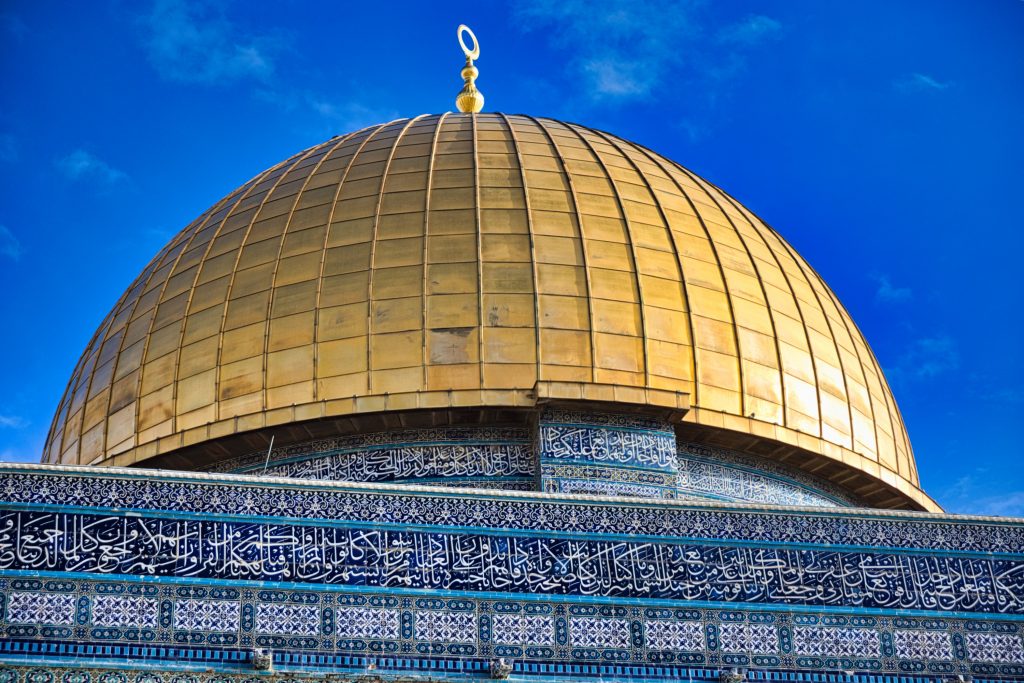
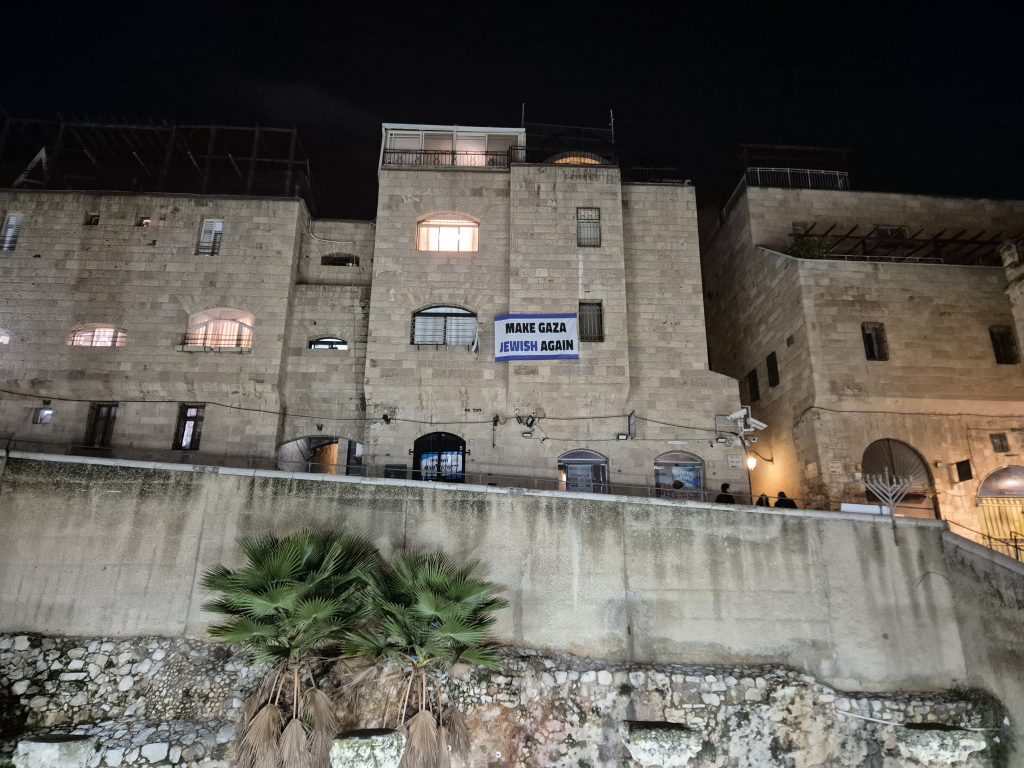
Our feeling was that since the Gaza war unrests have been scarce and palestinians intimidated and each year it seems that Israelis claim more and more land and buildings that originally belonged to muslims before. We now see Israeli flags on some of the houses in the muslim quarter, we see small groups of ultra orthodox jews strolling the grounds of the table mountain with heavy Israeli police protection (which they are not supposed to do), there are petitions to tear down Al Aksa and the dome of the rock and to rebuild their two temples instead and of course many new settlements in the palestinian side of east Jerusalem. All that leads to a widening rift between the two parties with no end or solution in sight.
Nevertheless, it was worth seeing the impressive and beautiful dome and grounds bathed in the early sunlight at 7 AM and without any tourists. We admired the tile art on the walls and the peacefulness of the moment counting us lucky to live in a country without wars.
We exited through one of the other gates, meandering through the rabbit warren of small passageways back to our Hospice grabbing the car keys to make our way up to Mount of Olives.
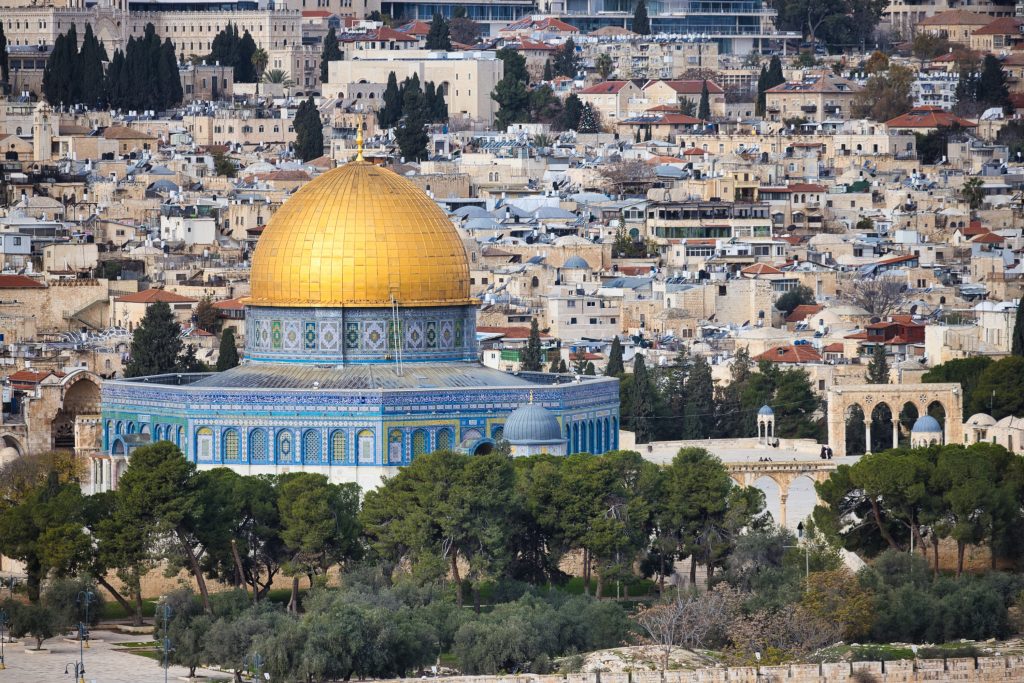
True to the name, there are many olive trees on Mount of Olives. It“s quite a steep drive up to the top and there we could admire the dome from the other side of the valley. Thousands of mostly Jewish graves line the hillside looking like a white\yellow rocky desert patch. This is a prized burial place for any Jew as it“s the prime and closest spot to follow the Messiah (once he comes) to the temple mountain.
On our way down we visited various churches that have been built during various centuries by different christian confessions.
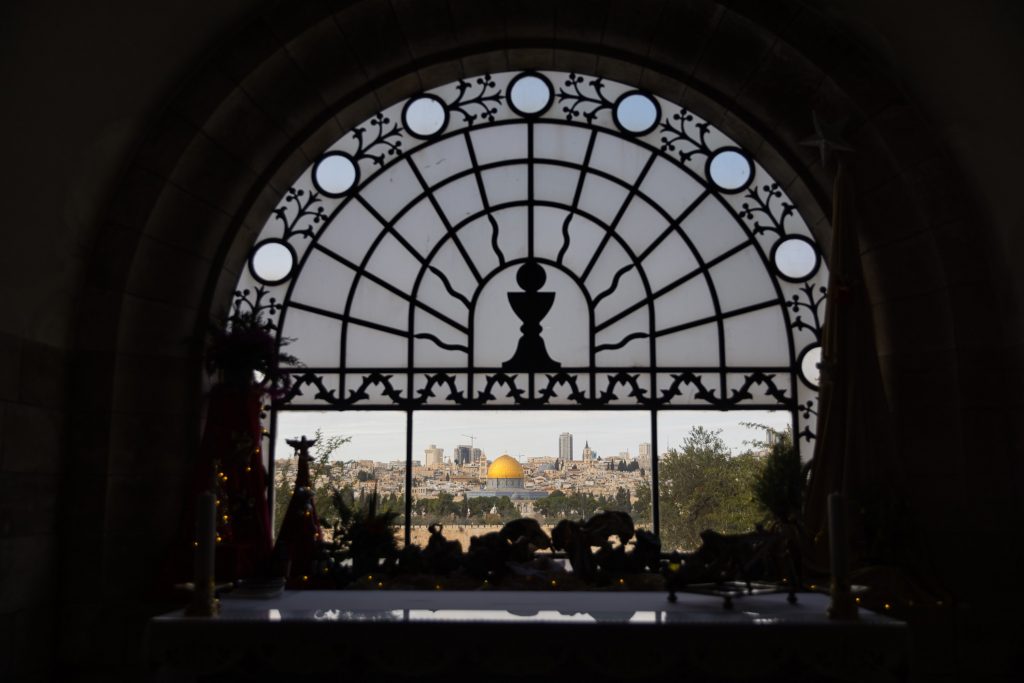
Parking our car at Jaffa gate this time, we decided to walk the ramparts. This is possible across the entire length of the city wall with the exception of the temple mountain area. Countless rock stairs led on narrow ledges from gate to gate allowing intimate views into private terraces and areas of the city one usually does not get to see. It was literally several kilometers of wall walk ways and steps so by the end of it we were sore and exhaused from walking 25.000 steps/ 17 kms and stairs on one single day – always up or down as Jerusalem is one hilly city.
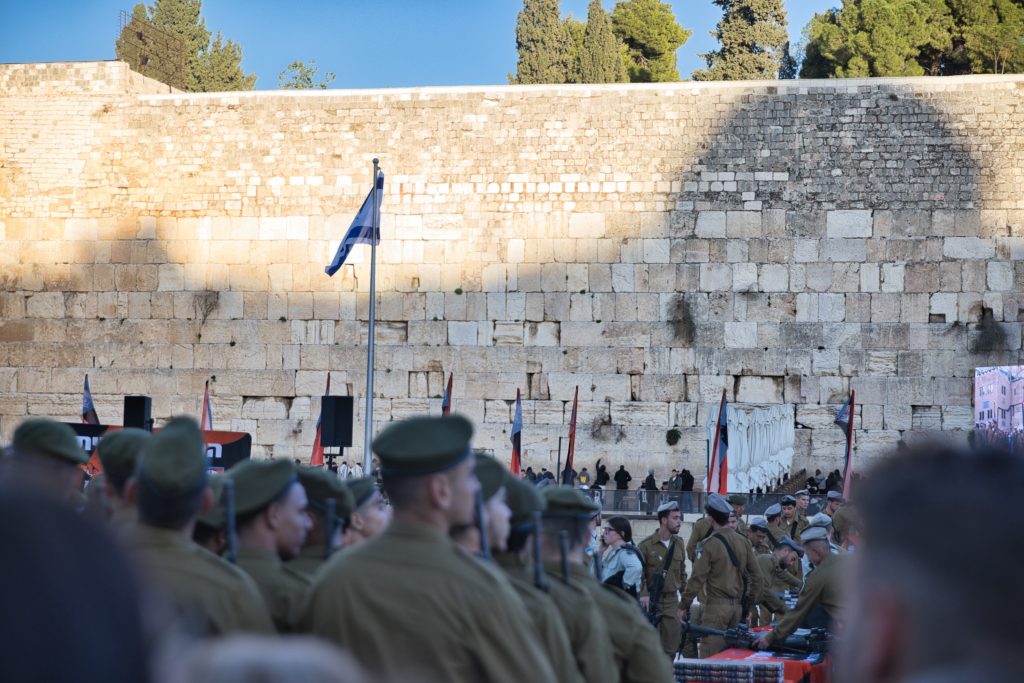
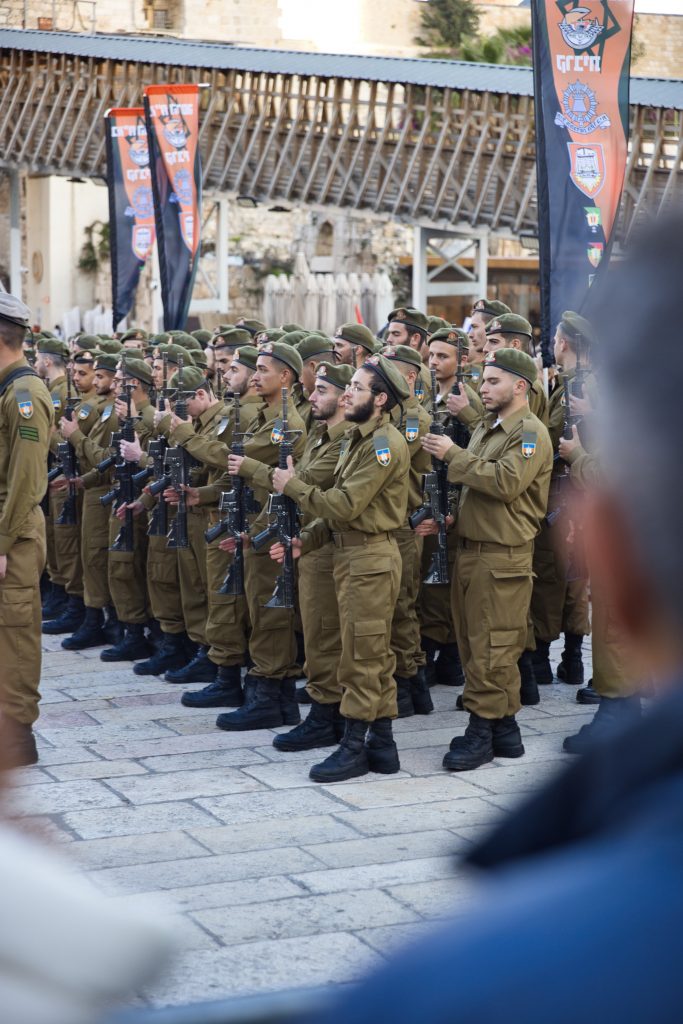
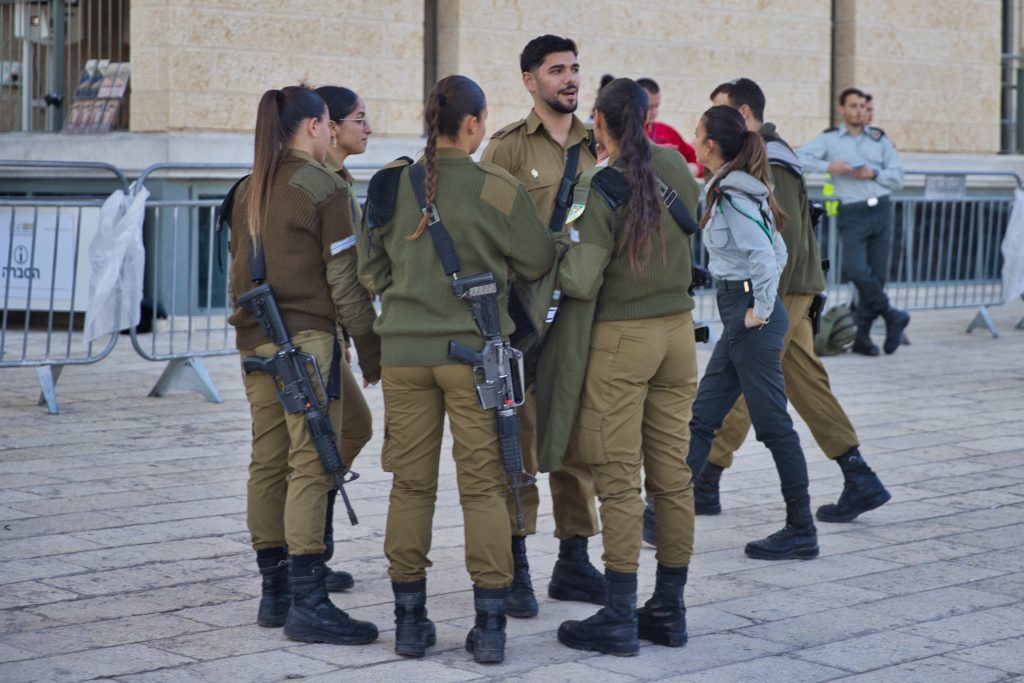
We passed by the Western Wall once more, but this time the plaza was filled with young recruits, apparently about to take their oath of service for Israel. The ceremony was noticeably larger than Chris remembered it from his visit some twenty years ago. In Israel, most Jewish citizens are conscripted: men serve around 32 months, women about 24 months, making military service a visible and formative part of everyday life.
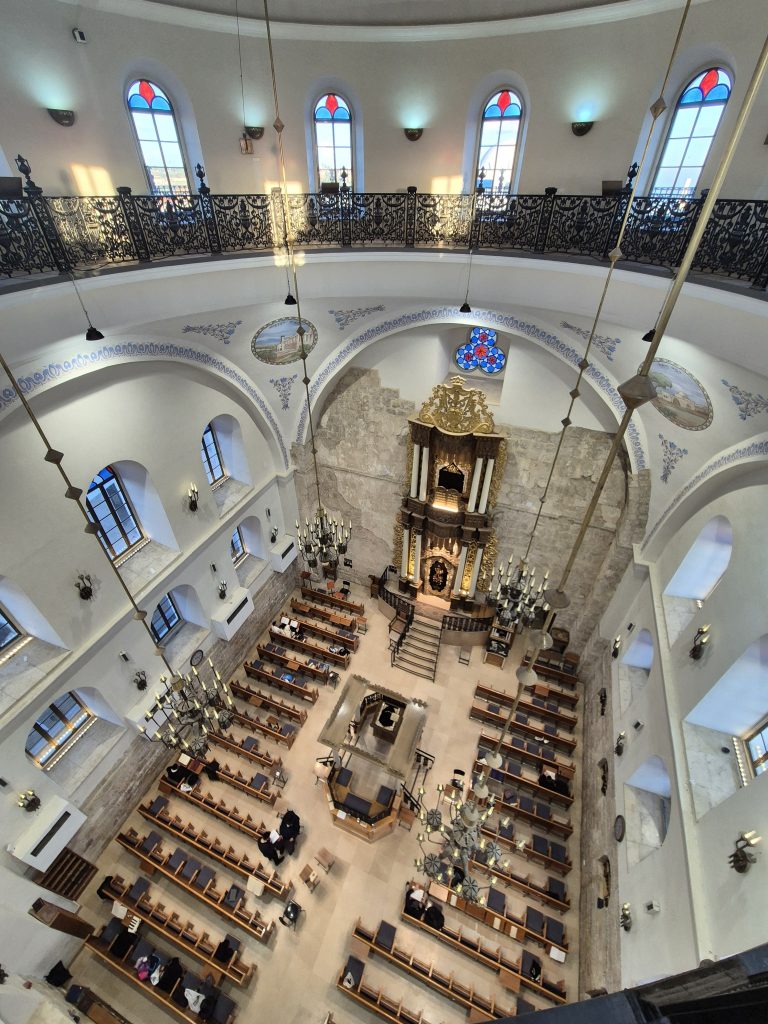
After that, we finally visited the Hurva Synagogue, a reconstruction, as the original building was destroyed by the Jordanian Arab Legion in 1948 during the fighting over the Old City.
The synagogue has a viewing terrace that offers for 22 NIS (6 Euro) beautiful views over Jerusalem’s rooftops—well worth the climb.
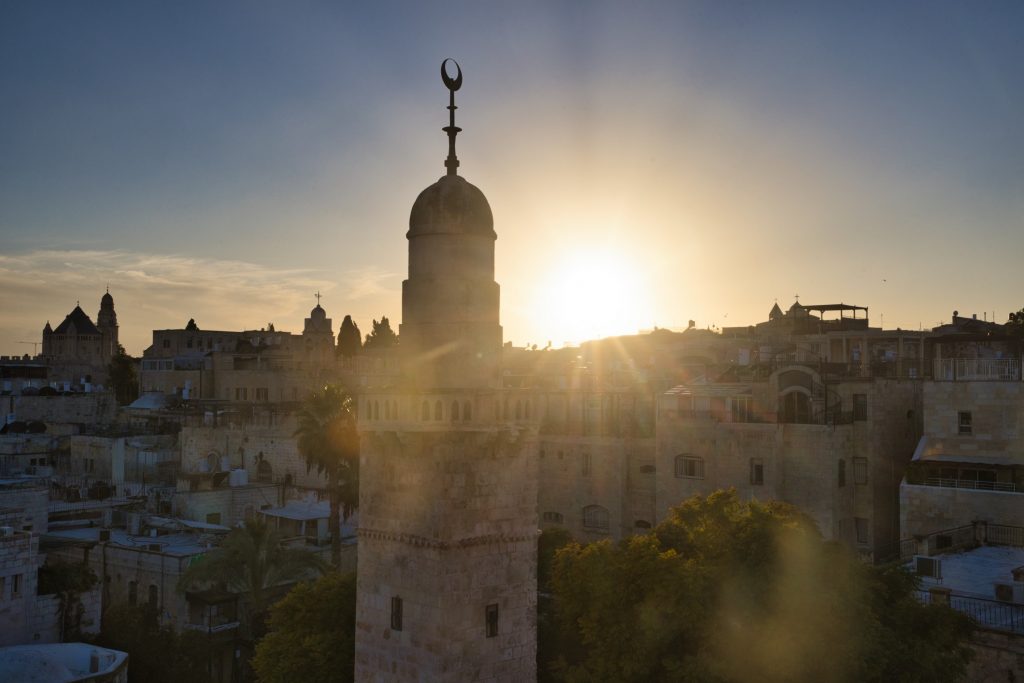
One beautiful sunset later and dining at a small Lebanese restaurant, we felt we are too pooped to stay up late despite it being December 31st. In Jerusalem nobody celebrates the new year, no fireworks or big dinners, so we are going with the locals and just go to bed early and sleep through into the new year….
Find Chris’ 2020 Jerusalem blog with some additional pictures & details here and here.
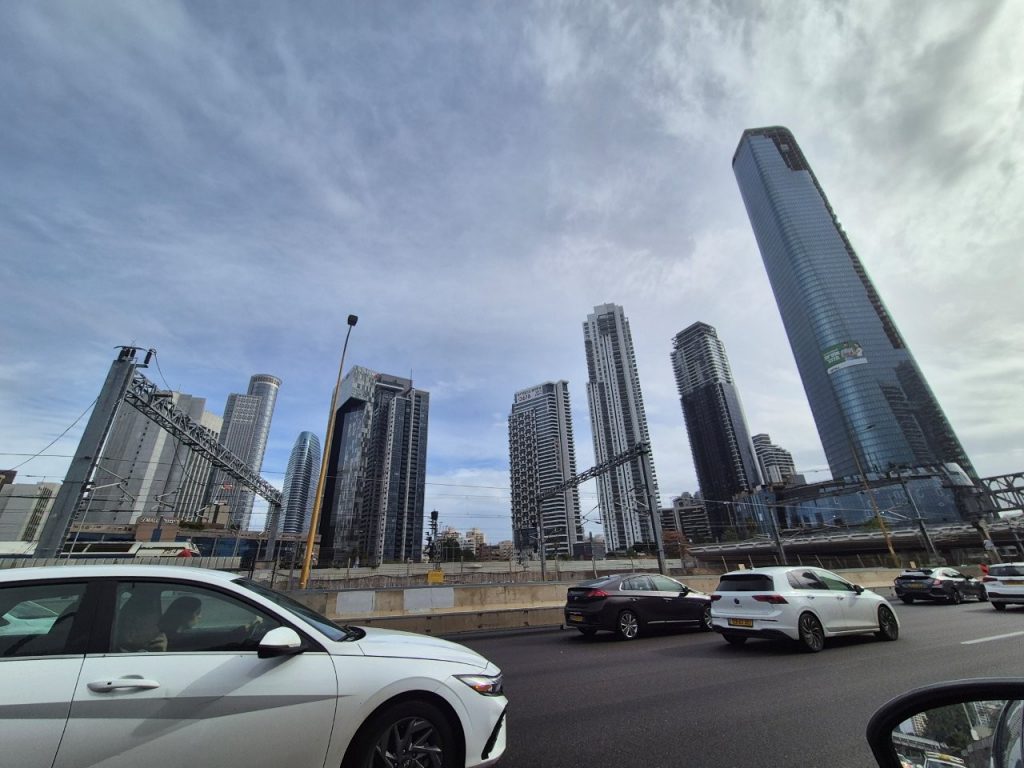
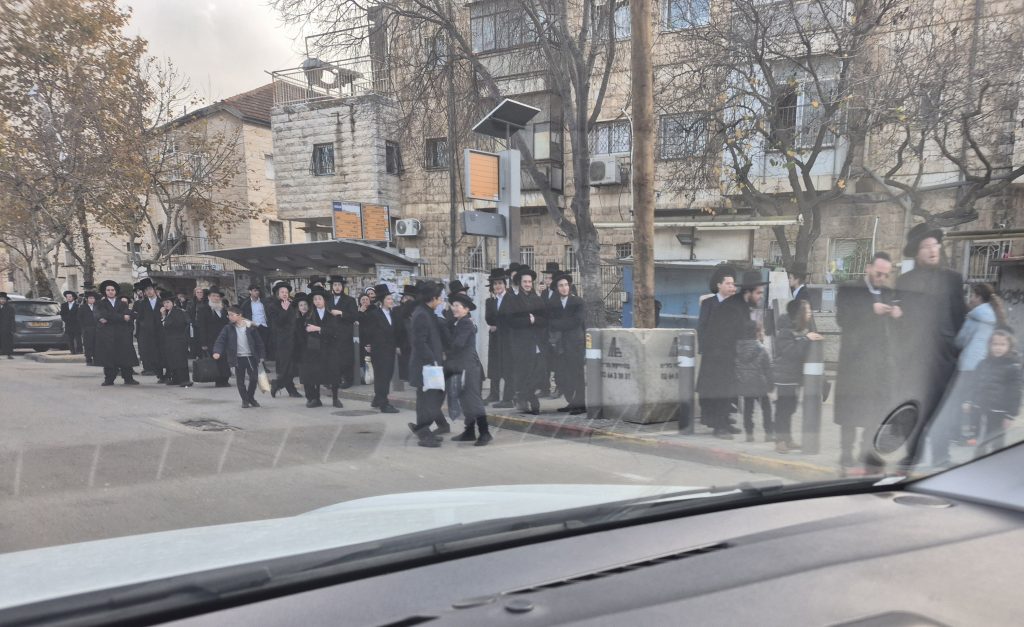
Jerusalem is only an hours drive from Tel Aviv. And driving into the city, one immediately thinks one is in a different country. While in Tel Aviv, people were walking around like in any Western country, here the contrast is stark and visible on each street corner, on each bus stop. Ultra orthodox jews everywhere. The men recongnizable by their black outfits, two long temple locks, Kippa or other head coverings, knotted strings hanging from their trousers and the women in very demure attire. Always wearing a black, long skirt, head scarf or often a wig, no bare skin. It seems to be true what the Israelis say: Party in Tel Aviv, Pray in Jerusalem and work in Haifa.
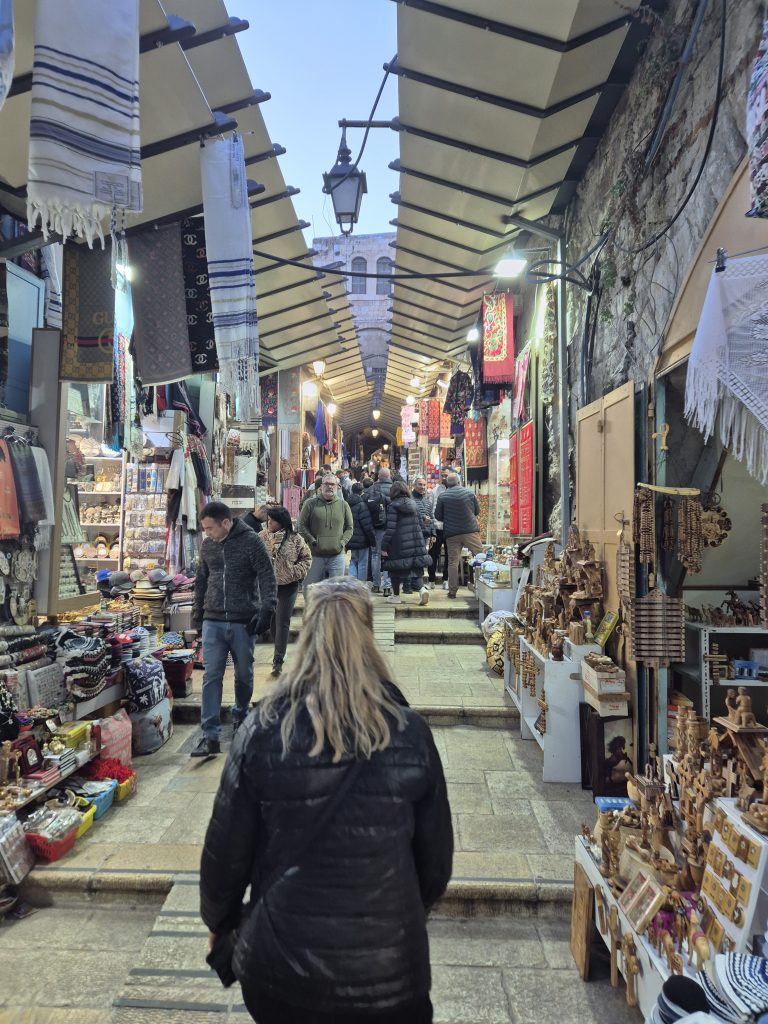
We parked our car close to the Damascus gate, one of the most beautiful gates leading into the city and only a few minutes walk to our hotel. Ordinary folks have to walk into the old town, as the streets are very narrow and through many only little motorbikes can pass. Walking through Damascus Gate felt like walking back centuries. At 3 PM the narrow street was bustling with pedestrians, little market stalls right and left, offering their wares, and oriental smells wafting throughout. It“s the middle of Muslim quarter and you can feel the energizing atmosphere of people milling about shopping.
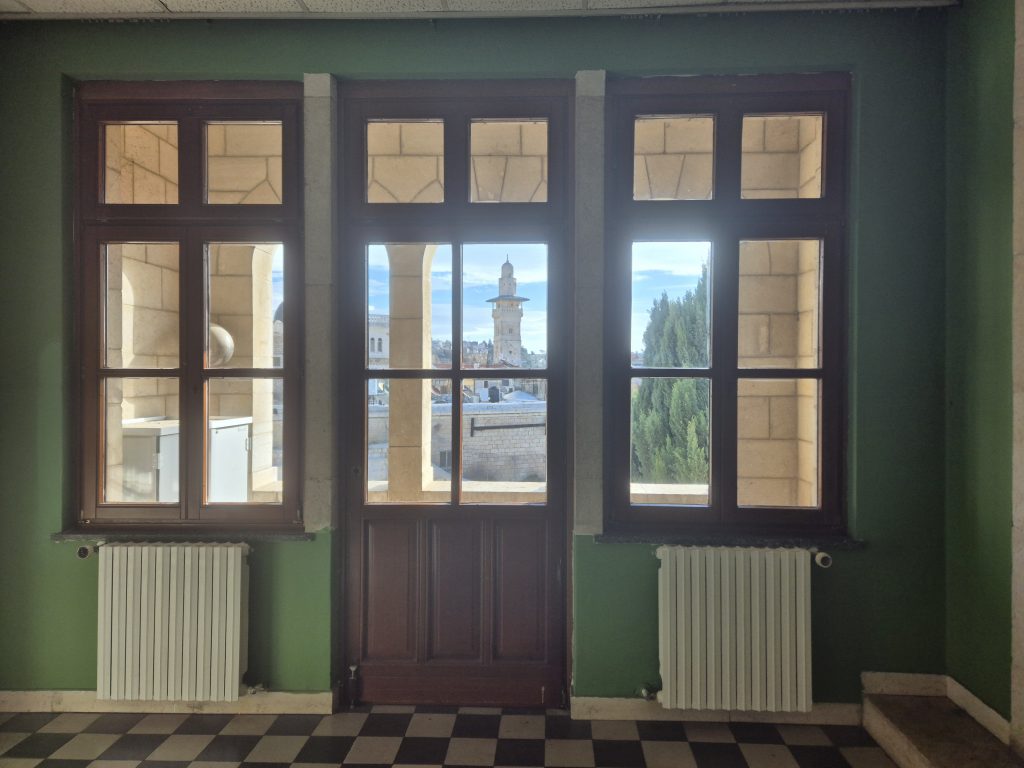
We were lucky to get rooms in the Austrian Hospice, a jewel of a large historic building, beautifully kept in excellent shape and supported by an army of Christian volunteers who are here for a few months in exchange for a memorable and humbling exprience living in such memorable surroundings. The Austrian Hospice is a catholic pilgrim guest house run by the archdiocese of Vienna … and many volunteers. It is weird to get served Meindl Coffee, see Schnitzel on the menu and being served a Linzer Torte as dessert. The rooms are large and basic, what was good for the Kaiser Franz Josef I was certainly good enough for us. Plenty of European nobles stayed here when visiting the holy land.
More pictures here.
After checking in and looking at a very nice sunset to come, we decided to head out immediately to a high point from where we could have a good view of the old town and the dome of the rock bathed in golden light. Chris was here several times so he knew that the tower of the redeemer church was the best spot for great sunset views. Seems still a secret, as we were the only ones climbing up hundreds of narrow steps until the top platform. But it was well worth it. The views from atop were stunning. The dome of the rock glinting golden in the distance, the Mount of Olives serving as a perfect backdrop. We“ll get back to the dome in tomorrows post.
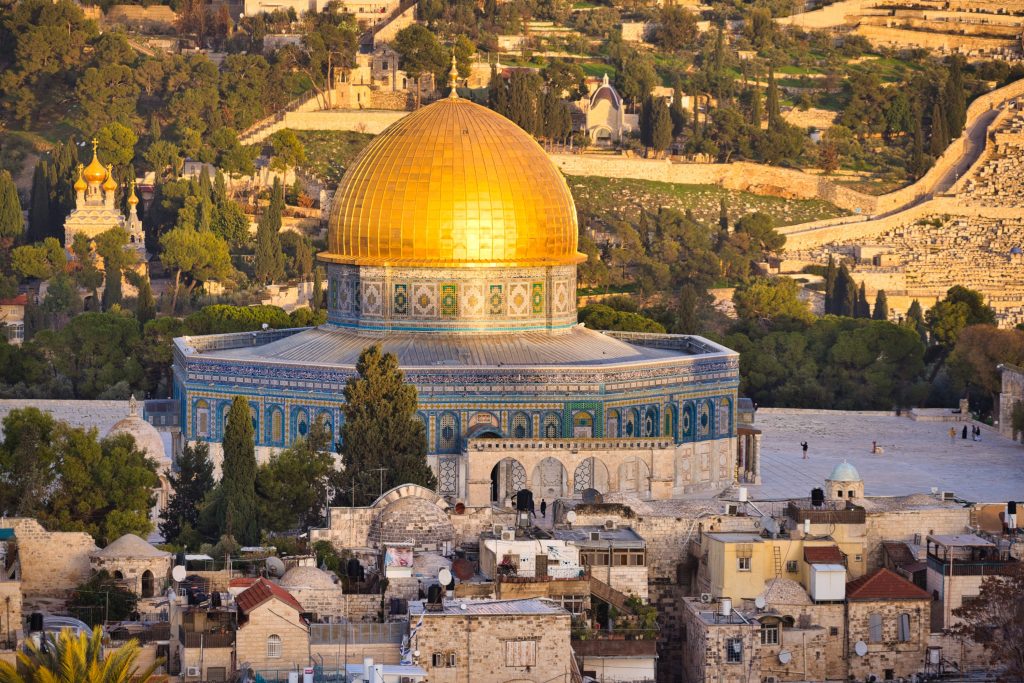
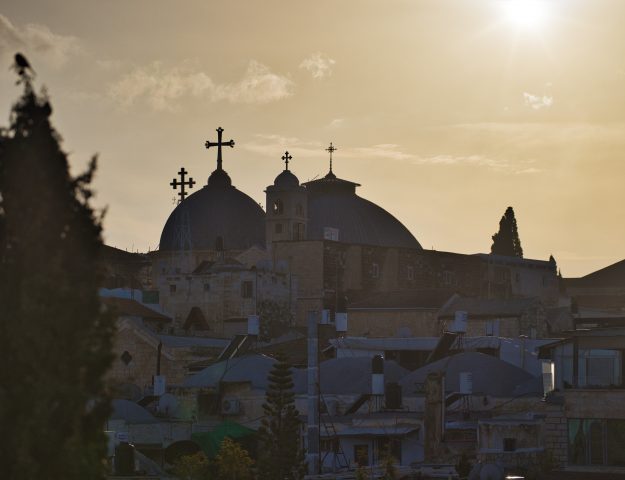
It is hard to top that sunset view. But equally memorable was our visit if the church of the holy sepulchre. What a strange constellation. Four different christian fractions share the same grounds and churches in very complex ways. First the Etiopian Christians, we went through the back door of the little Ethiopian church.
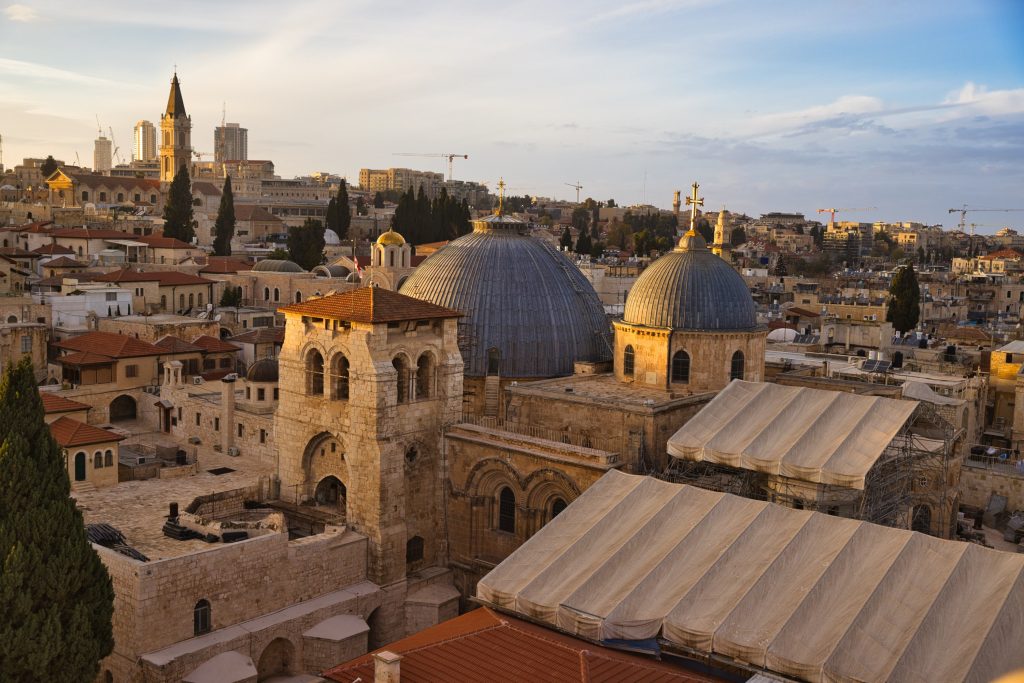
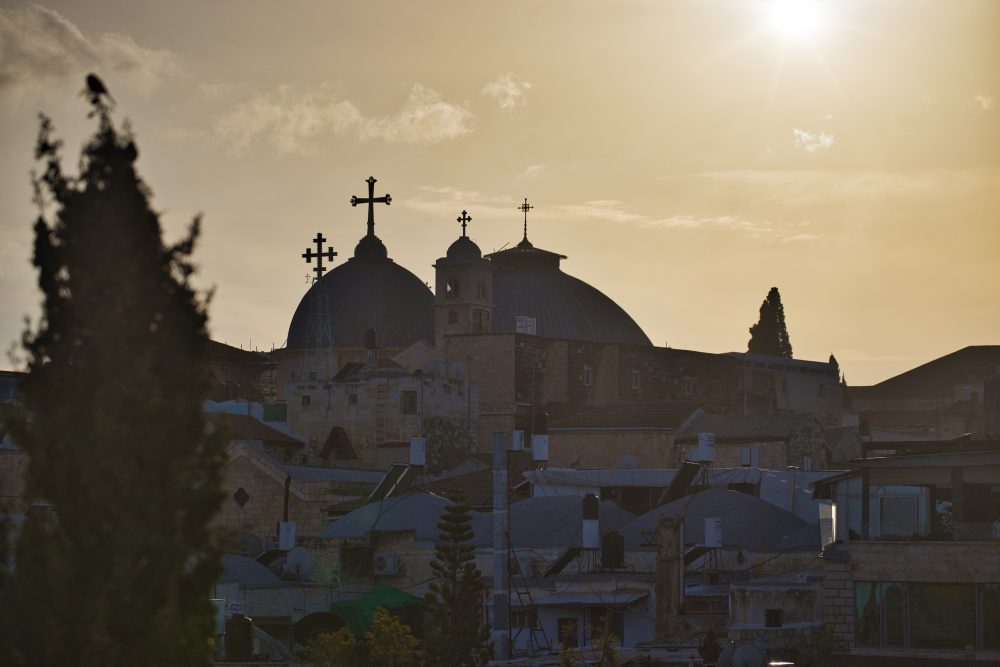
The Ethiopians were originally not part of the main movement but still wanted to partake. They therefore settled on the roof of the main church with two little chapels like an add on to the main church. The three parties controlling the church now are the Franciscans representing the roman catholic strain, the Armenian apostolic church, and the greek orthodox church. Each of the confessions has areas and times for prayer in the main church and when one confession leaves, the other has many ritiuals to „purge“ the air before their disciples arrive for prayer. When we were there the Franciscans were in charge.
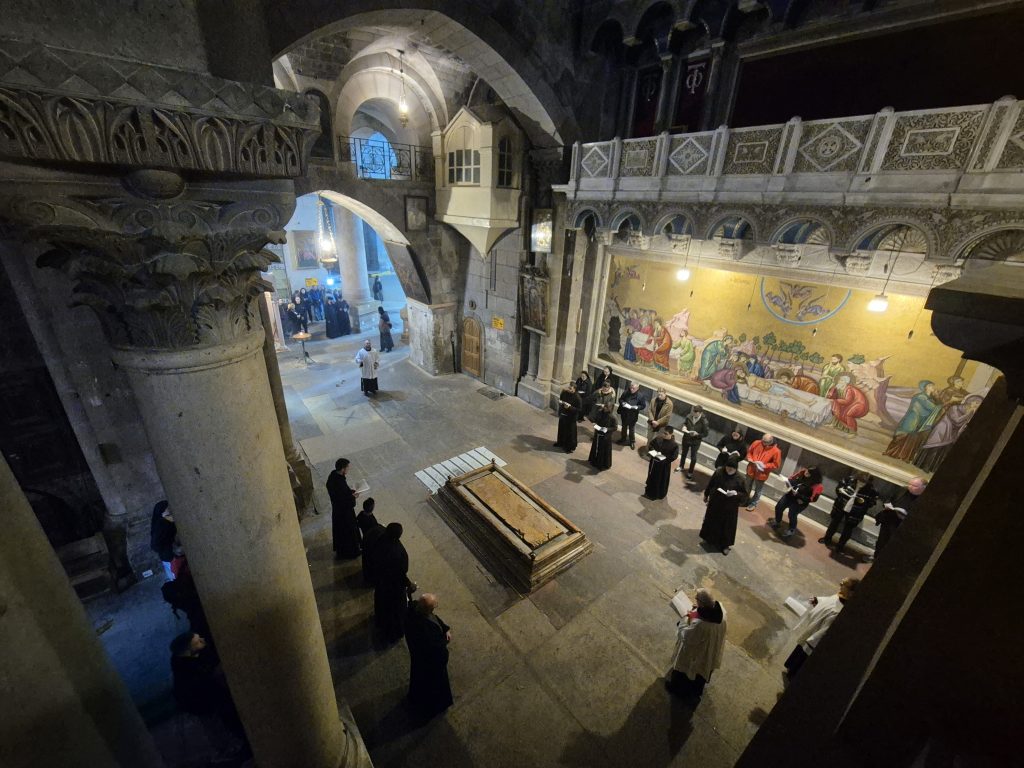
The church itself is surprisingly vast inside with many side rooms and chapels dedicated to various Saints. Here is where Jesus is said to be crucified, taken off the cross to be prepared for burial and also where he was buried and resurrected again.
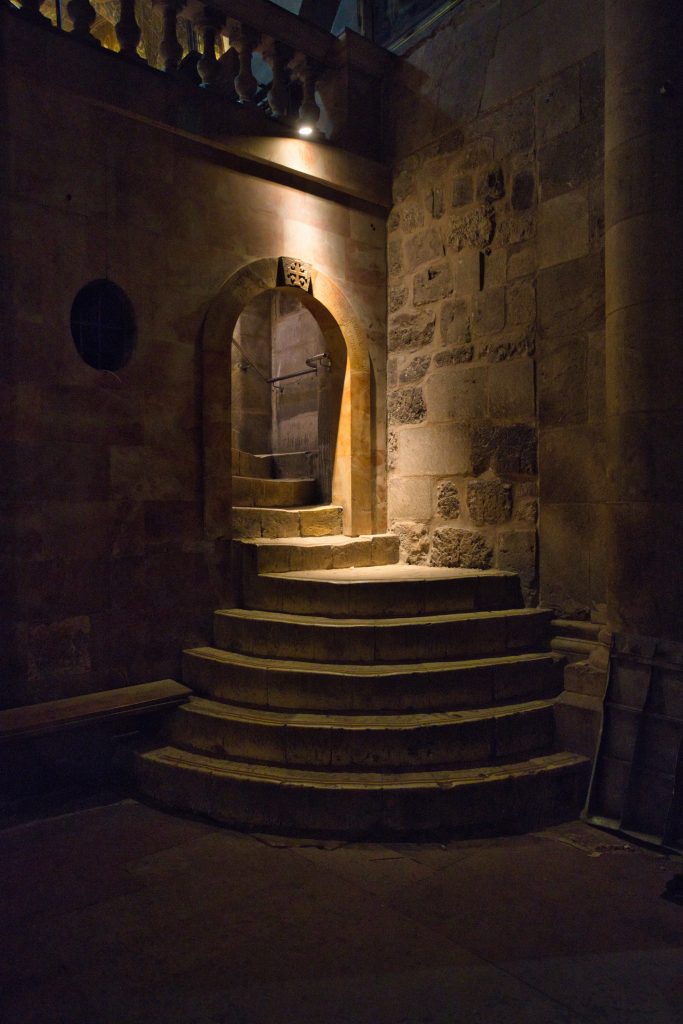
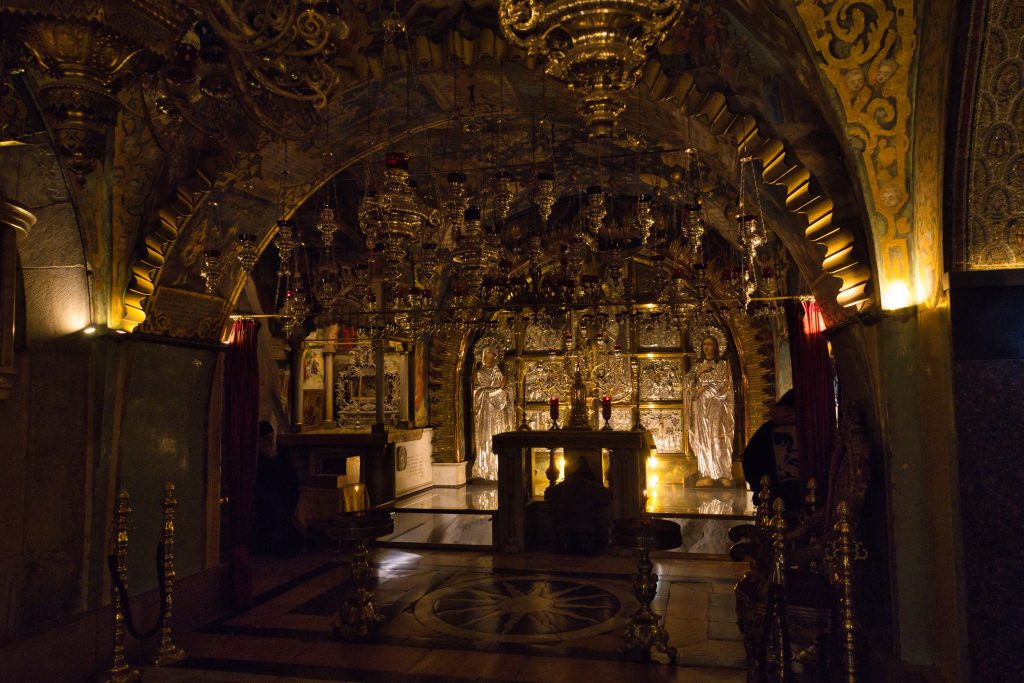
One could clearly see how deeply emotional many of the visitors were to be here in person at the very place where they had read and heard so much about during their lives.
We spend quite a long time wandering through the different rooms and parts of the church, before making our way outside and down to the westen wall. It is amazing to pass from one religion to another in a mere few hundred meters. Black robed jews – men and women – flooded to the western wall, down by the temple mountain. A sea of black with the occasional colorful tourist bobbing their head out of the masses, It was prayer time and the western wall was packed several rows deep with people. Men on the larger left part and women on the smaller right side of the wall. With my blond hair and trousers I felt a bit out of place, but I did not feel uncomfortable.
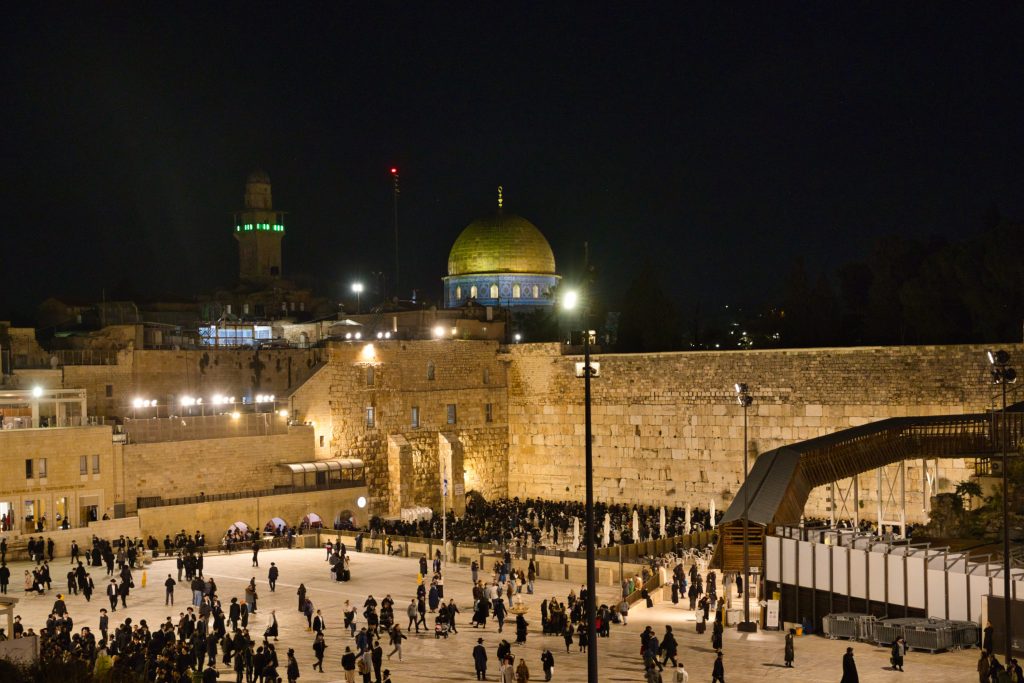
Then at 5 PM the Muezzin started calling and all three big religions felt condensed into one city with so much history, living side by side sometimes peacefully, sometimes not. And that“s how it was for hundreds of years and probably will be for the next hundred years.
Tired from all the up and down walking across town, we decided to have dinner at the Austrian Hospice and settle into bed early. What a memorable first day!
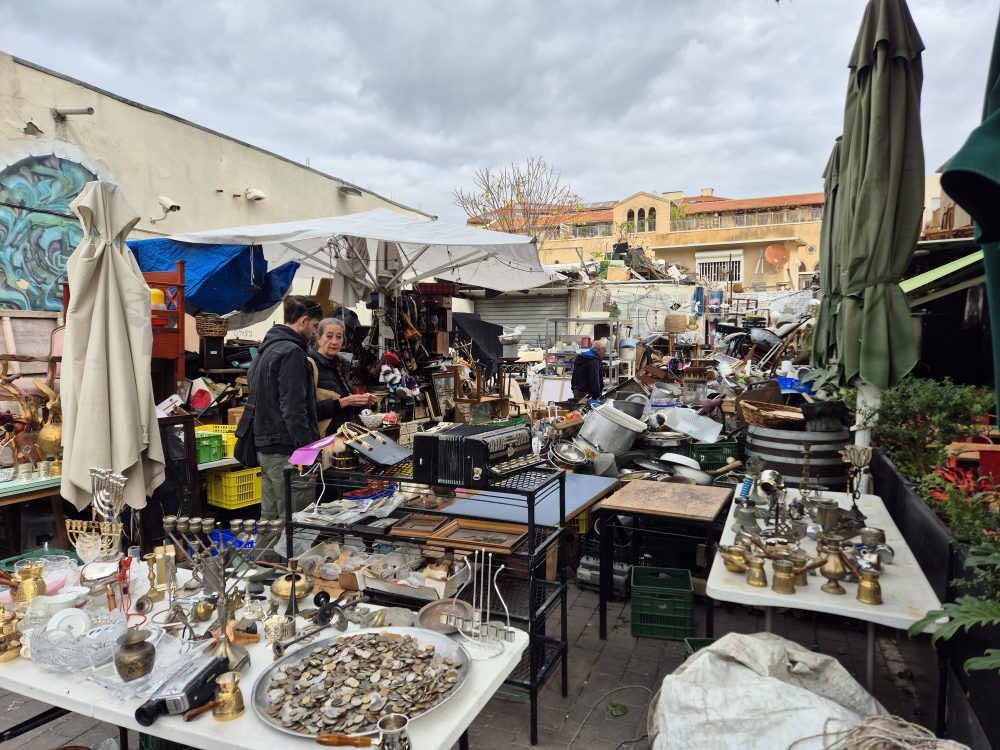
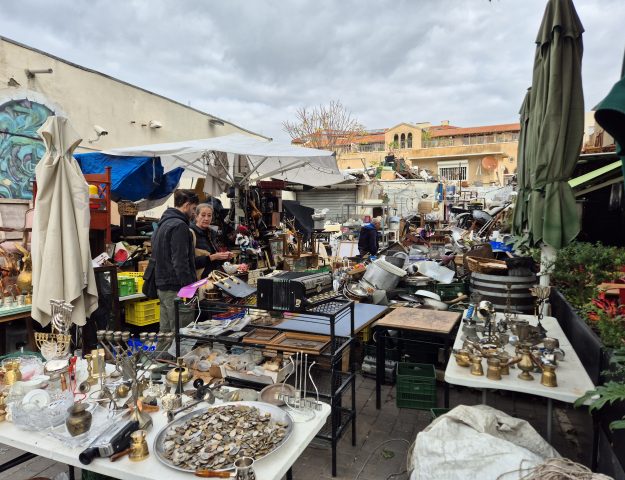
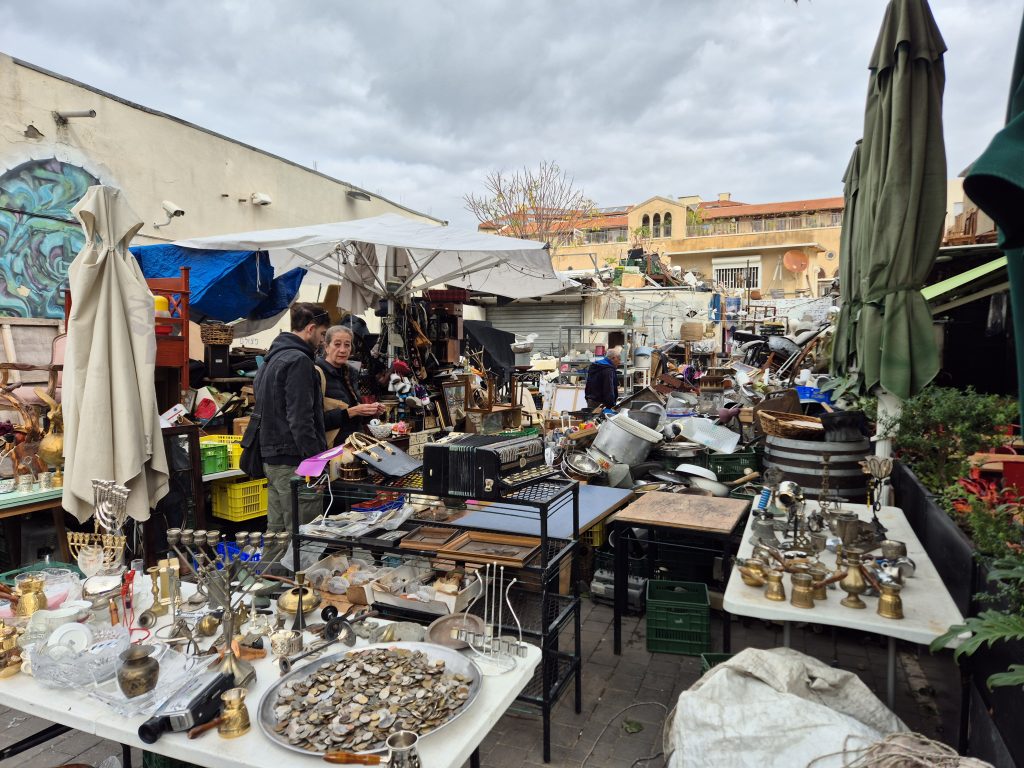
Luckily today no rain was forcast. After our coffee at a local coffee shop we decided to head to Jaffa to stroll through the famous flea market. Our usual parking karma did not kick in and so we parked in a garage that cost us more than our lunch. Just a minute from the flea market we made our way through what looked like heaps of (s)crap.
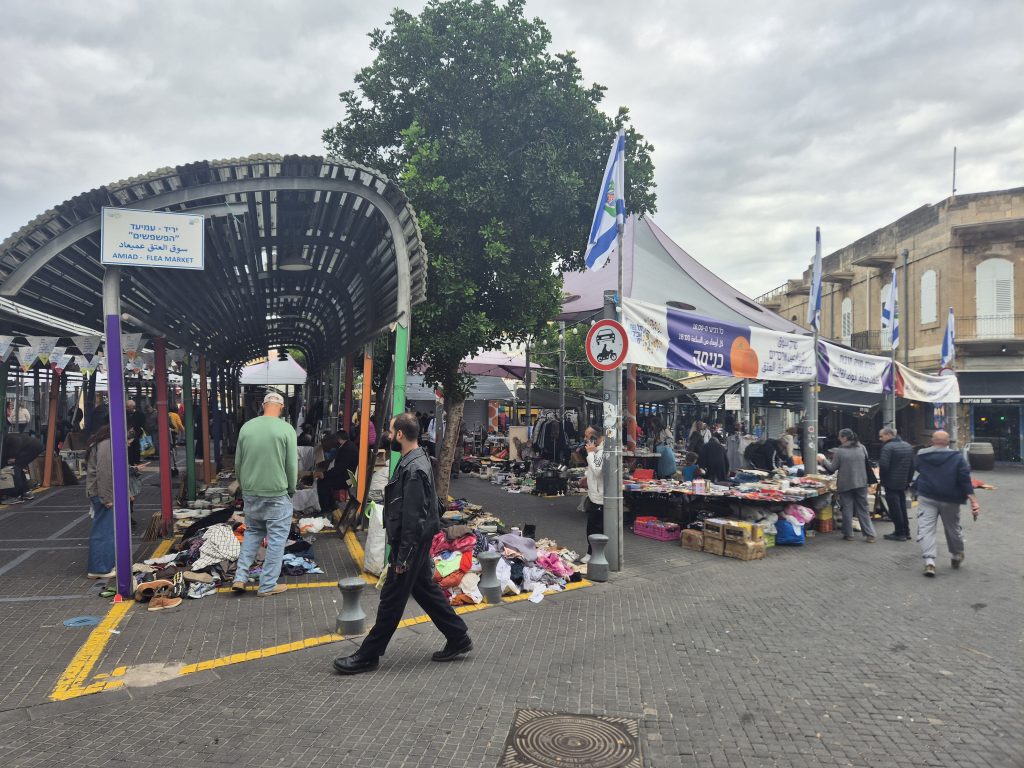
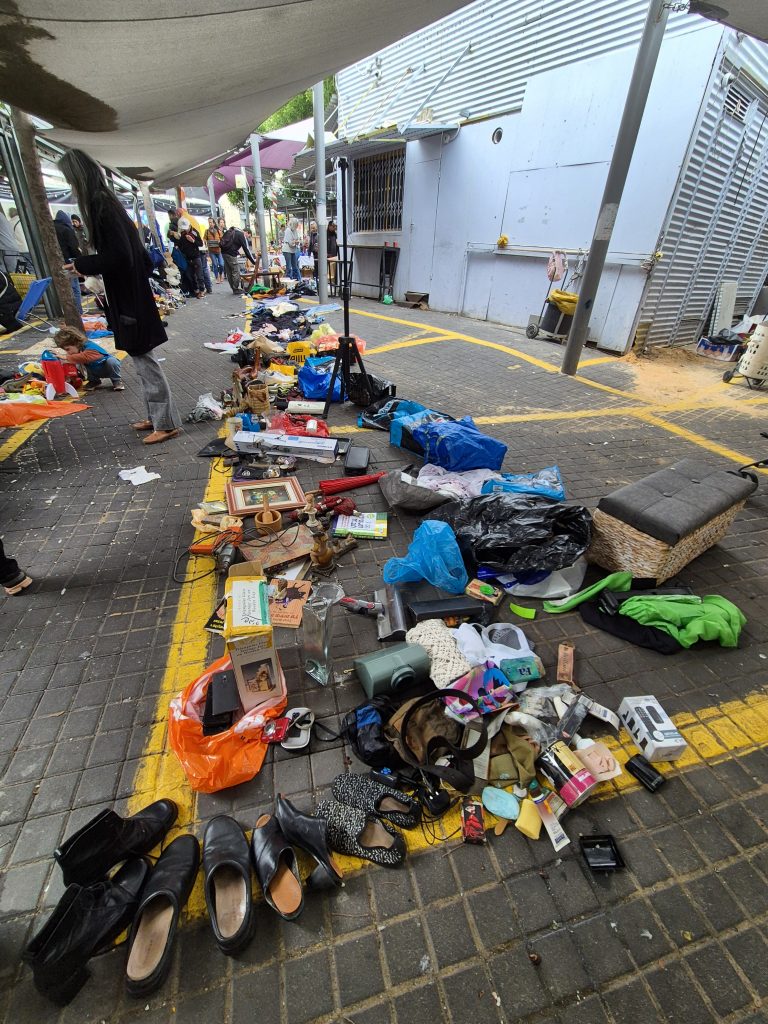
It was quite disappointing and we soon learned that the antiquity shops had nicer stuff than the flea market itself. Esther found a set of nice learning cards for our Grandchild Katharina, but that was it. No further finds. Chris gave up soon and plonked down at a coffee shop, while Esther kept hunting for a little horse or donkey, one thing that we gotten used to bring with us from any foreign country. No luck here either.
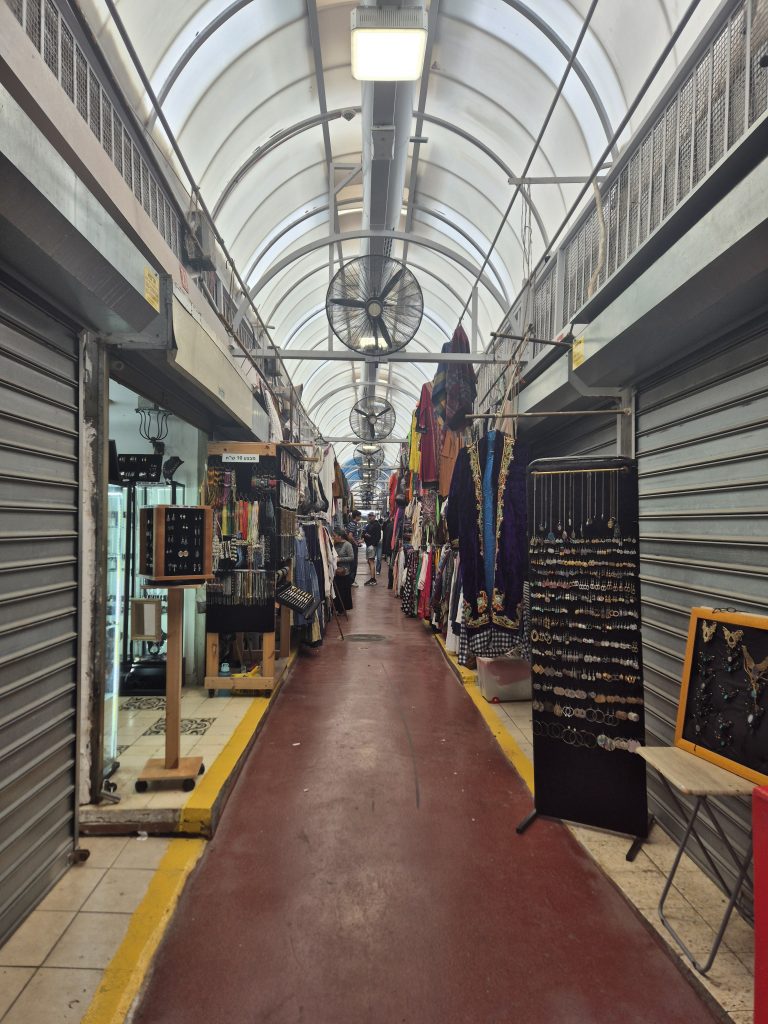
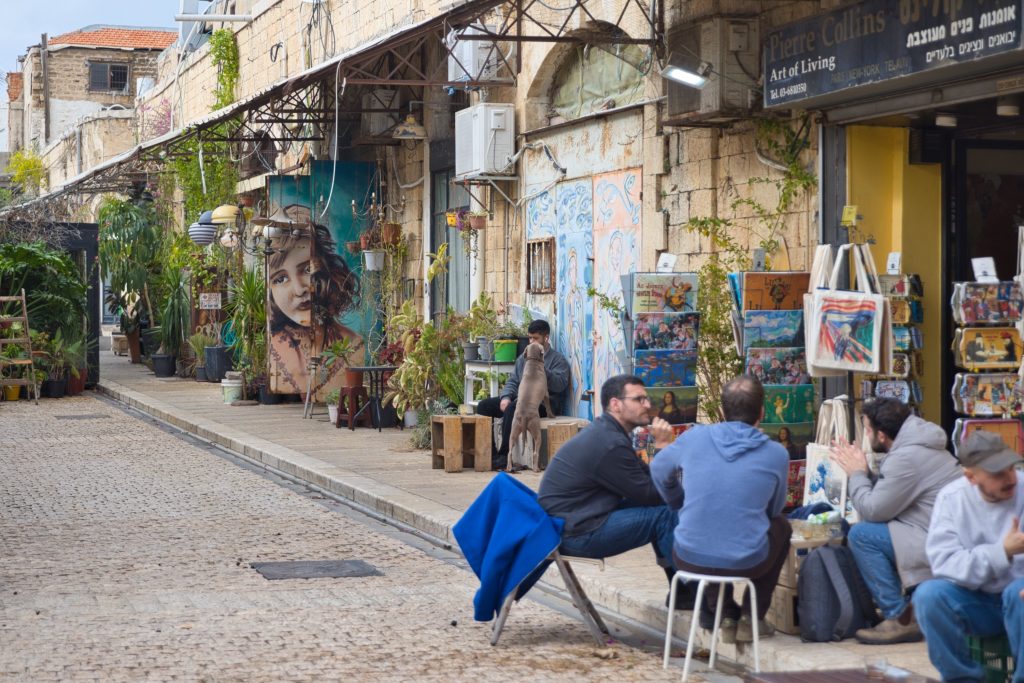
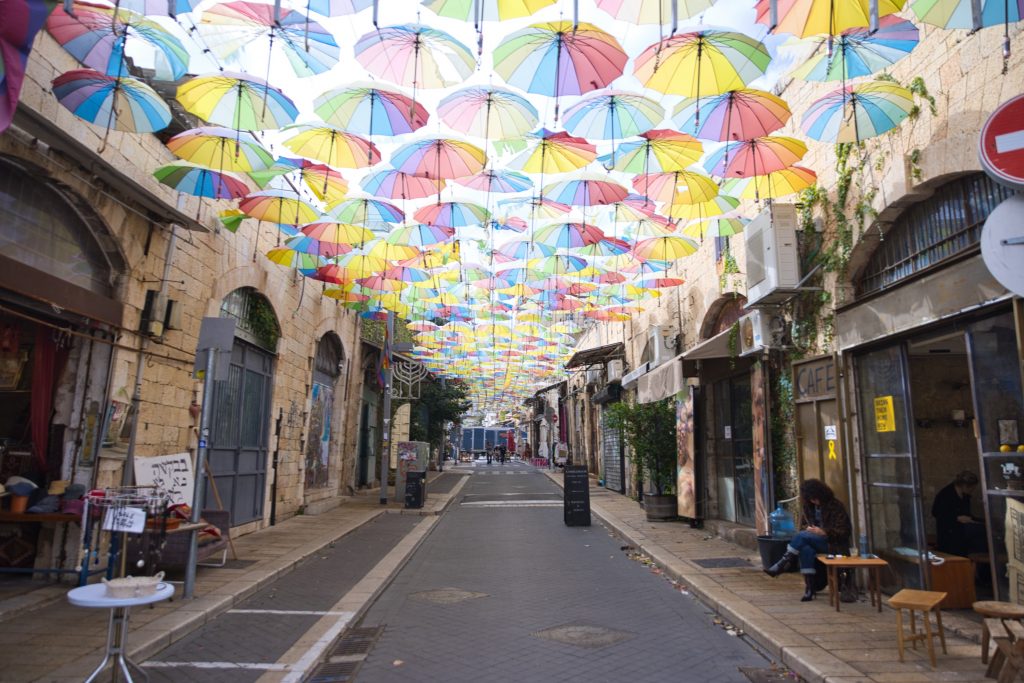
We decided to wander around the little colorful streets instead. See the weirdly out of place clock tower and the making our way to the most famous hummus street food shop according to our research. It took a while to find Ali Caravan, but we arrived at the right place. It was packed with locals and it served only two plates: plain warm hummus with fresh onions and bread and a hummus/ fuul mixed plate equally with fresh onions and bread. Fuul is a brown bean paste we already had eaten in Egypt when we visited. It was a very simple yet delicious lunch and lots of family pictures and printed accolades were hanging on the walls.
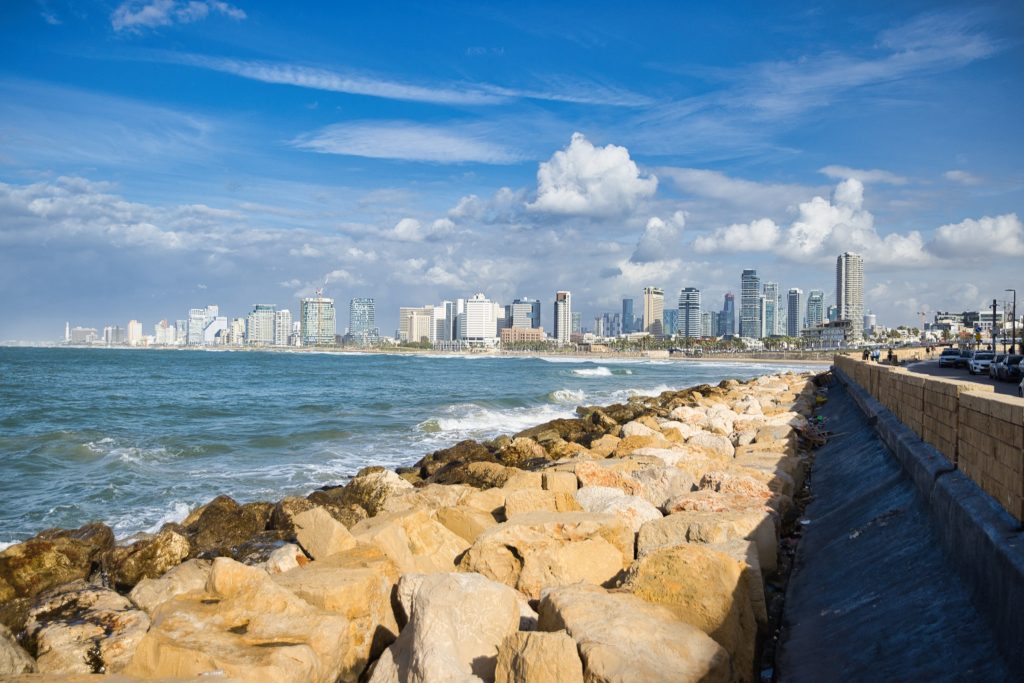
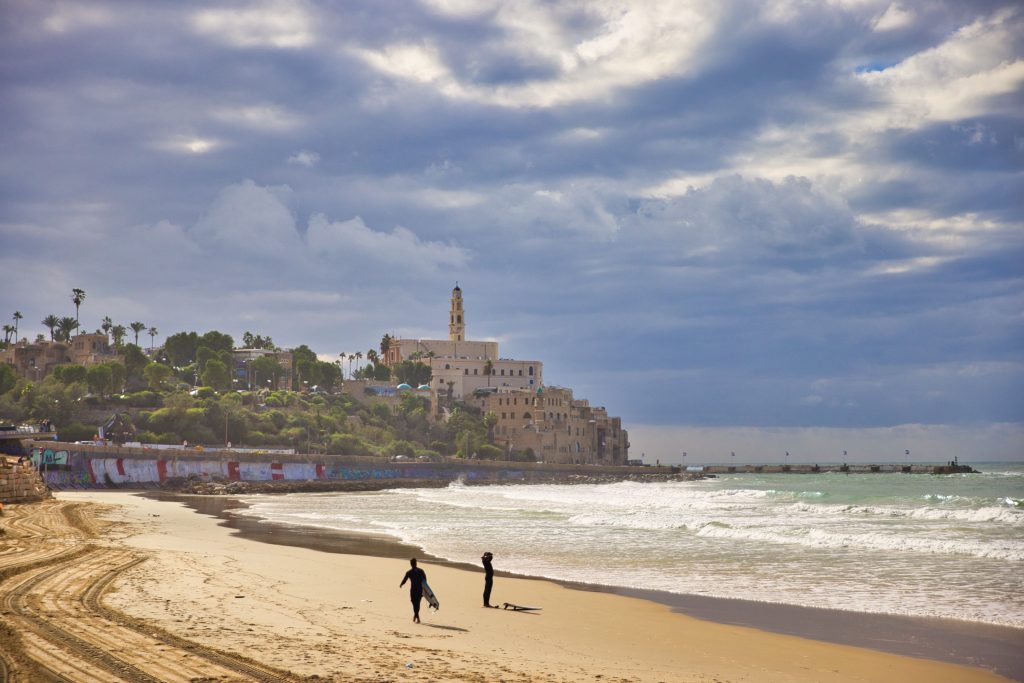
We decided to walk back by the sea side, strolling past Jaffa harbour, having a wonderful view onto the Tel Aviv skyline. It’s called the most scenic beach city and it certainly prettier than Miami. Clean sandy beaches all along the water front, many surfers bobbing their heads in the water, but too cold for normal swimming in December.
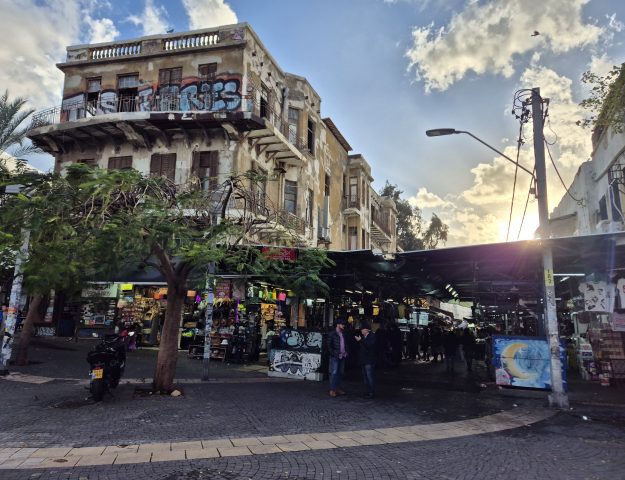
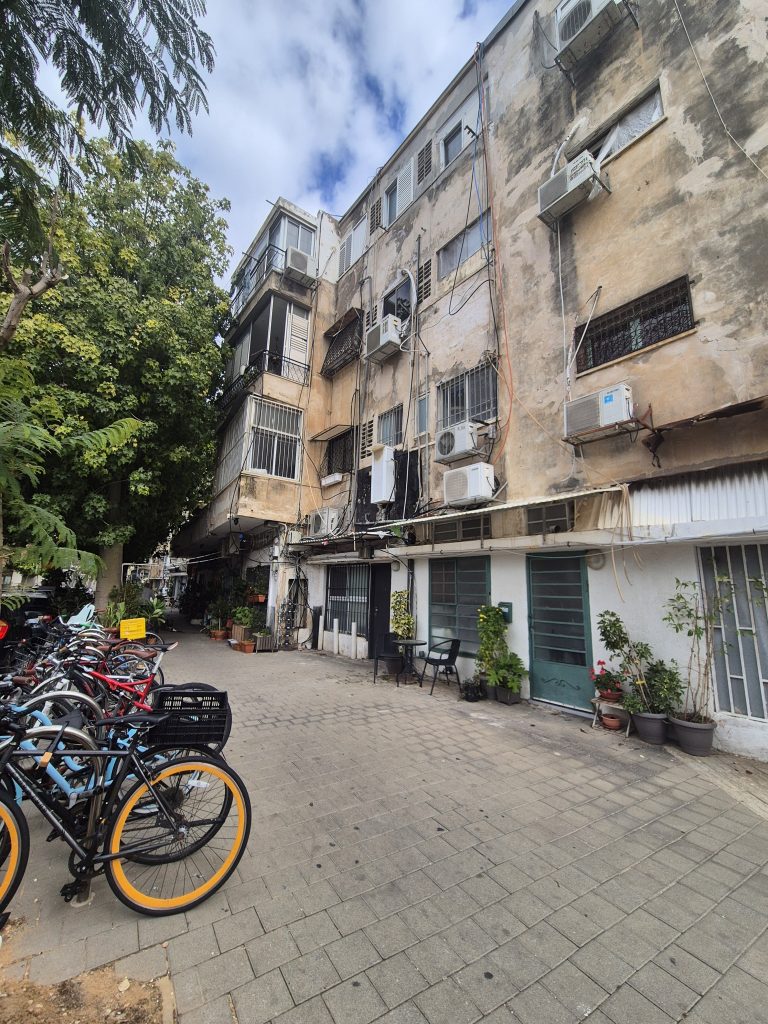
Once again, walking back to our car, it struck us how many differences are combined in one city. Electric wiring hanging willy nilly on the outside of crumbling buildings, versus the spiffy new constructions where no cable is to be seen.
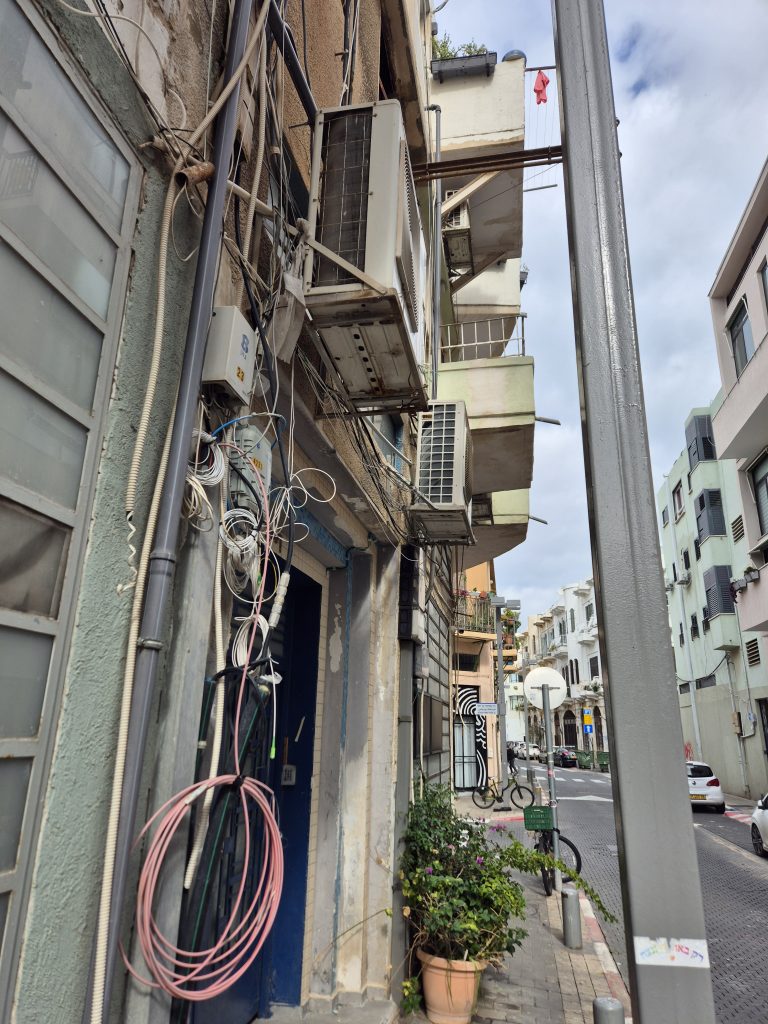
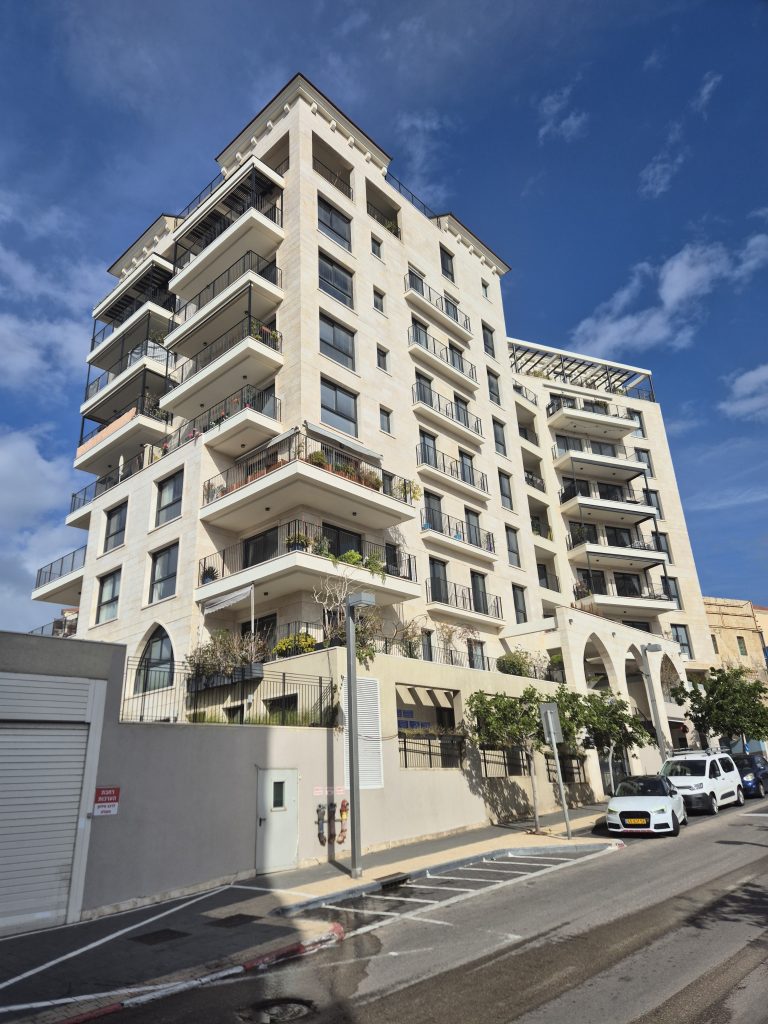
Checking housing prices in Tel Aviv, we were stunned to read that a normal flat share room is over 1000 EUR a month, the m² price being between 25.000 and 35.000 EUR, that tops even Munich‘s hig price tag.
Having spent 2 days in Tel Aviv and Jaffa Esther was curious what contrast Jerusalem, our next stop would bring.
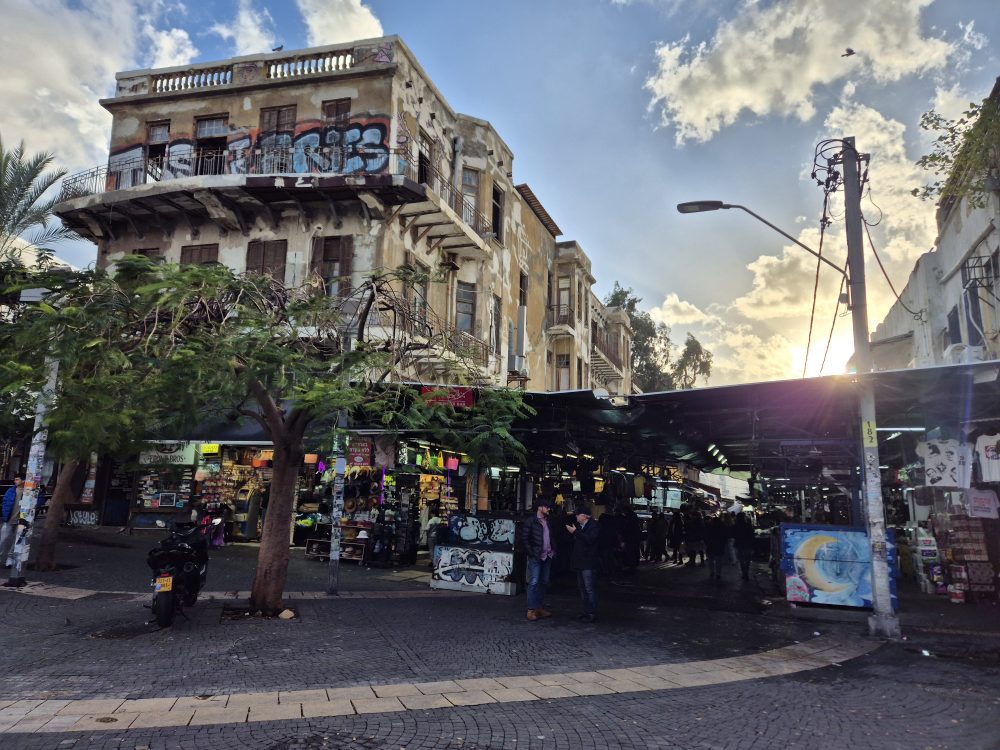
Why on earth do you want to go to Israel at the moment? Isn“t it very dangerous ? That was the most heard question/statement we got when we told people we were going to visit Israel for 12 days.
Well we usually go when others are not going. Chris was already several times in Israel, while Esther was not. The last time he went was before Covid and the Gaza war in 2020. You can read his experience here and here
The world has changed quite a bit since then. Traveling freely becomes harder and harder
Nevertheless, we don‘t let that stop us from exploring the world. Despite governments that come and go and we may not always agree with, Israel is such a historically important country with such significant and revered places that it should be on any bucket list at least once in a life time to visit.
Here where so much history was shaped, where the area changed hands and rulers so many times over thousands of years, we wanted to see, feel and experience the significance of those places here.
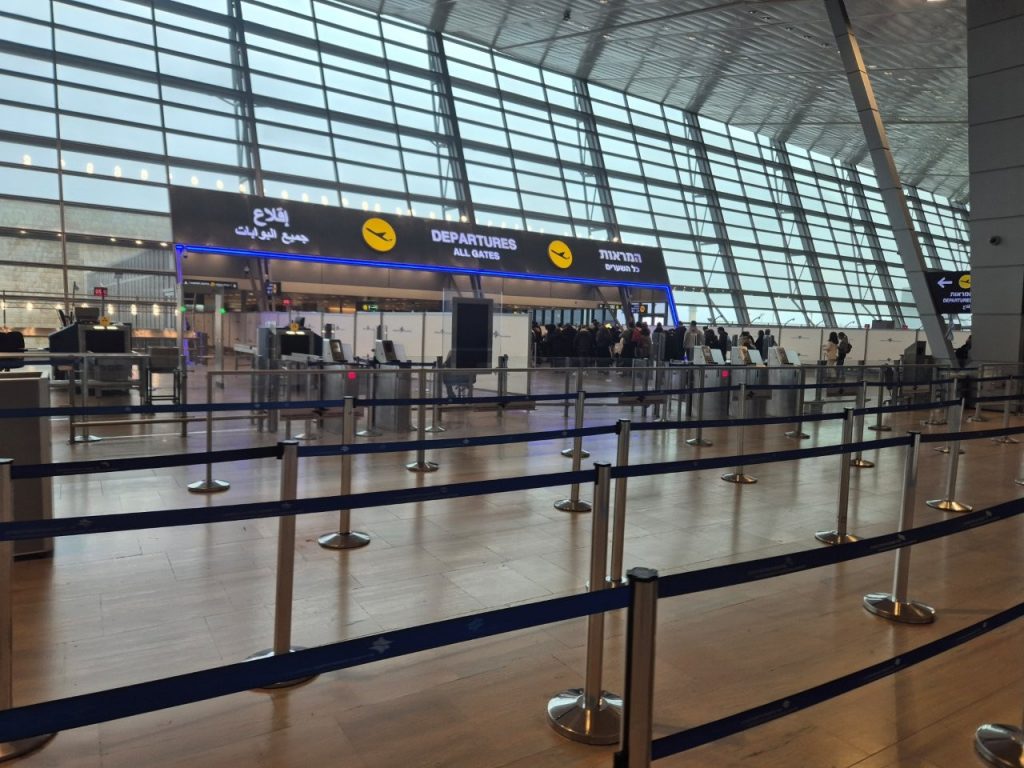
We arrived on Sunday December 28, 2025 in Tel Aviv. It is a bit of a drag to check in in a seperate corner of Munich Airport, the Terminal 1F, as security is extra tight for Israel flights. No one wants another terror attack after Munich 1972. Lufthansa passengers get bussed then from terminal 1F to terminal 2 and then wait in a closed off area.
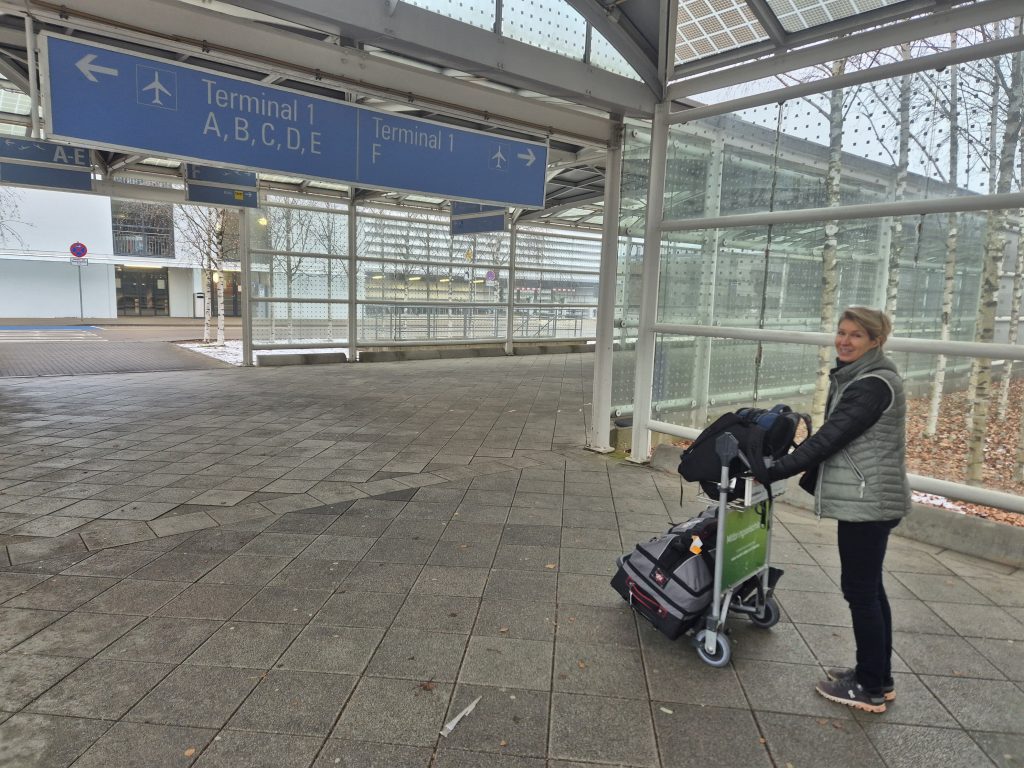
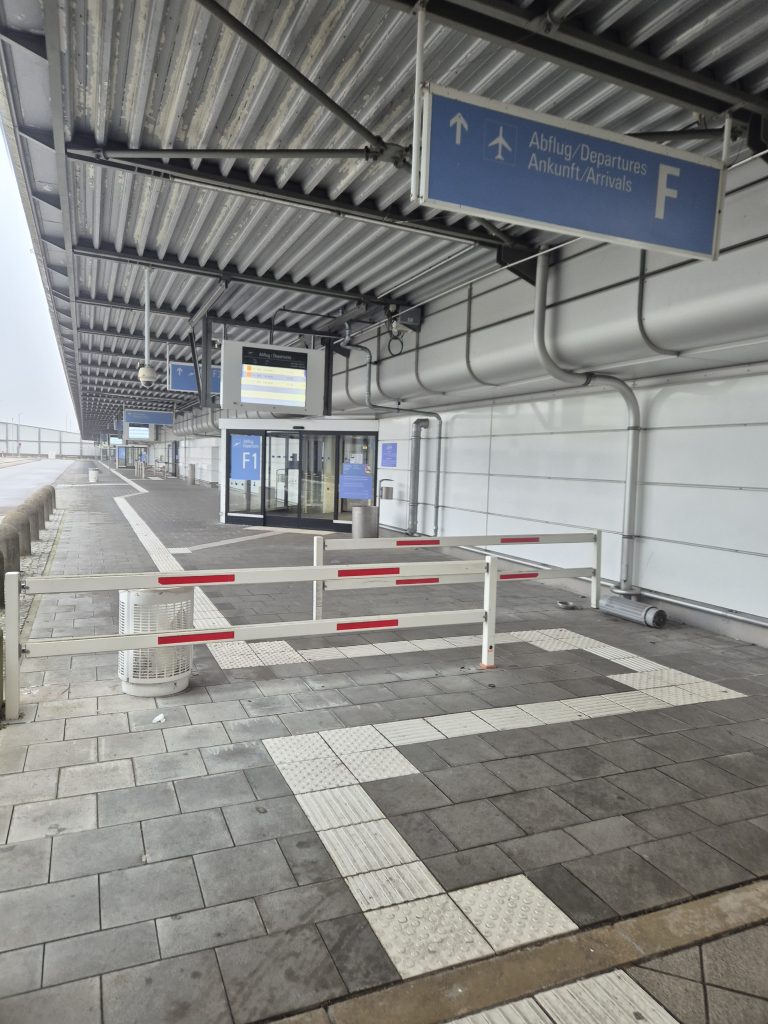
You can leave it to get to the lounge, but then you have to pass through a another security creening again.
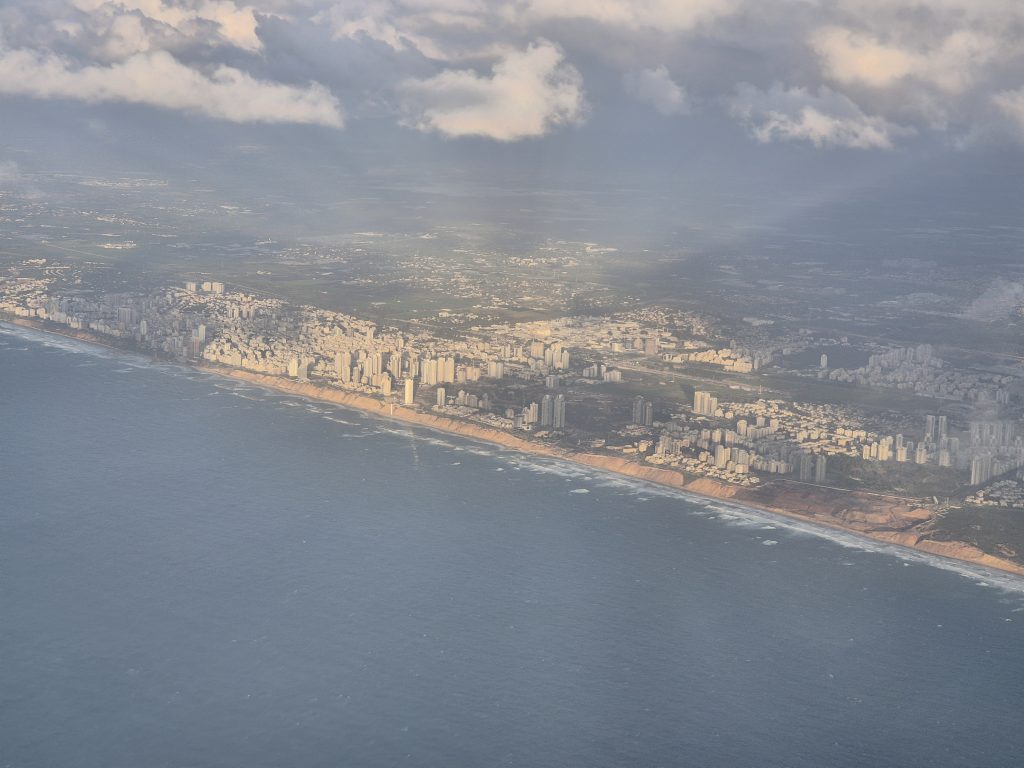
After an uneventful 3 hr flight Esther was expecting the immigration to be very tedious with lots of questions asked by the Israeli border control.
The opposite was true, we breezed through immigration and customs in 10 minutes. Rental car, drive to our boutique hotel, no problem and we were settled in an hour and a half later. Easy first day and we were looking forward to exploring Tel Aviv in the morning.
We were awakened by thunderstorms and pouring rain. And we mean pouring. Still we braced the weather and drove to down town Tel Aviv to explore the city on foot. First investment here – an umbrella. As the rain was coming nearly from sideways with the gusty winds, we were quite soaked and decided to seek refuge in one of the plentiful street cafes. Even the Israelis took videos of the several dowpours interrupted by short spells of rainless moments. Nobody was accustomed to so much water coming down in such a short period of time. Great start of our vacation…
Finally after lunch it stopped raining for good. We still had a lot of things we wanted to see. The old Port area on the seaside was beautiful to stroll on, even though we got wet by the thundering waves causing ocean spray to fly high. Finally the sun came out and bathed everything in golden light.
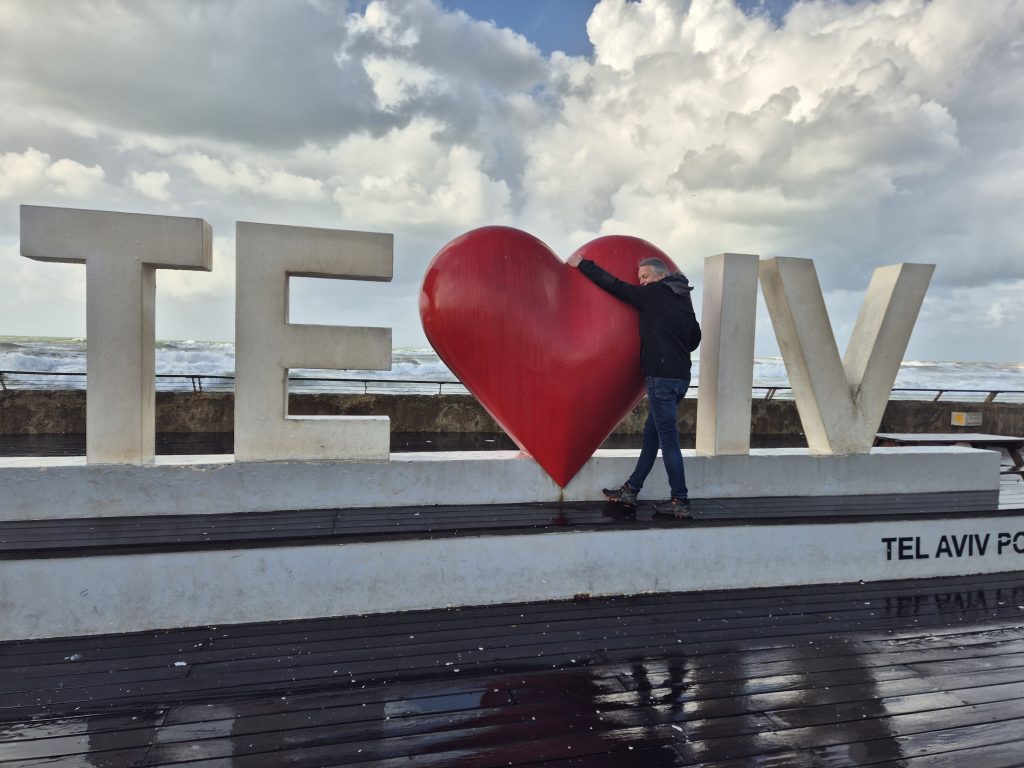
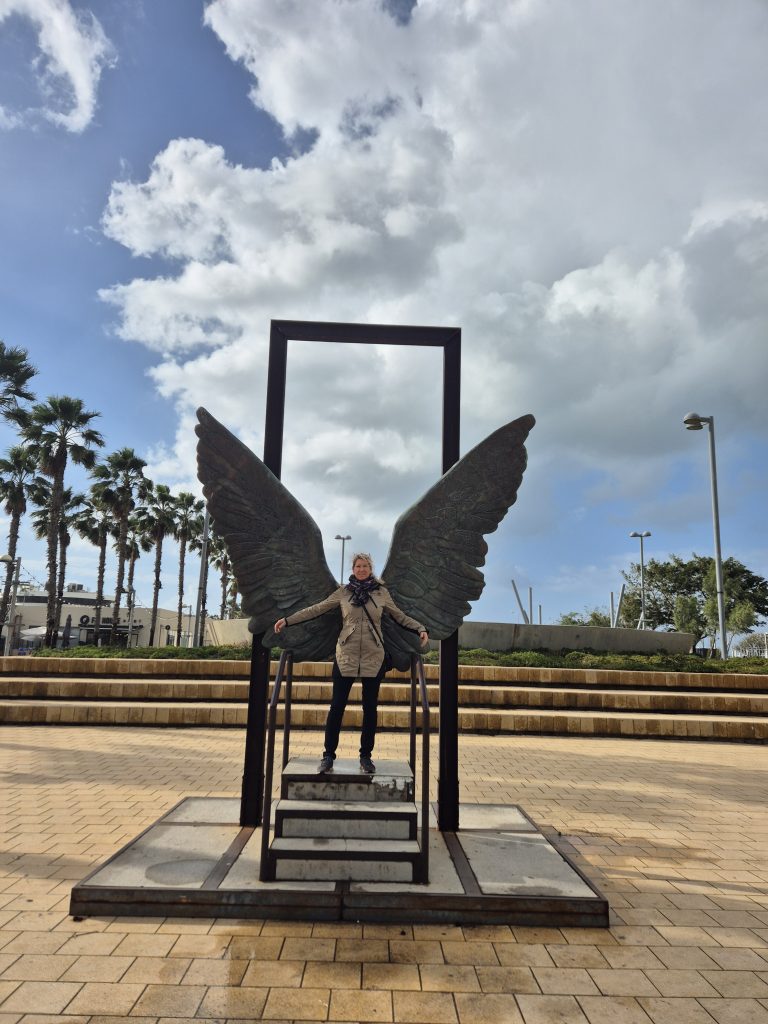
Tel Aviv is a strange mixture between old and run down houses, beautifully renovated Bauhaus buildings (an Unesco world heritage site) and many new constructions popping up everywhere.
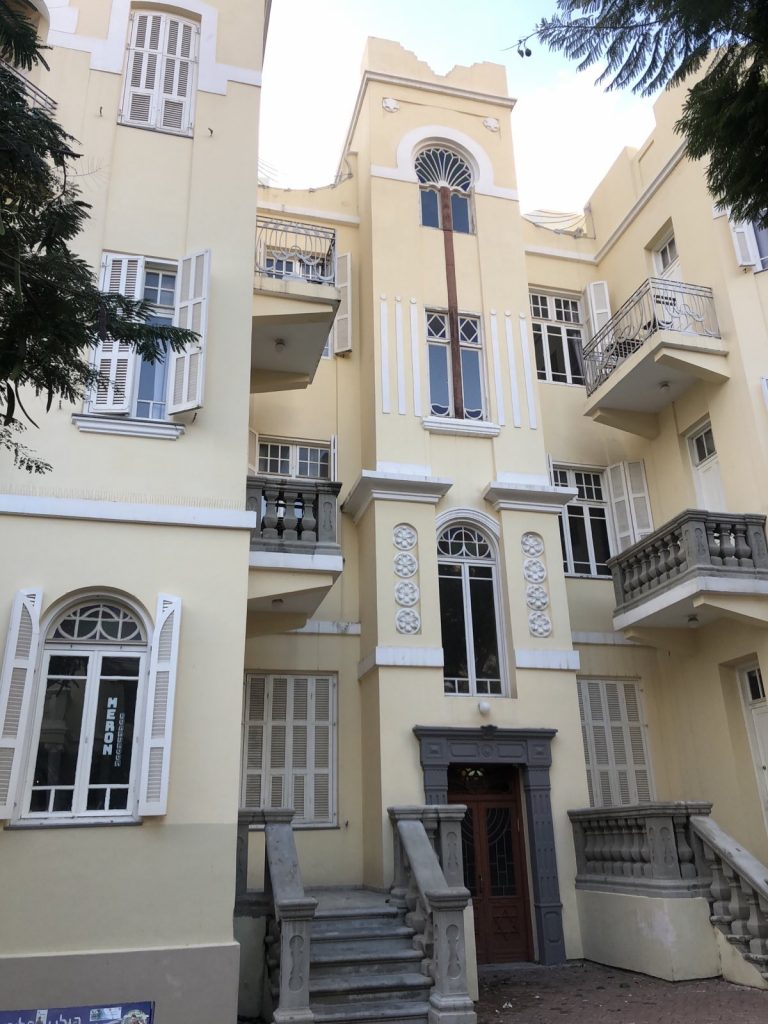
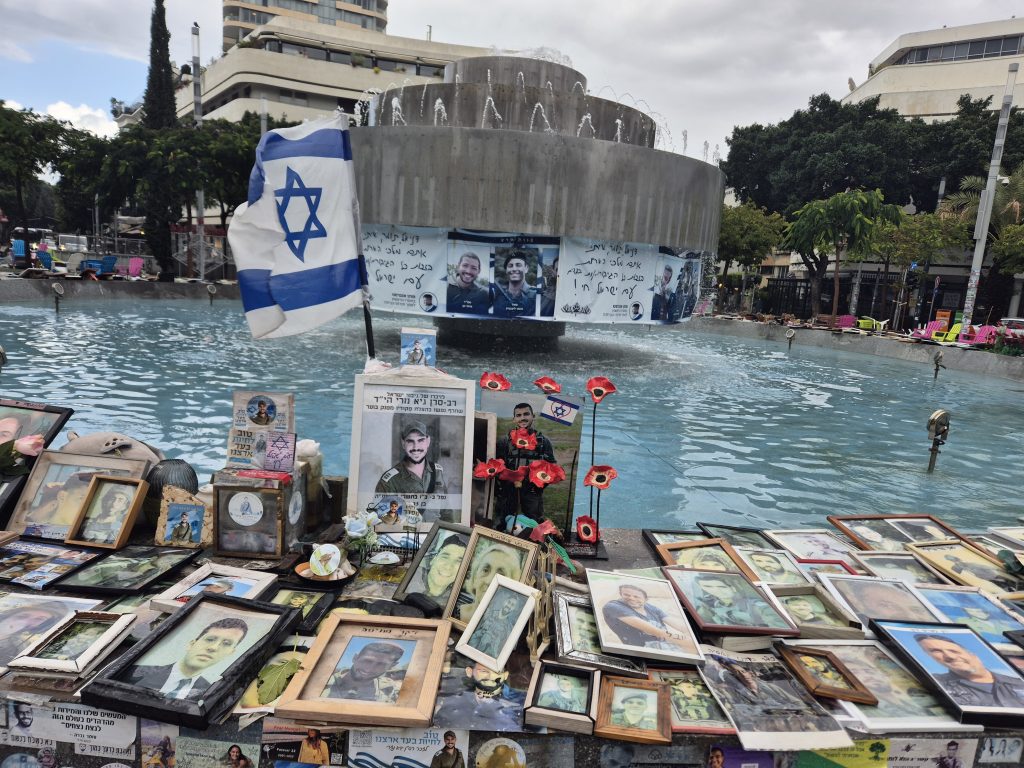
We strolled along Rothchild Boulevard, where a good number of Bauhaus buildings are located. Rothchild boulevard ends at one of the many places in Tel Aviv where we saw countless cards, stickers and memorabilia for the victimes of this senseless Gaza war. Hostages, fallen soldiers, and soldiers still serving, male and female, are being commemorated everywhere here. On each square, in each lift, on each street corner. What surprised us is that we hardly saw anyone with a gun on the streets. We had expected to see many.
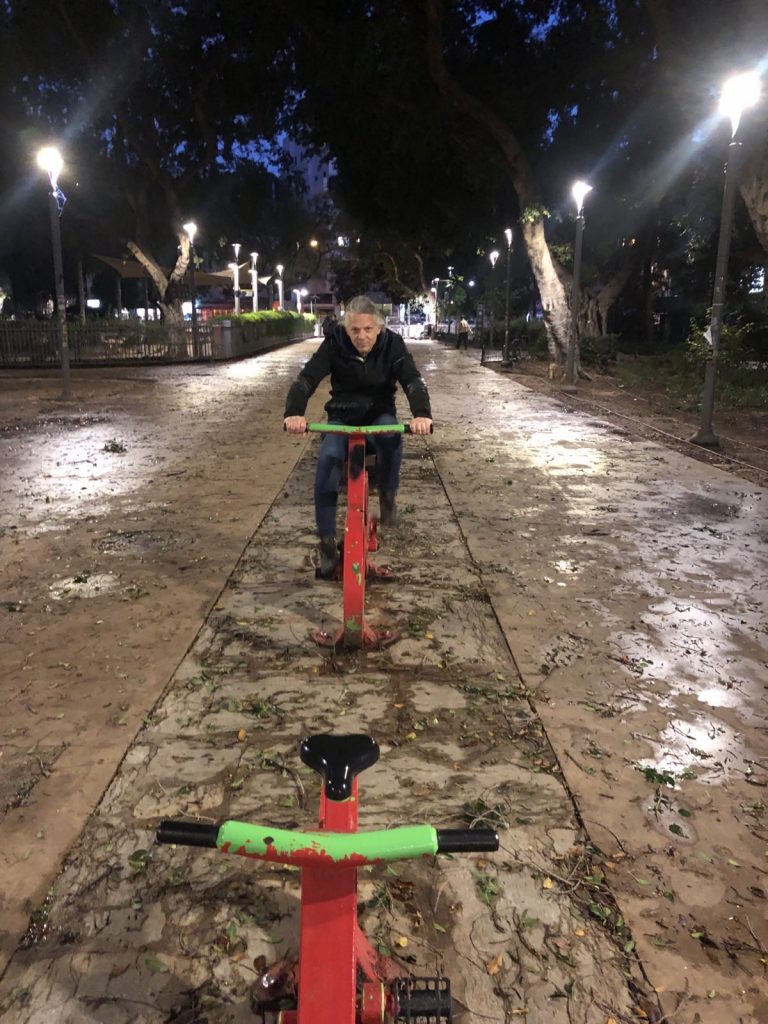
Exploring a city on foot is still the best way to get the feel for it. In every parc and on the beach we saw fitness equipment and people are really using it.
We strolled randomly through different quarters, sat down on street cafes for a cup of coffee, which are plentiful and well frequented. Before we made our way to the southern part of the city, Jaffa, we ambled through Carmel market.
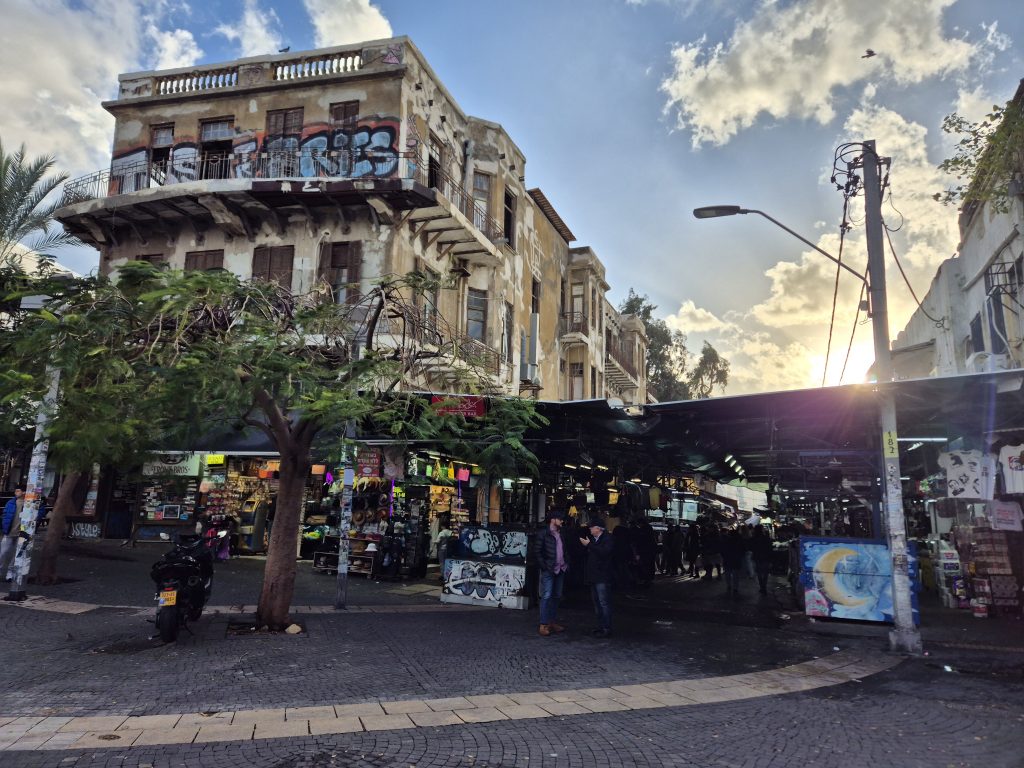
Carmel market is the largest of the markets in Tel Aviv and offers everything from meat, fresh vegetables, sweets, household wares, clothes and jewellery. Different scents waft through the narrow streets and making us hungry. We decided to go to Jaffa for dinner as there is a large selection of more middle eastern food we wanted to try. While Tel Aviv is majority Jewish, we hardly saw any ultra orthodox. Jaffa used to be Muslim and has a different feel to it. More and more parts of Jaffa get incorporated into Tel Aviv and it is being gentrified fast.
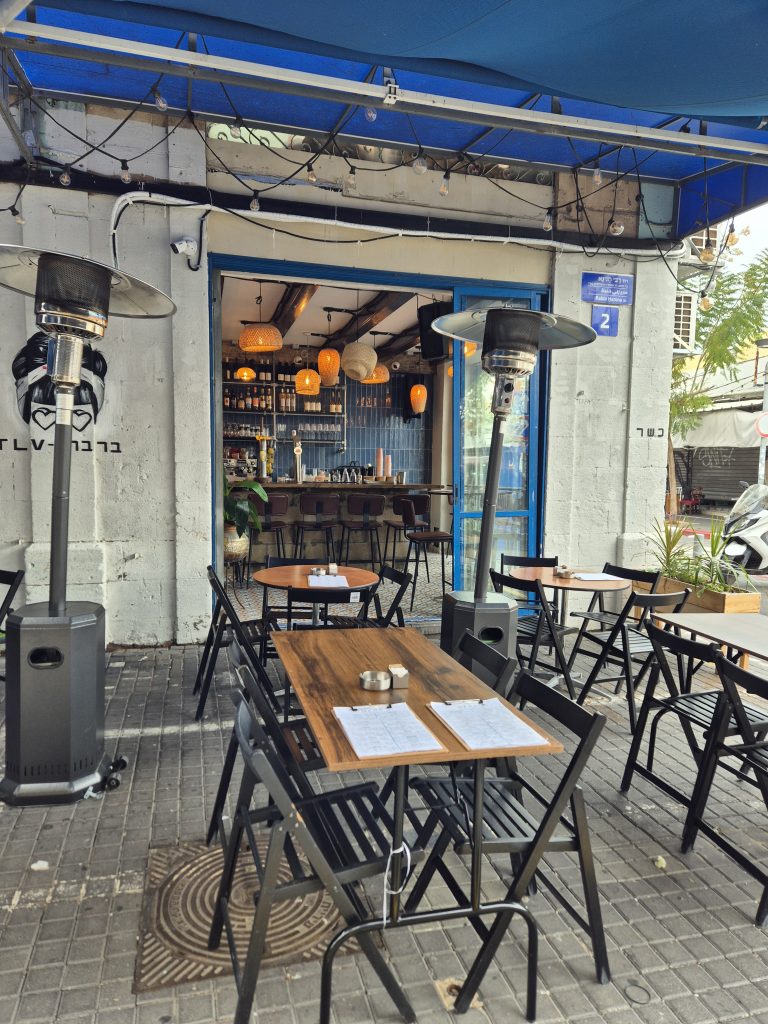
We had a lovely and delicious dinner with local specialties and fresh lemonade. We decided to come back the next day to Jaffa and explore that part of the town on our second day here. Tired but in good spirits we arrived back at our little hotel and reflected on day 1. There was not a single situation where Esther felt in danger, even though it is strange to think that Gaza is a mere 50 kms away from where we were.

We woke up early again, eager to beat the crowds at the world-famous Pyramids of Giza (Gizeh). They open at seven AM, and we weren’t sure how busy it would get. From our rooftop terrace, we could already see the pyramids, and it was just a 15-minute walk to the entrance from our hotel, the Embrace Elite Pyramids Boutique Hotel.

Be careful with the name, as there are thousands of hotels with the word “Pyramids” in them, and not all are a good choice. We had purchased tickets online to skip any potential queues at the ticket office, and by 7:45 AM, we were inside the pyramid grounds (because we didn’t want to skip breakfast either).
It was a glorious morning! The wind had cleared away all the haze and smog, and for once, we could see all the way to the Sakkara pyramids—a rare and breathtaking sight.

Wanting to take advantage of very few tourists, no busses there yet and wonderful light to take pictures, we set out nearly all by ourselves. Not even the camels and horses for tourists were there yet.

Giza is known for its three gigantic pyramids, all built during the 4th dynasty of pharaohs. Each pyramid is named after the ruler it was built for: Khufu (also known as Cheops), Khafre (Chephren), and Menkaure (Mykerinos).

These monumental structures are essentially massive tombs. Each pyramid had a memorial temple next to it, complete with a ramp connecting it to the pyramid. Two of the pyramids are surrounded by three smaller pyramids, which house the tombs of royal family members.

We started wandering around the oldest and largest pyramid, the Khufu Pyramid, also known as the Cheops Pyramid. Originally built between 2575 BCE and 2465 BCE, these pyramids have endured for over 4,000 years, and that alone is a fascinating and staggering number. What building today would last that long? The pyramids appeared sandblasted and worn until we learned that the sandstone blocks visible today were not part of the original casing but the rougher core stones.

At the top of the Khafre Pyramid, the second-largest of the three at 136 meters in height (originally 143 m), you can still see the original smooth surface of white limestone, rather than the coarser and softer yellow/red limestone used in the interior.


Menkaure is the smallest of the three pyramids, originally measuring 66 meters (217 feet) in height, but now only 62 meters (203 feet) due to the loss of its casing. Unlike the other two pyramids, it was covered in harder-to-break red granite rather than limestone. An interesting fact that highlights the enormity of the task: The Menkaure Pyramid required only 1/10th of the amount of stone used to build the Khufu Pyramid, illustrating the scale of these monumental projects, that are still standing after 4.500 years!

All three pyramids must have glared in bright white at the time, clearly visible from a long distance. It is believed that the original capstone of the Great Pyramid was covered in gold or electrum (a naturally occurring alloy of gold and silver), which would have made it gleam in the sunlight. Sadly all pyramids were plundered inside and outside over the centuries by grave robbers and people needing building materials.

The Great Pyramid of Khufu (Cheops) is the largest and consists of 2.3 million blocks of limestone, weighing a combined total of 5.75 million tons. It was assembled without a single bit of mortar. This is an amazing feat of engineering and architecture, and the true secret of how it was constructed remains a riddle to this day. If you want to dive deeper into this question, experts are debating three main theories: First, the use of ramps—either straight, zigzagging, or a spiral ramp built from the inside out. Then there’s the lever and rollers theory, as well as the potential use of counterweights or pulleys to lift the stone blocks.

Newer theories also suggest that water might have been used to reduce friction in the sand, making it easier to move the massive stones. Additionally, it’s believed there was a canal from the Nile directly to the pyramid construction site, allowing stones to be transported more easily. New evidence has also emerged suggesting that the workforce might have been highly organized, rather than consisting of just slaves, as traditionally thought.

Archaeological discoveries, such as workers’ tombs near the pyramids, indicate that the builders were likely skilled laborers and craftsmen who worked in rotating shifts. They were probably well-fed, housed, and compensated for their labor. However, the true methods may never be fully known, and the construction of the Great Pyramid remains one of the most remarkable engineering feats in human history.

We didn’t go inside any of the pyramids—Chris because he had been inside before, and Esther because claustrophobia and narrow, hot, confined passages don’t mix well. There isn’t much to see inside, so it’s more about the experience of being inside such a massive structure. Be aware that you need to buy an additional ticket upfront to get inside.
Since we just mentioned that Chris had been inside before, here’s a bit of personal history: In 1987, Chris and his parents visited Egypt together. At that time, tickets to the Giza Pyramids cost just three Egyptian Pounds (compared to 700 today). While many things have changed since then (there are two luxurious restaurants now on the premises f.e.), the Pyramids themselves have not. Interestingly, 1987 was also the year they began constructing the glass pyramid at the Louvre in Paris.


After exploring all three pyramids from ground level (climbing the lower parts of the pyramids was still common in 1987, but the ban is now strictly enforced), we decided to walk to a viewpoint opposite the pyramids, where we noticed a little café nearby.

In the past, the pyramids were located far outside the boundaries of Cairo, but today, the city has grown around the entire site, and wherever you look, you can see housing. The grounds are quite large, so we decided to walk the 1.5 km to the viewpoint.

It was warming up but still pleasant in the sun, and we watched as camels and horses arrived, either carrying carriages or saddles for the day’s tourists. We had heard several troubling stories about how the animals are treated here, so we decided not to ride or take a carriage in Giza. Instead, we walked the short distance to the lookout and, turning around, simply enjoyed the stunning view of all three pyramids together.

If we had known, we could have reserved breakfast table here, with the pyramids view. We still enjoyed an excellent cappuccino (or two) overlooking the whole vista complete with 4.500 year old pyramids, horses and camels arriving to do a days work.


Until about nine AM there were very few tourists out and about, but that started to change and the horse and camel guides found their customers quickly. We saw where they were taking pictures and those were indeed the best angles, the very same ones we had chosen before.

Added bonus was, that since they had brought their clients there, we were not offered rides constantly.
Next we walked in a circle back to the first pyramid and down the hill to THE Sphinx of Sphinxes.

Carved out of limestone, this impressive monument features a man’s head and a lion’s body. It stands approximately 20 meters (66 feet) high and is about 63 meters (207 feet) long. The head is believed to be modeled after King Khafre, and it was likely built at the same time as his pyramid. The Sphinx is a solid monument, with no hidden chambers or doors.
In the Arabic world, the Great Sphinx of Giza is known as Abu al-Hawl (Father of Terror), and there are rumors that it was intended as a symbol of protection for King Khafre aka Cheops.

At the Sphinx, we got a sense of how crowded it usually is. Plenty of tourists milled about, both in groups and individually, taking their Instagram shots. Fortunately, the Sphinx is cordoned off widely, allowing us to see the entire monument relatively well despite the crowds.

Having spent nearly four hours in peace and quiet—first at the pyramids and then walking the grounds to the lookouts and back, with few people around—we decided to try our luck at one of the two restaurants on the grounds. Khufu’s had the last available table at the bar for us. Since we didn’t want to eat as much as we had in the past few days, we initially planned to share one meal. However, we were told we had to order one each, or share a mixed grill for whopping 99 Euros. Chris was a little annoyed since he wanted to skip the main course, but we ended up enjoying a high-class meal, beautifully prepared.

This turned out to be our most expensive meal in Egypt, but the location and the occasion—our last day here—made it well worth it. (Nevertheless, we would recommend the other place at Panorama 2, where we had our coffee. The prices there are much more reasonable, with an à la carte menu. But be sure to make your reservation early!)
As it was a three course meal plus amuse bouche we took our time enjoying our food. When we came out, it was afternoon and the previously sunny and exceptionally clear day had turned into an overcast sky with sand blowing up everywhere. One could not even see the lookout clearly anymore. Also the place was crawling with tourists by now.

Once again, as so many times on this trip, we counted ourselves lucky to have chosen the right time, location, and activities to fully enjoy the sights of Egypt.
We decided to drop off our bags at the hotel, and turn around quickly to visit the newly opened GEM (Grand Egyptian Museum) before it closed at five PM. We decided to walk there , which according to google maps was a 20 min walk. What we hadn‘t counted on was that there is major road works going on and we had to walk alongside a six lane highway for about 10 minutes and even cross it at least once. Not a great feeling, but we had no choice as a car would have forced us to circle very widely around the area.

We were curious, as we had been told that the museum is quite special and super modern. The original Egyptian Museum, which still houses Tutankhamun’s death mask, still exists, but many of the artefacts have already been moved to this new location, which is much closer to the pyramids.

Not all exhibits were open yet (especially the Tutankhamun section), and rumor has it that the official opening will coincide with a special political moment. As of now, the museum is in a so-called “trial opening,” but it has not been officially inaugurated due to ongoing artefacts restoration and setup work. However, speculation is high that, once the work is completed, the official opening will happen quickly and likely coincide with a large global event (e.g., the World Games, a world leaders’ summit, or something similar). President Al-Sisi is known for thinking big.

The museum has a vast and easy-to-navigate layout, with sections ranging from the earliest periods of ancient Egypt to the Roman/Greek period. From displays of everyday life to religious ceremonies, warfare, and science, it offers an extensive range of exhibits. We saw many artifacts from places we had visited before, including statues, reliefs, and valuables from the Abu Simbel, Edfu, and Kom Ombo temples, Habu and Luxor, the Valley of the Kings tombs, and Karnak. We couldn’t help but recall our guide in Luxor, who had complained that all the artefacts seem to travel to Cairo instead of being displayed at their original locations.


It was a bit overwhelming for 1.5 hours, but we were glad we took the time to visit. Back at the hotel, we were exhausted from all the walking (20 km, most of it on sandy ground) and still full from our lunch. We decided to skip dinner, pack our bags, and retire early for some much-needed sleep. Our driver would be waiting for us a 6:30 AM the next day to beat morning traffic and take us to the airport.

This concludes our Egypt blog. In summary, we feel fortunate to have chosen this time of year and route, which allowed us to enjoy fewer tourists, pleasant temperatures, and lower prices than we had expected or would normally experience. The perceived proximity to the war in Gaza seemed to have deterred many tourists, but we found no reason to let it affect our experience. All in all, we were pleasantly surprised by Egypt and are glad we decided to visit, despite some of Chris’ concerns about how touristic and crowded it might be. Even though there were many attempts to sell us services or products, and occasional begging, we were always treated respectfully, and our “no, thank you” was always accepted.

We only have two full days in Cairo, so we had to take our picks of places to see and visit. The first day we decided to tour the city, the second we planned to visit the pyramids and the new Egyptian Grand Museum that recently opened. We splurged on a professional guide and driver for the city but decided to do the pyramids without.
We woke up early on Sunday as our driver was picking us up at 8.30 AM. The Pyramids Elite Boutique Hotel (every second hotel here has the word Pyramids in their name) had a great view on the pyramids and was within easy walking distance, but that meant it was a bit outside of Cairo city.

We headed up to the rooftop terrace for breakfast and were pleasantly surprised that the indicated pyramid view really lived up to the advertised pictures and we got ourselves a corner table overlooking two of the pyramids. From afar they did not look overly tall but the fact that they looked like someone put them together like Lego bricks was clearly visible and a stunning feat.
We started our day with a traditional Egyptian breakfast consisting of boiled eggs, mashed fava beans, a cheese spread similar to tzatziki but without cucumber, falafel, and a sweet tahini dip, all accompanied by various types of local bread. It was absolutely delicious and, to our delight, we finally had some real coffee! For the coffee enthusiasts out there, Egypt offers two main types: the first is a strong black coffee, brewed by pouring boiling water over the grounds and waiting ages for the sediment to settle. The second is Nescafé, the freeze-dried granules that are popular in many former British colonies and communist countries (Obviously neither of us likes that stuff). Fortunately, our hotel served real coffee, setting a perfect tone for the day ahead.
As it was Sunday, the traffic was lighter than usual as we drove into the city. We picked up our guide, Mary Edward, along the way. We always try to support female guides to encourage women working in male-dominated fields. Despite her British-sounding name, Mary was born in Kuwait and moved to Egypt when she was four years old. She is one of the minority Christians with Egyptian parents and spoke English quite well.

We went first to Old Cairo and the Coptic quarter. It houses some of the oldest religious buildings in Egypt. The 9th century hanging Coptic church is the most famous of them. Its called hanging church as it is suspended over the water Gate of Roman Babylon. All that‘s left of Roman Babylon are two round towers which formed part of the western gate. The Coptic church does contain an 8th century painting of the virgin Mary as the Coptic Mona Lisa and displays very fine geometric designs so similar to the Islamic ones that one had to look for the tiny crosses worked into the patterns to spot a difference. The stairs leading up to the church are a fine work of art in wood carving.

The next church, barely a minute walk away, was the Greek Orthodox church of St. George. All the displays in here were of St. George slaying a dragon. Many of the thank you texts inside the church were written in Arabic, despite this being a christian church.

Next we went to the church of St Sergius & Bacchus, the oldest church site in Cairo, dating back to the 5th century. It has been destroyed and rebuilt several times, and so the current church looks quite new and freshly restored. The most memorable visit is the crypt below the altar, which was once a cave where supposedly the holy family used to take refuge from King Herodes for three months.

All religious buildings were within easy walking distance and so on we went through small little passageways to the only synagogue in Cairo. The Ben Ezra Synagogue. Dated back to the 9th century it now does not operate as a synagogue anymore, as there are only around 100 Jews who live in Egypt now (according to Mary Edwards) and most of them in Alexandria.
By now we had our fill of churches, it was pretty amazing to see that so many religions had lived peacefully together for a long time and that Egypt had rulers who fostered that diversity.

Our next stop is the Citadel (Al Qala‘a). It is difficult to say when exactly it has been built, as it‘s form has changed greatly over the years. The older parts were built by the ruler Saladin around 1176, successors added to it and converted it into military barracks, other rulers added a royal residence to it and in 1830 the Mohammad Ali mosque was built there.

The citadel sits on top of a hill and one has to walk up to it . The first thing we saw was dilapidated buildings that once was a palace. Mary Edward said that the renovations had been going on for ages with no end in sight.

Heading higher up we were impressed by the size and grandeur of the Mohammad Ali mosque with its turret towers and silver sparkling roofs. This is now really the heart of the Citadel and we wandered around and barefoot inside.


It‘s a museum now and religious services are only happening once on Fridays.

This fact, that the mosque is viewed as a monument for the rest of the week is a reminder that Mohamed Morsi from the controversial Muslim Brotherhood had actually been ousted by the military, one year after he won the elections. The military coup took place on July 3, 2013, led by General Abdel Fattah al-Sisi. Since then, al-Sisi has been the President of Egypt, having been officially elected in 2014 and re-elected in subsequent elections.
The sheer size was fascinating.

The citadel houses a second smaller mosque right below which is much older but is dwarfed by it‘s big neighbor. The An Nasir Mohammed mosque was built in 1318 and throughout the years had to serve as a horse stable before being converted back into a mosque and Madrassa. We loved the intricate woodwork on the ceilings. It was well worth a detour that not many tourists made.


Last on our tour before lunch was a trip to Bab Zuweila. This is also a hidden gem as we discovered. Bab Zuweila is one of the remaining original city gates dividing the palace district from the common workers district Fusat.

Each day the workers filed out of that gate to return to their homes (of the five city gates only two remain). Bab Zuweila was also used for public executions at the time. It‘s two towers serve as Minarets to the adjacent Mosque of Al Mu‘ayyad Shaykh which is the only mosque in Egypt where the minarets are not inside the mosque.

We had heard that those minaret towers could be climbed and you had a great view from above. We gave it a try and sure enough, we were able to not only climb up to the top of the city gate, but also way higher onto the minarets highest balcony. We had a great view and it was well worth the stop here.


Mary Edward then brought us to one of her favorite lunch spots and we ate incredibly cheap and well. Chris had the yummiest chicken Kebab in a crêpe.

Afterwards we ambled through the side streets until we entered the souk. Like other Souks, this also was a bustling street, not super touristy but stuffed with all sorts of goods for sale. We found some things to bring home, after some hard but fun bargaining.


The last stop for the day was a coffee stop at a heavily frequented square with hundreds of pigeons flying about constantly and dozens of cats sneaking between people‘s legs while they sat drinking or eating. Again we saw another Russian Blue, just like our cat at home.

On the way, we also stopped at a local bakery to get some delicious pastries.

As the day came to a close, we eagerly anticipated returning to our hotel to relax in the warm water pool and enjoy a delightful dinner on the rooftop terrace, with its stunning view.

The only downside was that the pyramids were not illuminated as we had hoped. It turns out they are only lit for significant events and not on regular evenings.

Exhausted from all the walking and feeling as stuffed as geese, we slept soundly through the night.

We had booked a sunrise balloon trip which meant to get up at 4.15 AM in the pitch dark. Chris was grumpy about the early start but was a good sport about it. Exactly on time, at 4:45 AM, we were picked up by a minibus driver who took us to a meeting point for all the balloon companies. We were transferred to another white minibus, where we joined our fellow passengers for the balloon ride. We got a safety briefing from our guide Waleed, had to sign waivers, got an intro of a videographer who was accompanying our group and finally set off once all had arrived.
We had three English, two Germans, and five Americans on our bus. Since there was no balloon ride on Friday, it seemed that everyone had been rescheduled for Saturday. Each person had to send a copy of their passport prior to the flight, and it was up to the Egyptian military to give the green light for the balloons to take off.

A convoy of about 50 white minibuses set off at exactly the same time, racing to their respective balloons at the airfield. There, the balloons were still flat on the ground, and each group was guided to their balloon.

The baskets can hold anywhere from 15 to 30 people. Ours was for 20, with five people assigned to each corner compartment of the balloon. The center was reserved for the pilot.

It was still pitch black and quite cold, so we even wore woolly hats and extra windproof jackets. Egypt in winter is chillier than one might expect, especially before the sun comes up. We felt a bit like a flock of sheep as our group (remember, you’re number 2!) was guided to our balloon. We couldn’t imagine what would happen if you got lost in this bustling place and had to find the right balloon.
The anticipation all around us was palpable. There were so many balloons and baskets being prepared at the same time, it looked like a busy bee hive. All startled when all of a sudden the big generator powered fans started to blow air into the empty lying balloon envelopes.

The noise was deafening, but the spectacle was incredible. Slowly, the flat hulls began to take shape as the burners were lit, pumping hot air into the expanding envelopes. The sound of the powerful burners igniting was like a hissing, fire-spitting dragon contest, briefly illuminating the surrounding area with wild dancing shadows cast all around.


In the dark the sight was mesmerizing. One by one the balloons righted themselves and the basket were filling up with people. We hopped into our basket into one corner with the three English folks.

Once everyone was settled in the basket, the ropes were loosened, the helping hands stepped back, and off we went, ascending into the sky as dawn slowly broke. We quickly gained altitude, and seeing over 50 balloons rise together within 20 minutes was a truly grand sight.

Esther was so glad we decided to take this ride; for her, it was undoubtedly the highlight of the trip. And even though Chris wasn’t particularly keen on getting up that early, he didn’t regret it one bit.

Up we went, and soon the Temple of Hatshepsut came into full view. After 15 minutes, the sun peeked over the horizon, bathing everything in a golden early morning light.

The Valley of the Nobles, with all its tombs, the Habu, Hatshepsut, and the Ramesseum, the fields, and the Nile—all illuminated by the soft light—made the 50 balloons above look like colorful dots in the sky. It was such a wonderful sight, hard to top.


Esther had never done a balloon ride and her fear of heights is well known. Nevertheless the solidity of the basket, the professionalism of the pilot, the smoothness of the ride and the breathtaking views put that fear to the back of her mind.

And once again, we were incredibly lucky. The wind from the previous day had blown away all the smog and haze that usually lingers near the ground, leaving the sky crystal clear.

Our pilot sometimes soared high, then descended again, always watching the movement of the other balloons to gauge the wind direction at different altitudes. Using this knowledge, he navigated us right back to our starting point. Fifty minutes later, we landed exactly where we had taken off.

Great navigation! Other balloons had to land in nearby fields or even farther away, like the one we had seen on Thursday morning next to the Habu Temple. The rule is that any damage done by a balloon landing to fields, crop or property needs to be paid for by the balloon operator company. That led to funny scenes we watched where a balloon could not make it on its own back to the air field but threatened to sink down in a nearby field. The respective balloon ground crew dashed madly to their balloon and from a few meters above a rope was let down. The ground crew grabbed the rope, and the pilot’s only task now was to keep the balloon high enough to clear the bushes and trees on the way back to the field. The crew pulled the balloon like a human tugboat, guiding it back to the airfield to avoid any damage that might need to be paid for. Farmers watched like hawks over their crops, carefully monitoring for any potential damage.

We finished our ride by seven AM. Most of the balloons had returned as well, and some were getting ready for a second flight with another group after the sunrise trip. Occasionally, there are even third trips, but by ten AM, everything is usually wrapped up.

Instead of being dropped off at our hotel, we asked our minibus driver to take us to the Habu Temple ticket office on the way back.
The temple opens at six AM but as by seven AM the ticket system had not been powered up ,we knew that we were the first ones today. We bought two tickets (credit card only these days!) and headed a short way down the road to the temple. We were literally the first ones entering that day.

The ticket office is a five-minute walk from the temple, and as we wandered through the fields, a man carrying freshly cut sugar cane crossed our path. After a brief conversation, he told us he owned a coffee shop next to the temple and invited us to stop by. This is something you’ll encounter frequently in Egypt: someone crossing your path and inviting you to their shop, restaurant, or their cousin’s factory, trying to sell you something. While it can be a bit annoying for unseasoned travelers, a polite “no, thank you,” or “lah, shukran” in Arabic, is usually accepted after being repeated a few times. Without exception, we were always wished well in the end. But in this case, since we hadn’t had any coffee or breakfast yet, we promised to drop by his place after the temple visit.

It felt like a privilege to have the entire temple to ourselves. To be able to study the different murals and engravings at leisure and for as long as one wanted. The heavy stone pillars supporting heavy stone blocks on top, thus forming a ceilings of solid rock over a portion of the temple.

A lot of the ceiling still had their original bright blue color with thousands of stars painted on them. The columns still had some of the red and blue stripes on them and the robes of the kings and queens as well as the gods and their wives were intricately painted in different colors and displaying fashion styles of former times that were painted, not engraved.

Here one could see probably the best display of how color was applied to the temples in ancient times. White plaster on the walls that was then engraved to give plasticity and painted all white. Then as a last step artists applied colors to each and everyone of the figures depicted. The temple must have been a display of vivid colors top to bottom, inside and outside.

Habu temple was built to be the memorial temple of Ramses III. The first pylon is the biggest and is like the gateway to splendor. Walking the steps slightly upwards the path opens into a wide square courtyard with large columns on each side supporting large roof blocks made of sandstone thus creating a colonnade on all four sides. Seven columns on the right were shaped like Ramses III.. Others were square, others round. The common people were only allowed in the first court yard to make their sacrifices and donations.

The king could observe his subjects through a hidden window on the left side, which led directly from his ceremonial palace living quarters to the temple. In the second courtyard, originally fully covered with a roof made of large stone blocks, only the nobles of the king’s entourage were allowed to enter. As for the holiest of holies—usually a small chamber with a granite altar and housing golden statues of the gods—only the pharaoh and the high priest were permitted to enter.

Unfortunately at Habu, the last hall and the holy chamber were in ruins and the stone columns taken to build other structures after. It must have been a majestic colonnade hall in ancient times.

Having gotten our fill of Habu temple after 1,5 hrs, we were on our way out when we saw the first tour busses arrive. Happy to have had our time, we kept our promise and had a coffee and delicious mango juice on top of the small cafe Belzoni Alaa El Din opposite the temple. As if on command, a few late balloons were drifting our way and made for some spectacular pictures with the ruins in the foreground.

This was our last day in Luxor. Being booked on an evening flight, we still had plenty of time. We decided to walk back to the hotel on foot. 50 minutes walking in the early morning through some villages and across some fields was very nice and relaxing and we felt good after so much eating the days before.

Back at the hotel by ten AM we just caught breakfast before it closed and then decided to make use of the hotels pool and late check out policy to have a lazy afternoon before our air port pick up at six PM. We packed our bags, put them in storage with the reception and lounged at the pool, which was way too cold to swim in. Nevertheless we soaked up some sun and by three PM we headed on foot to the River banks and had a late lunch/ early dinner at the Nile Freedom restaurant which serves delicious fresh fish for a small price. Sadly, it was also time to say goodbye to the horses, and to Agi and Mohammed, who took such great care of us and made us feel like longtime friends. We wish you all the best for your upcoming business plans, especially for the new place in the Siwa Oasis!

Instead of having the hotel organize our pickup for $30, we booked a ride through Booking.com for just $10. We were a little anxious about whether the driver would be on time or even find the hotel, but ten minutes before the scheduled time, we received a WhatsApp message (a very important tool here in Egypt!) from our driver—he was already waiting in front of the hotel. The driver, Moussa, had just bought a brand-new car— a generic Honda Civic sedan, which had cost him $40,000 here in Egypt. Interestingly, he had already driven one of the minibuses to the balloon rides earlier that morning. He hadn’t slept since, as he told us, and we were his last ride at five PM—followed by another balloon pickup the next morning.
As seems to be the norm here, our flight was delayed again by an hour. We finally landed in Cairo at eleven PM, waited for our luggage, and then endured a long drive to our hotel, which got us there only at 12:30 AM.

We just collapsed into our beds, as we had a full day planned for the next day in Cairo.

Luckily, we were told at ten PM the day before that the balloons wouldn’t fly on Friday due to heavy winds. For us, that meant hoping for Saturday, our last day in Luxor. It also meant we could finally sleep in, which we happily did—we are on holiday, after all! Our alternate program sounded good as well.
At ten AM we made our way to the stables, which are right next door to Mohammads family home. We would help his mom make fresh Egyptian bread. We washed our hands and then proceeded to dive elbow deep into a large tin bowl where Mohammad mom Saida had put about five kg flour, water and a bit of yeast.

We were supposed to mix it all up and then she added another five kg of sourdough that had already risen to it. It was the stickiest dough we ever made. In order to make it airy and light you had to bat it with your own hands, making loud slapping sounds. The whole family watched in amusement how we tried our best.
The dough was barely clinging to Saida‘s hands, while ours clung to our entire forearms. The trickiest thing was to separate a blob of dough the size of a grapefruit from the rest, sling it so it became a ball and then squeeze it as a round shape on a board. We laughed a lot and Mohammads family as well at our pitiful tries. Finally with Saida‘s help we had produced twelve blobs on twelve boards and those were set to the sun to raise some more before being baked in an outside clay oven.

Our mouths were watering once we saw the fresh break being baked and we were looking forward eating some of that bread for lunch. Mohammeas family had done the cooking and we sat down and enjoyed a home cooked meal with self made Egyptian bread.


After lunch, we decided to have one final horse ride across the fields and along the Nile’s riverbanks. Esther chose Jazeera again, the little paint mare, with whom she had such a great connection. Chris, on the other hand, wanted something different and got to ride a stunning white Arabian stallion named Sahib. He was a bit of a character, though—only knowing three speeds: walk, trot, or full-on dance!

Mohammad got him two months ago from someone who had trained him as a dancing horse. This meant that as soon as he was outside and was asked to go a bit faster than a trot, instead of going forward into a canter, Sahib started hopping on the spot like a mad rocking horse. Mohammad has tried his best to teach him that it is OK to go forward, but clearly Sahib has not understood that yet.
So we were agreeing on it being only a walk/trot ride so that Sahib could also participate and Chris would not be thrown out of the saddle by the rocking motion. After a little while trying to find each others buttons it actually worked quite well. They cantered for about ten seconds, but it was obvious that it was hopeless to get him to canter any longer. Hopefully one day Sahib is learning that now it‘s Ok to go forward more.
We finished our ride and had a lovely and very good meal at the Wolf restaurant in walking distance to our hotel. The owner had worked in San Francisco for 23 years as a chef there but preferred to retire in his home country Egypt. He explained to us his philosophy of cooking and indeed the dishes were super tasty. We were glad we had a walk back to the hotel.
Later that evening we got the green light for the balloons on Saturday morning, so we retired early.

Today we mounted our horses for a lovely ride to one of the most stunning temples on the West Bank – Habu Temple.
We took a generous route through fields with lots of sandy paths to canter on.
Farmers were busy tilling their fields, little white egrets were busy picking the worms after tilling, donkeys were dozing in the sun, waiting for their carts to be filled with a days harvest in the afternoon. Very peaceful scenery indeed. After an hour the landscape changed into a desert with rocky and sandy patches and a long stretch for galloping fast.

Lula our dog always at our heels, deftly ducking and navigating the dangerous world of the other dogs territories. Those were not amused at all to have an intruder passing by and often would ferociously bark, threaten and sometimes charge at Lula. The horses and we were ignored totally. Lula always kept close to our mounts and tried to keep them in between her and her enemies. That mostly worked well. One feisty dog came too close to Jazeera, Esthers mounts hind legs and Jazeera expertly tried to kick that dog away. Lula was safe once again.

After a long gallop and some cool down walk, we saw a huge balloon that had just landed in front of us, right next to Habu temple. We were lucky that the balloon was still up, while the basket had just landed on the ground. We were able to snap some nice pictures in front of it.


Once the balloon started to deflate Our horses got a bit nervous. They are totally OK with the balloons being blown up, but hardly see them come down, so this was new to them and made them side step a bit in order to navigate around the balloon to the temple entrance.

We took the bridles off our horses, loosened the girths and tethered them to a stone wall while we went to buy the tickets for Habu.

For our liking, there were far too many people at Habu at that moment—several school groups, numerous large buses with Asian tourists, in short, many more people than we had expected. The schoolgirls, feeling bold, decided to ask Esther for a selfie. Once again, Esther was the star with her blonde hair.

Our guide Saʽid had arrived by car and led us through the temple, explaining many of the scenes and carvings we could see there.


We decided then to return to this temple early morning on one of the next days and look at it in peace and quiet. Hence more about Habu temple in the Day 11 blog entry.
After an hour we joined our horses again and rode back to our stables. Happy and hungry, Agnes and Mohammed invited us for a special lunch. We changed back at the hotel, donned some nicer clothes and were happy that we did when we saw that our hosts also had changed into some finer garb.
They were waiting for us at the hotel with two morotcycles, the normal mode of transport here whenever possible. Chris and I hopped onto the motorcycle that Mohammed drove and Agnes joined Mohameds friend.

Driving three or four on a single motorcycle, is totally common here. Up to five is allowed and we did see some families riding with five people on it. Nowadays all the motorcycles are Chinese made. Helmets are nowhere to be seen and are not mandatory. Luckily we did not see a single road accident so far, but it seems to happen quite often in the countryside. But the roads are generally in OK condition. Only the main roads are paved. All other roads are dirt tracks, with dust flying everywhere, and air pollution is quite high in and around the roads. Most cars don’t have catalytic converters, and their exhausts create a visible and noticeable (smellable) mist. On any of the main roads many sleeping policemen slow down the traffic significantly, so people are forced to drive slower in general. That system works quite well.
The ride was short, only to the harbour of the West Bank. We boarded a private little ferry boat to bring us quickly to the other side, directly in front of the Winter Palace.

The Winter Palace is a wonderful old and charming colonial style building built in 1886 under British Colonial Rule. It always was designed as a hotel and used to be meeting place of the British nobles when traveling to Egypt.

It is now owned by the Sofitel group and room nights cosy upwards of 500 EUR a night. The Winter Palace has five restaurants on the grounds. We enjoyed a drink at the bar first before heading to one of the Restaurants overlooing a beautiful garden and pool, complete with peacocks and flamingoes. We had a very good lunch and certainly felt a bit like royalty ourselves.


After lunch we boarded the same boat back to the West Bank side of Luxor and walked back to our hotel for only a short rest, as by four PM we were picked up again for our sailing trip on the Nile with a little Felucca sail boat.
The bigger sailing boats are called Dahabeiyas, those take up to 30-40 passengers and can do overnight trips. Feluccas are small and nimble sailing boats used to ferry goods from one side of the river to the other. Wide bellied and shallow, they can take a large load, but most have been converted to Tourist boats sailing into the sunste on the river Nile.

We had a boat to ourselves and our crew of two set sails upriver. It was slow going at first. Some boats have loud party music on board, others none at all, just some fresh fruit and tea. We got asked to have our playlist on the boats loud speaker. Chris, not able to control the playlist on his phone, amused us all with the random selection and renditions of Abba, German Rap, French Arabian hits of the 80s, Western and Country music from Montana, Hubert von Goisern and LaBrass Banda as well as the latest Egypt top 10 hits. Our captain and crew of one liked it. It certainly was not what they had expected.
After enjoying a beautiful sunset on the river, we returned to our hotel and skipped dinner, as we were still stuffed from our late lunch.
Tomorrow, Inshallah, we will go on a balloon ride early morning, Esther trying to ditch her fear of heights, Chris his grumpiness of having to get up at 4.15 AM for it.


Today we decided to visit Karnak Temple again during early morning hours as well as Luxor in daylight. We arrived at 8 AM and literally we were the first people there. What a treat to walk the temple with no other visitors there. Big difference from last time.

We strolled slowly through the different sections, discovering things we had overlooked the first time. Sitting down at the small cafe on the holy lake and just enjoying the view was a treat.


We must have missed the temple of Khonsu the first time as it was a bit apart from the main complex and so we explored that temple as well.

Everything in former times revolved around the Nile. We saw Nilometers, ancient water height indicators, predicing either a good harvest or meager harvest. Each temple was accessible by boat at that time. And once a year the Opet festival was celebrated when the god Amon, his wife Mut and their son Khons were celebrated with a procession on foot from the Karnak temple through the alley of Sphinxes to Luxor temple and back to Karnak by boat.


We did the first part of the journey and walked from Karnak to Luxor temples on foot as well along the alley of the Sphinxes. Many Sphinxes had fallen down, broken or were removed to some museum but towards Luxor temple an impressive number still remained and the alley continues to be restored to it‘s original splendor.
Luxor by daylight was also a treat as very few visitors were present and we could explore at leisure.


Last stop on the West side of Luxor was the souk, the local market. As so0n as we left the tourist market section, the real Luxor was showing its face. As expected, small streets were crowded with people doing their daily shopping, we bought some fresh dates and sampled some local cookies that we ended up buying.


Exotic smells everywhere and after so much walking we headed back to our hotel for a simple lunch and a nap before our next horse ride.
At three PM we mounted our horses. Esther got a nice little paint mare this time called Jazeera (Island), who used to pull carriages for tourists.

Chris got Ramses again, and later was allowed to try out Mohammeds beautiful chestnut stallion. We headed out through several villages and fields into the banana plantations. There we had lots of sandy paths where to gallop for long stretches.


We went around a wide circle and ended up on the river banks of the Nile. What a nice ride along the many fields on the river banks, seeing the people return from a days work with their water buffalos, donkey carts or herding goats and sheep who grazed on the river for the day. It was very peaceful and to our surprise we were heading to a nice sandy spot on the river bak and were greeted there by Agnes and some stable hands who had prepared a sundowner drink and fresh fruit for us.
We dismounted and enjoyed the refreshments while watching a spectacular sunset on the river.

Small boats were sailing behind us and a partially cloudy sky made the red and orange of the sky much more dramatic looking. Luckily we were only 20 min from home and so in twilight we found our way back.
For dinner, Agnes and Mohammed took us to a local fish restaurant where we enjoyed a very nice fish dinner, caught freshly from the Nile river.

Today our horse ride was planned to be an afternoon and sunset ride in the desert. So we decided on exploring a few more tombs in the valley of the kings in the morning. Early at eight AM we were already one of the first visitors with Saʽid, our driver and guide for the week. With our entrance ticket we could see three more tombs, Ramses I, III and Meremptah.


Each tomb is unique and it is amazing how different they are. Angle of descent, length, width and height of tunnels, number of chambers, the main tomb chamber itself, the paintings and decorations as well as the Sarcophargus inside.


Beating the crowds by half hour, we headed to a different type of tomb next, where hardly anyone visits. Sure enough we arrived to an empty parking lot of the workers tombs. Here lies the ancient, excavated village formerly housing the workers working on temples and tombs.

Some of the craftsmen so skilled that they created smaller version of the tombs for themselves and their families. It felt like visiting miniature versions of the pharaohs tombs. For sure simpler and less precious, but impressive nevertheless.


Also on the grounds was a small temple, which we found very charming and authentic.
Back in the car we made one last stop at the Ramasseum. The Ramasseum is the memorial temple of Ramses II. Each Pharao is supposed to start three things as soon as he becomes a pharao: Built a temple for his people (or extend an existing one), start building his tomb and build a memorial temple for his afterlife.

The Ramesseum is such a memorial temple and it once housed the largest statue made from a single piece of granite rock in Egypt. Ramses II knew how to impress. The staute has fallen down and broken since, but feet and his shoulders give an indication of the original size.

We liked this temple very much.


We had a yummy local lunch, fantastic mango juice and a lovely nap before heading out for our first horse ride in Egypt.

Esther had Sahib, a feisty white pure Arabian stallion, and Chris had Ramses, a larger version of the same. The tack was impeccable, we rode in nice English saddles with traditional neck decorations.

For three hours we headed out into the desert in a good mix of walk, trot and canter as the sun began to set. The pictures speak for themselves. A beautiful sunset on top of a dune on top of a stunning horse in great company.

Heading back the horses got feistier, bucking a bit and playing up, wanting to run faster than we let them. We had to walk the last half hour in twiight and then after dark on lit roads. Road traffic is quite chaotic here. Cars, trucks, motorcycles, donkey carts everywhere. The honking is constant, the sverving through traffice as well and lights are optional. Mini busses stop at short notice and sometimes people use the other side of the road to make progress. Anything goes it seems. We weaved through the traffic with the horses as best as we could and by and large the drivers were keeping a respectful distance to the horses.
Happy and hungry we arrived back at the stables and had a traditional BBQ of grilled chicken, aubergine and potatoe vegetable dishes and rice there with a very nice French couple from Annecy as the other guests there.
Getting back into our room in the hotel, we found out, that we had company…


Today was a change over day for us. Leaving the boat after another sumptuous breakfast.

Turns out finding a taxi to go from the West side to the East banks of Luxor is not that easy. There are only two bridges, one to the North and one in the South. Most of the traffic between the two banks is still done by little boats. Connecting the two centers together. Taxis usually avoid crossing over as this normally means a long drive when using one of the two bridges. Our taxi driver knew his way on the West bank, but not on the East. Chris Google Maps on his phone was a life saver and it was interesting watching the driver trying to follow the directions, indicating immediately despite the turn being 800m away. Clearly google maps have not made it to this cab driver in Luxor yet. But thanks to the app, we found our hotel immediately.

The Embrace hotel was tucked away into small unpaved side roads, but within walking distance to the riding stables.
As our stay with Agnes and Mohammed only started at four PM with a visit to the horses, we had plenty of time relaxing in the sun and having a light lunch at the hotel.
The Embrace is quite quaint, and quiet, complete with a lovely garden and a swimming pool. But super weak internet, and hot showers were also an adventure. Chris ended up fixing the internet issue unbeknownst to them (by reactivating their repeater which was protect by a very simple password), while we were here. We are late with our blog as the coming days as our days were really busy and event filled.

Agnes (Agi) and Mohammed are the two owners of the Desert Dreams (website) stable, the one that we had booked a five day stay with. Half a day riding and half a day sight seeing. They picked us up and we walked five minutes to the stables. We were very impressed how well the horses were kept. One of the darker side of Egypt, besides a lot of trash on the sides of the roads and in the canals, are many badly treated horses and donkeys. Most are bone thin and have old or new sores from badly fitting harnesses. Donkeys are used to pull carts with varying loads and horses to pull coaches for tourists. We refused to board any carriage where the animal did not look healthy.
So when we arrived at Desert Dreams stables, our first look was how the horses looked. All were well fed and shod, of the mares and geldings, some were tethered with a rope on the wall with some room to move and lie down, the stallions had regular size stalls away from the mares.

The tack room was tidy, and the tack was in very good condition. Agnes and Mohammed have several rescue horses that were saved from grim fates as carriage or dancing horses. When they bought them, all were far too thin. Dancing horses, in particular, are kept confined except when saddled up. They are forced to “dance” on the spot by applying pressure from behind, similar to the use of spurs, while not allowing the horse to move forward. Often, their heads are jerked high, causing the horses to step in place, as there is no space for them to move. It’s a very sad fate for these horses. With patience, they must be retrained to walk normally—or even to canter—again.

We ended the day with a delicious local dinner at a restaurant called Africa (after all, Egypt is part of the African continent, even though it is predominantly influenced by Arabic culture). From their terrace, we enjoyed a beautiful view of the Nile, with the cityscape of Luxor on the opposite bank, as a red moon rose in the sky.
We went to bed early, excited for our first ride the next day.

Today, we woke up early to witness another beautiful sunrise and watch many colorful hot air balloons launch into the sky. Esther is torn between booking a balloon ride or not—her fear of heights clashes with her curiosity to see Luxor from a bird’s-eye view. As for Chris, he’s not so keen on getting up really early for the experience. We’ll see.
We set out at 7 AM to drive to the valley of the kings. What was once a a very cumbersome road in bad shape is now an asphalted road, and smooth ride. The bus parking is huge and we could see that apart from a few larger busses, the visitor count must have been down here as well. Hopping on a little electric golf cart, we were driven to the entrance of the valley and deposited there with dozens of others.

The regular entrance ticket allows access to just three tombs. This limitation is in place to help manage the number of visitors and prevent the buildup of humid air from respiration and transpiration inside the tombs.

So far, 63 tombs have been discovered, and it’s believed that two more are still hidden. Of these, only eleven are open for visitation. For the eleventh tomb, that of Tutankhamun, an additional fee is required. If you want to visit more than three tombs, you’ll either need to purchase the Luxor Pass ($ 130) or buy a second ticket. Since our cruise trip and horse riding excursion include visits, we can explore six tombs.

The landscape is a barren rocky desert and hill landscape without a single bit of greenery anywhere. The tombs are built into the ground at an angle, to make it as difficult as possible for grave robbers to detect and pillage them. Unfortunately almost all of them were ransacked before being excavated properly by archeologists.
What we found out is that all those tourists in large groups only visit the three nearest tombs to save time. So we visited the tomb of Ramses the IV, which had some traffic, but then decided to head up to one that was further up the valley and less visited. We had the place to ourselves.


A beautifully colored and carved tomb was the tomb of Tausert & Setnakht, a queens tomb (Tausert) that was reused as a kings tomb (Setnakht) with two sarcophagus on top of each other. The queens sarcophagus below and her kings above. The vivid colours remaining on the walls are amazing after thousands of years.

The valley of the kings graves span a period of roughly 500 years. We will be coming back again for more visits in a few days. Feeling the need to walk back to the car instead of taking the golf cart again, we took a stroll downhill.

Next stop is the Hatshepsut Temple, which is distinctly different from other temples. Built into the hillside, it spans three levels, with a long ramp leading up to the highest terrace. It’s a striking sight when standing in front of it.

Chris recalled a strenuous hike up to the rim of the Hatshepsut Temple over 30 years ago. This area is no longer accessible to tourists due to the tragic events in 1997, when six gunmen attacked the temple, resulting in the deaths of 58 foreign nationals and four Egyptians. At the time when Chris visited the temple in 1987, only two levels had been excavated, and the temple was far less preserved—or rather, less remodeled—than what we see now.

Hatshepsut was the first queen to rule as a pharaoh for many years. Unlike other queens, who were typically only allowed to rule for a short time—either as regents for their sons or in the absence of their husbands—Hatshepsut maintained power until her death. She claimed to be a direct descendant of the sun god Ra, asserting her right to rule as pharaoh for an unlimited time. To emphasize her authority and underline her role as a pharaoh, not just as an interim queen, she adopted the traditional symbols of male pharaohs, including wearing a fake beard. As a result, even her statues depict her with a beard, further reinforcing her masculine presentation of power.

Chris was a bit disappointed by the temple, as his memories were more impressive than what he saw now. For Esther it was a first time, and she enjoyed strolling through the many areas of the temple.

As nearly always when school classes are present, we got asked to pose for pictures with the kids, turning into a tourist attraction ourselves. We gracefully and patiently complied with all the requests to make local kids smile and happy. Fun fact, while it was a nice 20 degrees and sunshine, all of the kids wore thick winter jackets and some even wore woolly hats … strange world, T-shirt weather for us, deep winter weather for locals.

Our last stop before lunch was the Valley of the Queens, where only two tombs were open for visitation: the tomb of Queen Titi and her son. Once again, we had the place to ourselves. The paintings and carvings in these tombs were exquisite—vibrant and colorful, making them well worth the visit. Unfortunately, the tomb of Queen Nefertiti was closed, which is said to be the most beautiful tomb in all of the valleys. When it reopens, an additional fee is required to enter.

After lunch back at the ship and a quick rest, we set out to explore the east side of Luxor where there are two magnificent temples to see: the temple of Karnak and the temple of Luxor.

Both temples used to be linked by a 3 km long alley of sphinxes, of which only a few hundred meters can be walked today. Karnak is not one temple, it‘s a whole temple complex.

This was the most impressive visit so far by the sheer size of the place. Not only are the grounds huge, the biggest hall was home to 134 large stone columns, each at least 20 meters high and carrying huge stone blocks on top.

Originally the entire roof was made from large stone blocks and the pillars were needed to support those. Most of the columns are still standing in their complete height and the sheer size and number is baffling.

Karnak temple was not built by one pharaoh alone. Like many temples here in Egypt one pharaoh started the building phase and others added to it over time.

Walking through a number of pylons (huge gates that are hollow but built with large square rocks) from two sides, one can only imagine how this place must have felt intact and painted with vivid colors everywhere. The way through an alley of ram sphinxes and through four pylons led to an inner temple where the largest granite altar of Egypt is kept. In this inner sanctum, only the pharaoh and the high priest were allowed.
The entire temple complex had bits and pieces of ancient ruins lying all over like a gigantic puzzle that is still waiting to be assembled. We had a leisurely coffee at the sacred lake within the compound and watched the setting sun bathing the ruins in orange and red lights.

As the temple closes at five PM we had to head out at that time and headed to our last stop for the day, the beautifully lit Luxor temple at night.

Unfortunately many other groups had the same idea as it is spectacular to watch and open later than Karnak. Nevertheless it was a breathtaking view with the lights illuminating the statues, walls and columns of Luxor temple.

At least three rulers added additional pieces to Luxor temple. In the 14th century a mosque was taking up one of the adjacent areas and built wall to with the temple. Christian conquerors later on repurposed one of the halls as a christian church by simply plastering over existing Egyptian carvings and covering them with Christian paintings.
We decided that those two temples are worth a second visit while we are staying in Luxor.

We briefly woke up at 4 AM when our ship left the dock in Aswan. Surprisingly smooth our boat, the Jaz Regency, is gliding through the Nile waters downriver. At 6.30 our alarm woke us to a spectacular sunrise over the river. We passed serene and beautiful river banks full of palm trees and banana plantations. Mot many villages or cities could be seen. But plenty of fishermen and water fowl. We had a wonderful breakfast on board, everything the heart desires…. We ditched the idea of losing weight here in Egypt. The food simply is too good and plentiful.
After breakfast we docked at our first temple. Kom Ombo is the temple of Sobek, the crocodile god.

Crocodiles were common in the Nile, and they held both a dangerous and sacred place in Egyptian life. Sobek was seen as the embodiment of the Nile’s power: its life-giving floods and its more destructive potential. In some ways, Sobek’s duality as both a destructive and protective force mirrored the nature of the river itself—beneficial for crops yet capable of causing devastation.

By the time the Temple of Kom Ombo was constructed, many of Egypt’s major gods, like Ra, Amun, Isis, Osiris, and Horus, had already been the focus of large, elaborate temples across Egypt. The reason Sobek was honored with such an important temple during the Ptolemaic period is somewhat tied to regional shifts in power and the cultural dynamics of the time. Kom Ombo was located in Upper Egypt, an area where the crocodile god had significant local importance. Sobek had long been worshiped in regions along the Nile, especially in Crocodilopolis (modern-day Fayum), but the Kom Ombo temple reflects a period when local gods gained prominence, especially in the wake of Egyptian cities’ increasing interactions with foreign influences, like the Greeks and Romans.

It is partially restored and it‘s principal attraction ate the exquisite reliefs and carvings inside the temple. It is amazing with how much attention to detail thousands of reliefs have been hewn into the rocks from bottom to ceiling. Even the ceilings themselves still had remains of color and paintings on them.


Many depictions of crocodiles could be found everywhere. The temple grounds even had basins where crocodiles were bred. In the museum they even showed burial chambers and clay sarcophargus for different sizes of mummified crocodiles.

Back on the boat we cruised a few hours , enjoying the view on deck. For a ship catering normally to 150 passengers, we were barely 12 on this trip. It felt like having the ship to oneself.


Lunch was again a lavish buffet, and after a short journey along the Nile, we arrived at the well-preserved Temple of Edfu. Having decided not to board any horse-drawn carriage if the horse appeared unhealthy, our guide Mahmud carefully selected one where the horse pulling it seemed to be in decent condition. While the horses here are generally thin, we refused to accept those that were emaciated, had open wounds, or were missing shoes. They waited patiently in long lines, fortunately not under the scorching sun.


After a 10 min carriage ride, we arrived at the Edfu Temple site. At 30+ meter height, the entrance to the temple looked very impressive.

Inside like many temples, are a series of chambers indicating the higher the status and rank, the further one was allowed to progress towards the inner sanctum.

To the innermost chamber only the high priest and the Pharao had access to.

Depicting a copy of the royal barge (the original was moved to the Louvre by a French explorer who rediscovered the temple around 1860) all the small chambers surrounding it were carved top to bottom in religious ceremonies involving many gods, but mostly Horus, Sobek and Isis. It was an impressive temple all in all and to imagine that it was originally painted in all vivid colors, this must have looked like a Disney fairy tale building of 1001 nights.
We saw a group of Caucasian people performing rituals, holding an Ankh (Egyptian symbol of life), and touching or kissing the walls. It seemed to be some neo-pagan movement practicing ancient rituals, or perhaps a New York-born cult that worships Egyptian religion. These types of groups clearly blend ancient symbolism with modern ideas of mysticism and personal transformation. A bit weird and unsettling from our point of view.

Back on board we proceeded on our way to Luxor. Sunset is always quick in Africa and so we enjoyed some last rays of sun on deck and enjoying afternoon tea time and biscuits. But bracing a stiff wind and not feeling like wanting to hop into our nice pool on deck, we ventured downstairs quite soon. We had to admit, Egypt can be quite cool at night and we had to bundle up in our wind stopper and GoreTex jackets when on top deck.

At 7 PM we are expected at happy hour in the grand salon, where the crew is outnumbering the guests by 4 to 1. Not great for Egyptian economy but very relaxed for us.
Dinner was at 7:30, and once again, we enjoyed a lavish buffet before retiring early to catch up on much-needed sleep. Chris jokingly wondered if the crew’s goal was to feed us so much that we’d be ready to be eaten, just like the witch tried to do with Hansel and Gretel.

Today we got up early at 5.30 AM. Sunrise was supposed to be at 6.30 and we wanted to make sure we were the first ones to arrive. Sunrise was supposed to bathe the two temples in glowing light.

We set out without breakfast. While it first felt, we would be the only ones around – arriving at the gate we saw a long line of visitors already waiting to be let in. Turns out that two bus loads full of Japanese tourists were there before us. Luckily we had visited the inside of the temples the day before without any tourists.


We kept back to the outside and waited until at 6.35 the sun rose and bathed the two temple facades in glowing orange sunlight. It was a sight to be seen. All of the groups had dispersed by 7.30 AM and so for 30 min until 8 AM we had the place to ourselves again. What a privilege!

Happy and full of memorable pictures in our heads we arrived back at the hotel for a leisurely breakfast. Airport Pick up worked perfectly as well as the flight back to Aswan.

And so by 12 noon we were meeting our greeter from Helios Reisen at Aswan airport for our Nile cruise check in.
Always a dream of Esther’s was a Nile cruise. Ideally on an old steamer, but those were not running at the time and length of trip we needed. So we booked a ship that could take up to 150 passengers which sounded still OK to us. With pool on deck and stops at some temples on the way from Aswan to Luxor. Four days luxury….

After check in at the Jaz Regent cruise ship, we had lunch on board followed by a Helios organized Tour to a nearby temple with an German speaking guide. Everything was perfectly organized. Pick up from the Airport, transfer from the ship to the boat where we set out to explore Philae Temple on a little island in Lake Nasser.

The temple was picturesque, but nowhere near as striking as Abu Simbel.

The most memorable part of our visit was encountering the island’s many cats—two of them looked exactly like our Russian Blue, Blaubär (or Blue, as we call him). Chris didn’t exactly get homesick, but as Esther pointed out, he did get “cat sick.”

While we relaxed and sipped fresh orange juice, we watched as several cats were fed. It made perfect sense: Philae Temple is dedicated to Isis, the goddess of fertility, motherhood, healing, magic, and protection. Cats, revered as demigods in ancient Egypt, were associated with Bastet. Originally depicted as a lioness or a woman with the head of a lioness or domestic cat, Bastet symbolized both the fierce warrior and the gentle protector, linked to home, fertility, childbirth, and women’s secrets. Certainly Chris would worship them.

Back on the boat we watched a beautiful African sunset, enjoying a glass of white wine and looking forward to slowly gliding down river the next day.

We got up to enjoy a rather spartan breakfast, and Chris got his cat fix as three curious kittens joined us for the morning snack. Afterward, we headed to the airport for our flight to Abu Simbel. A quick 35-minute flight beat the tedious four-hour bus ride.

Instead of rushing through the visit, we decided to stay overnight at Abu Simbel, giving us the chance to explore the temples bathed in the warm afternoon light and catch the breathtaking sunrise the next morning.
After a smooth and punctual flight from Aswan to Abu Simbel, we arrived and checked into our hotel, The Tuya, which is just a short walk from the temples. It’s a charming little hotel with clean rooms and a lovely garden. Upon arrival, we were welcomed with a refreshing drink that turned out to be Hibiscus juice – Esther’s new favorite! Since we were the only guests, checking in early was no problem. At noon, our guide, Mohammed (who we had arranged the night before), met us at the reception. (Interestingly, 99% of the men here seem to be named Mohammed, Ahmad, or Mahmud)
We set out after a little lunch to experience the famed temples of Abu Simbel. Expecting bus loads full of day tripper tourists from Aswan, we were surprised to see that after 1 pm not many people were here at all. The big busses had already left and so we nearly had the place to ourselves.

As we walked a few hundred meters around an artificial mountain, we were suddenly face-to-face with an awe-inspiring temple facade. Four colossal statues of Ramses II, each over 20 meters high, stared straight ahead, framing the entrance to the temple.

To the right stood a smaller temple dedicated by Ramses II to his favorite wife, Nefertari.

What’s truly remarkable, though, is that this is not the original location of the temples. Originally built into the mountainside along the banks of the Nile, they had to be relocated in the 1960s when Egypt decided to construct the massive Aswan Dam. The creation of Lake Nasser, a 500 km-long reservoir, threatened to submerge both temples. Over the course of five years, as the dam was being built, the temples were carefully disassembled into large stone blocks and moved—piece by piece—65 meters higher and 250 meters further back.

Instead of being inserted into an existing mountain, they were built up and an artificial mountain was then built around them again mimicking the original set up as closely as possible.
It was late afternoon and hardly anyone was there. Seems that the conflicts in the Middle East are affecting tourism in Egypt as well. We had free reign and could stroll between the two temples unhindered. We had taken a local guide to explain the history and back stories. After two hours he left us to explore on our own.


We had planned on visiting at sunrise again, and so we walked back to the Tuya hotel and had a simple but good tasting dinner there. We slept early as we were planning to get up early too.

We left at lunchtime to catch our flight to Egypt. This was more of an impromptu decision, as Esther had some vacation days left and Chris is always up for travel.
As this is only a 12 day vacation we planned the full itinerary up front.
We had decided to travel from the South to the North , the way the Nile flows (and opposite to what most visitors do)
So the first day was really only a travel day to get from Munich to Cairo, then catch a plane to Aswan (Assuan) , stay a short night over in Aswan and head out to Abu Simbel by plane to really start our trip.
Egypt isn’t exactly famous for punctuality and seamless organization – something we probably should have considered before booking a whirlwind itinerary: Munich to Cairo, then on to Aswan, and the next morning to Abu Simbel. A week before our trip, we got a heads-up that our connecting flight from Cairo to Aswan would be delayed by an hour. New arrival time: midnight. Add a 20-minute car ride to the hotel, and our schedule was already looking kind of exhausting.
Three days before departure, Chris received another email rebooking our 10:30 am Aswan to Abu Simbel flight with Air Cairo to a much earlier departure at 7:30 AM with EgyptAir, leaving us less than five hours of sleep. Determined to fix this, Chris spent two frustrating hours trying to reach someone at Air Cairo in Egypt to put us on a later flight. Finally, he got through to an EgyptAir employee at Frankfurt Airport, who helped us switch to a more merciful 9:50 AM flight, giving us a precious two extra hours of rest. Crisis averted—or so we thought.
The real chaos began on the day of departure. As we rushed to Munich Airport, we received an email: our flight to Cairo was delayed by three hours. Fantastic. Not only did this mean an extended wait at the airport, but it also slashed the originally gracious window for our connection in Cairo – just over an hour to navigate one of the world’s most notoriously disorganized airports, complete with visa-on-arrival and immigration, not knowing if we would have to recheck our luggage.


When we landed in Cairo, instead of a convenient jet bridge, our plane parked at a remote spot, with buses waiting to shuttle passengers to the terminal. We grabbed our bags and sprinted to a bank teller to purchase our visas (cash only, and dollars preferred). Then we followed the transfer signs, relieved to find no lines at all. A friendly immigration officer swiftly placed the visa in our passports and stamped them without fuss. For the first time that day, we felt confident we’d make it to our flight to Aswan in time.
And wouldn’t you know it? This flight was delayed as well. We informed our hotel shuttle of the new plan—our arrival now pushed to 1:00 AM.
Chris had found us a very nice, quaint Nubian resort hotel called Fenti. It was small but had those typically nubian domed little rooms right next to each other. Egyptians love color, so the many of those buildings had colorful exteriors. The drive there from the Aswan airport though was like driving through a war zone. Rocks everywhere, crumbled walls, only partially rebuilt and not a soul on the road. The roads got considerably worse as we approached the hotel, riddled with pot holes and bumps, so that in the end we could only crawl forward. It was an unexpected and pleasant surprise then when we turned into a driveway and saw what little gem of a hotel lied behind an austere exterior.
Eventually, at 2:00 AM, we stumbled into our hotel in Aswan, exhausted but relieved, with all our luggage miraculously making it there as well. We checked in and collapsed into an immediate, deep sleep—only to be woken up a few hours later by the call of the muezzin at 6:30 AM.


What we hadn’t noticed in the darkness the night before was the breathtaking view: our hotel overlooked the gently flowing Nile, revealing a serene Egyptian panorama. In that moment, we truly felt we had arrived in Egypt.

Heute war ein weiterer Reisetag. Wir sind relativ spät aufgestanden und ließen es gemütlich angehen. Beim Frühstück verging die Zeit wie im Flug dank lebhafter und lustiger Gespräche mit unseren beiden deutschen Mitreisenden. Sie haben sich über das Internet gefunden, als sie nach Mitreisenden für anspruchsvollere Reiseziele gesucht hatten. Dies war ihre zweite oder dritte Reise zusammen. Für uns war es vor allem auch deswegen unterhaltsam, weil die beiden extrem verschieden waren. Manchmal wirkten die beiden wie ein lange verheiratetes Ehepaar, das sich trotz aller Unterschiede und kleinere Streitereien irgendwie ergänzt und am Ende doch immer wieder zusammenfindet. Später kam die Eigentümerin des Camps vorbei und brachte uns jeweils ein Glas frisch gemolkene Kamelmilch. Da Esther sie noch nie probiert hatte, war sie zunächst skeptisch, aber zu ihrer Überraschung schmeckte die Milch recht mild und ähnelte Kuhmilch mit wenig Fett. Eine weitere Erfahrung für unseren Gaumen.

Wir packten unsere Koffer für den Flug zurück nach Taschkent, was nicht einfach war, da wir einen Liter Wodka für Inom und drei Liter frische Kamelmilch für die Besitzerin des Jurtencamps mitnehmen mussten, für ihre Verwandten in Taschkent. Die Menschen hier helfen sich immer gegenseitig, und so war es für Inom selbstverständlich, ja beinahe verpflichtend ihr diesen Gefallen zu tun. Irgendwie haben wir es geschafft, alles zu verstauen, und hofften nur, dass weder der Wodka noch die Kamelmilch oder der Liter Baumwollsamenöl, den wir gekauft hatten, während des Fluges auslaufen würde.
Wir machten uns gegen Mittag auf den Weg nach Urgench, dem nächstgelegenen Flughafen (auch für Reisen nach Khiwa, wenn man den Zug oder die Straße meiden möchte). Da wir noch etwas Zeit hatten, bevor unser Flug ging, beschlossen wir, am örtlichen Markt von Urgench für einige letzte Einkäufe und ein schnelles Mittagessen anzuhalten. In der Stadt bemerkten wir viele Autos mit kleinen Stücken Papier oder Stoff, die Teile ihrer Nummernschilder bedeckten. Offenbar verwenden Polizeiautos Kameras verwenden, um im Vorbeifahren geparkte Autos aufzunehmen und dann Bußgelder für falsches Parken verhängen. Wenn jedoch die Nummernschilder teilweise verdeckt sind, können die Kameras nicht die vollständige Nummer erfassen, was die Behörden daran hindert, Bußgelder zu verhängen.

Wir lieben lokale Märkte. So viele Gerüche und Eindrücke. Alte, klapprige Einkaufswagen, die durch die Gänge geschoben werden, Säcke mit Gewürzen, die herumstehen, viele verschiedene Süßigkeiten, die uns zum Probieren verführten, und der Viehsektor, der lebende Hühner und Kaninchen verkaufte. Da hatten wir allerdings kein Bedarf – wir kauften lieber verschiedene Teesorten und Gewürze.


Nachdem wir mit dem Einkaufen fertig waren, machten wir uns auf die Suche nach einem Ort, um einen schnellen Happen zu essen.

Immer der Nase nach entdeckten wir frisch gegrilltes Hähnchen, also setzten wir uns in das entsprechende, kleine, aber sehr geschäftiges Restaurant voller Einheimischer.

Wir fielen auf wie bunte Hunde, weil wir die einzigen Ausländer hier waren. Wir verspeisten sechs köstliche Hähnchenspieße und etwas Salat für nur 100.000 Soms (~7,50 EUR) für drei Personen, einschließlich drei Flaschen Cola. Unschlagbar.

Bis zu unserem Flug um 15:30 Uhr von Urgench nach Taschkent blieb uns genug Zeit für unser Mittagsmahl.
Der Flug war unsere erste Gelegenheit, mit Uzbekistan Airways zu fliegen.

Wer denkt, dass Uzbekistan Airways eine ‘never-come-back airline’ ist, mit alten Ilyushin-Flugzeugen, liegt komplett falsch.

Wir bestiegen einen brandneuen, gut ausgestatteten Airbus, komplett mit Bildschirmen und USB-Ladeanschlüssen – viel mehr als Lufthansa (Hallo Herr Spohr?!) auf Inlandsflügen bietet. Außerdem erhält man ein Sandwich und kostenlose Getränke. Uzbekistan Airways haben ausserdem ein sehr unterhaltsames Sicherheitsvideo, das alle touristischen Highlights des Landes zeigt.


Da dies das Ende unserer Reise war, erkannten wir alle Sehenswürdigkeiten wieder, da wir jede einzelne besucht hatten. Lufthansa hat endlich auch ein neues Sicherheitsvideo veröffentlicht – allerdings ist es komplett humorfrei. Passt wohl nicht zum deutschen Image.
Inom bat seine Sitznachbarn, sich ihm für ein schnelles Gebet anzuschließen, und so hoben wir mit Allahs Segen ab, zurück zum Ausgangspunkt unserer Reise, nach Tashkent.

An unserem letzten Abend reservierten wir ein sehr schönes Restaurant und wollten Inom und seine Frau zu unserem Abschiedsessen hier in Usbekistan einladen. Lustigerweise war eine Reisebekantschaft, die wir in Myanmar getroffen hatten, Amish aus Indien, zur gleichen Zeit in der Stadt, und so vereinbarten wir, gemeinsam zu Abend zu essen. Da Amish ein Reisebüro in Indien betreibt und Inom Reisen in Uzbekistan organisiert, weiß man nie, was die Erweiterung seines Netzwerks bringen kann.

Es war ein schöner Abend, und wieder geht ein schöner Urlaub zu Ende. Morgen früh geht unser Flug zurück nach München via Istanbul, und Inom bestand darauf, uns selbst zum Flughafen zu fahren.
Wir hätten uns keinen netteren und besseren Reiseführer als Inom wünschen können. Zusammenfassend war dies ein sehr interessanter Urlaub. Eine gute Mischung aus Natur, Kultur und Aktivitäten sowie dem Besuch verschiedener Städte. Uns haben Samarkand und Taschkent am besten gefallen, da diese Städte eine gute Mischung aus Geschichte und authentischen Alltag bieten.
Khiva und Buchara waren auch großartig, aber nicht so belebt wie die anderen Städte. Damit hatten sie einen eher musealen Charakter. Das Essen war eher – sagen wir mal – herausfordernd. Während einfache Gerichte wie Suppen, Gemüse und Salate durchaus lecker waren, waren die meisten anderen Speisen nicht nach unserem Geschmack, insbesondere solche mit Ziegen- oder Lammfleisch, was letzten Ende auch Hammelfleisch einschließt. Die größte Herausforderung war das Plov, das für den ‘besseren’ Geschmack mit dem Hammelfett des Fettschwanzschafs zubereitet wird.
Damit kommt unser Reiseblog aus Usbekistan zu seinem Ende. Solltet Ihr noch Fragen haben oder weitere Details über Usbekistan wissen wollt… einfach schreiben oder uns fragen.
Today was another travel day. Getting up fairly late we started the day out slowly. Having animated and funny conversations with our fellow travelers from Germany at breakfast time flew by. They searched for fellow travelers for more challenging destinations through the internet. This was their second or third trip together. Despite their huge differences, which made it enjoyable to listen to their stories and experiences, they complemented each other well in some ways. The women owner came by and brought us each a glass of freshly milked camel milk. Having never tried it Esther was very sceptic at first, but to her surprise it tasted quite mild and very similar to rich cows milk. Another experience to add to our plate.
We packed our bags for the flight back to Tashkent, which was not easy as we had to fit in a liter of Vodka for Inom and three liters of fresh camel milk for the yurt camp owner to take to her relatives in Tashkent. People always help each other out here and so Inom did that lady a favor. We managed fit everything in and just hoped that neithr the Vodka, nor the camel milk or our liter of cotton seed oil we bought will be running out during our flight.
We set out mid morning to drive to Urgench, the closest airport. As we had some time left before taking our flight we decided to stop the the local Urgench market for some last minute shopping and light lunch. In the city, we noticed many cars with small pieces of paper or cloth covering parts of their license plates. It turns out that police cars use cameras to record parked cars while they drive by and issue fines for illegal parking. However, with the license plates partially obscured, the cameras can’t capture the full plate number, preventing the authorities from issuing fines.
We love the local markets. So many smells and sights. Old rickety shopping carts being pushed through the aisles, bags of spices standing around, lots of different sweets tempting us to be tried , the live stock section selling chickens and rabbits. We bought diferent types of teas and also decided to take home some cotton seed oil.
After being done with the shopping part we looked for a place to have a quick bite.
The noses smelled grilled chicken and so we went to sit in a small but very busy restaurant full with locals.
We stuck out as being the only foreigners here. We had delicious chicken kebaps and some salad for a mere 100.000 Soms (~7.50 EUR) for three people including three bottles of Coca-Cola. Can‘t beat that.
We had enough time to catch our 3:30 PM flight from Urgench to Tashkent, our first opportunity to fly with Uzbekistan Airways.
For those who might think that Uzbekistan Airways is some ‘never-come-back airline’ flying old Ilyushin planes, you couldn’t be more wrong.
We boarded a brand-new, well-equipped Airbus, complete with screens and USB charging ports—much more than Lufthansa offers on local flights. Plus, you get a sandwich and complimentary drinks. They even have a very entertaining safety video showcasing all the tourist highlights of the country.
Since this was the end of our journey, we recognized all the landmarks, having visited each one. Lufthansa has finally released a new safety video as well—needless to say, it is not funny at all. Inom asked his seat neighbors to join him for a quick prayer, and so we took off, safely protected by Allah’s hands, back to the starting point of our journey.
On our last evening we reserved a very nice restaurant and wanted to invite Inom and his wife for our final dinner here in Uzbekistan. Funny enough an aquaintance we met in Myanmar, Amish from India, happend to be in town at the same time and we agreed to have dinner together. Amish being a travel agent in india and Inom one in Uzbekistan, one never knows what extending ones network may bring.
It was a lovely evening and again a nice vacation comes to an end. Tomorrow morning our flight back to Munich via Istanbul leaves early and Inom insisted on driving us to the airport himself.
We could not have wished for a nicer and better guide then Inom. In summary this was a very interesting vacation. A good mix of nature and activity as well as visiting different cities. We liked Samarkand and Tashkent best as those cities have a good mix between history and real life.
Khiva and Bukhara were great too, but not as bustling with everyday life as the other cities. Food-wise, it was a bit challenging—while simple dishes like soups, vegetables, and salads were nice, most other foods weren’t to our taste, especially those involving goat or lamb, which includes all ages of mutton.
This concludes our travel blog from Uzbekistan. Feel free to ask any questions or if you need more details about Uzbekistan.

Heute haben wir einen letzten frühen Spaziergang durch Chiwa gemacht. Die Sonne bahnte sich ihren Weg durch die Wolken, und vor acht Uhr morgens war die Stadt leer, abgesehen von ein paar Händlern, die ihre Stände für den Tag vorbereiteten, und Frauen, die die Straßen fegten. Wir ließen uns durch die jahrhundertealte Stadt treiben und dachten darüber nach, wie anders diese Straßen und Gebäude im 16. Jahrhundert ausgesehen haben müssen.

Die Architektur und Fassaden haben uns sehr gefallen, dennoch fanden wir Chiwa als Stadt nicht so lebendig wie Samarkand oder Taschkent, wo Tradition und alltägliches Leben viel stärker miteinander verschmelzen.

Nach einem herzhaften Frühstück verließen wir unser gemütliches Hotel in Chiwa gegen zehn Uhr morgens und machten uns auf den Weg in die Wüste von Karakalpakistan, der autonomen Republik innerhalb Usbekistans. Karakalpakistan war einst eine blühende Region, die im großen Flussdelta des Amudarja-Flusses lag. Der Fluss, der in Tadschikistan entspringt, fließt auch durch Afghanistan und Turkmenistan und mündete einst in das Aralsee. Heutzutage erreicht nur noch ein Drittel des ursprünglichen Wasservolumens Usbekistan, da die Nachbarländer bereits zwei Drittel für die Landwirtschaft abzweigen. Von dem verbleibenden Drittel benötigt Usbekistan den Großteil für seine Baumwollindustrie. Heute fließt nichts mehr in den Aralsee, der große Fluss versiegt jetzt im Wüstensand.
Während der zweistündigen Fahrt sahen wir die gigantischen Kanäle, die gegraben wurden, um die enormen Wassermengen sicherzustellen, die für die Baumwollfelder benötigt werden. Baumwolle ist eine Pflanze, die kurz vor der Ernte, in den trockensten Zeiten des Jahres, riesige Mengen Wasser benötigt.
Dies ist eines der Umweltkatastrophen, die die Sowjets verursacht haben. In den 1940er Jahren wurden riesige Kanäle und Wasserreservoirs gebaut, um sicherzustellen, dass die Baumwollfelder im September rechtzeitig geflutet werden können, damit die Baumwollknospen aufplatzen und geerntet werden können.


Die Sowjets und später die usbekische Regierung konzentrierten sich auf Baumwolle als das Hauptexportgut, unbeeindruckt davon, wie schädlich diese Pflanze für die raue usbekische Umwelt war. Baumwolle benötigt nicht nur enorme Wassermengen in einem Wüstenstaat, sondern laugt auch den Boden aus und erfordert große Mengen an Düngemitteln sowie Pestiziden. Selbst heute noch ist die Bodenqualität in Usbekistan durch die toxischen Substanzen, die für den Baumwollanbau verwendet wurden, stark geschädigt. Langsam ändert sich die Situation, und das Land ist weniger abhängig vom Baumwollanbau, sondern setzt vermehrt auf Obst und Gemüse, das höhere Preise erzielt, sowie andere Rohstoffe wie Öl, Gas und Mineralien. Auch der Tourismus beginnt einen wesentlichen Beitrag zum BIP zu leisten.
Der Wassermangel hat die einst blühende Fischergemeinde in Karakalpakistan im wahrsten Sinne des Wortes austrocknen lassen, und die Städte wurden zunehmend verlassen. Heute ist es ein recht deprimierender Ort. Der Aralsee ist nahezu verschwunden. Die Grundwasserstände sind gesunken, und der Salzgehalt der verbleibenden Brunnen und Bäche ist hoch.

Je weiter wir in die Wüste fuhren, desto schlechter wurden die Straßen zu unserem letzten Ziel. Obwohl sie nicht so schlecht wie in Simbabwe waren, waren sie teilweise ziemlich holprig. Wir hatten den Eindruck, dass unser Fahrer schneller fuhr, um zu vermeiden, dass seine Reifen in ein Schlagloch fallen. Fun fact: Auf dem Weg nach Elliq Qala, was fünfzig Burgen bedeutet, fuhren wir durch eine Stadt namens Bo‘ston.

Zwischen dem einst grünen Flussdelta und den Wüstengebieten gab es eine große Anzahl von verlassenen Burgen, die bis ins Jahr 200 v. Chr. zurückreichen. Wir hielten an einem Hügel auf dem die Ruinen einer Burg mit Lehmmauern zu sehen waren.

Als wir einen steilen Pfad hinaufgingen, sahen wir einen Schwarm wunderschöner, leuchtend grüner Vögel mit roten Unterflügeln und einem schwarz-weißen Streifen auf dem Kopf sowie einem spitzen schwarzen Schnabel. Wir identifizierten sie als Grüne Bienenfresser.
Diese Festungen, die von den frühen Siedlern und Herrschern der Oase erbaut wurden, um sich gegen marodierende Nomadenstämme zu schützen, sind ziemlich groß (etwas mehr als 10×10 Meter) aber von den inneren Wänden sind nur noch vage Umrisse zu erkennen.

Der Regen und der ständig wehende Sand nagen jedes Jahr an ihnen. Tuprak Qala war eine solche Festung, die von 200 v. Chr. bis 600 n. Chr. zurückreicht, aber seitdem verlassen ist. Viele Mauern sind eingestürzt oder wurden weggeschwemmt. Wir wären fast selbst weggespült worden, als uns mitten während unseres Besuchs auf der Spitze ein schnell herannahendes Gewitter überraschte.

Wir machten uns so schnell wie möglich auf den Weg nach unten und retteten uns ins Auto, bevor der große Regen auf uns einprasselte. Andere Besucher hatten nicht so viel Glück und wurden nicht nur durchnässt, sondern rutschten auf den immer schlammiger werdenden Wegen aus.
Während des Gewitters fuhren wir weiter und erreichten schließlich das Ayaz Qala Jurtenlager, das sich direkt am Fuß von zwei ehemaligen Festungen, Ayaz Qala Eins und Zwei, befindet.

Wir hatten ein nettes Mittagessen in unserer Jurte, das von der Besitzerin des Lagers serviert wurde. Es parkten auch noch eine Reihe von Reisebussen und Autos, und so beschlossen wir zu warten, bis alle bis auf die Übernachtungsgäste gegangen waren. Um 17 Uhr hatten wir den Ort für uns alleine, und wie durch ein Wunder klarte das Wetter auf, und die Sonne kam heraus.

Wir machten uns auf den Weg zur ersten Festung, und ähnlich wie bei Tuplak Qala bestand Ayaz Qala eins aus einem großen Platz, der von hohen Mauern umgeben war.

Einige Teile waren noch sichtbar, andere waren verschwunden oder eingestürzt. Die Mauern mussten hohl gewesen sein, da Bögen einen überdachten Gang stützten. Einige davon sind noch erhalten. Nach der Tour durch die obere Festung machten wir uns auf den Weg zur unteren.


Wir sahen einen merkwürdig aussehenden kleinen Baum, der aus dem sandigen und felsigen Boden wuchs. Diese Pflanze wird von Einheimischen zur Behandlung von Diabetes verwendet. Nach den Frühlingsregen kann sie an einem Tag bis zu einem Meter wachsen, viel Wasser in ihrem Stamm speichern und ihr Fruchtfleisch kann auch gegessen werden, wenn es noch nicht vertrocknet ist. Wir sahen keine Pflanze, die größer als eineinhalb Meter war.

Die untere Festung war viel kleiner und beherbergte ursprünglich die Soldaten, die die Festung bewachten. Von dort aus war die Aussicht auf die obere Festung großartig.

Auf dem Rückweg zum Jurtenlager sahen wir niedliche kleine Erdhörnchen und kleine Eidechsen, die vor uns davonhuschten. Das Abendessen wurde auf einer großen, mit Teppichen ausgelegten Plattform serviert, und wir trafen unsere Mitreisenden, die auch über Nacht im Lager blieben.


Der Sonnenuntergang tauchte die Festung in goldenes Licht, und ein gekühltes Glas Wein und gutes Essen rundeten einen sehr angenehmen Abend in der Wüste ab.
Weiter geht es hier mit Tag 17, dem letzten Tag unserer Reise.
Today we went for an early last stroll through Khiva. The sun was making her way through the clouds and before eight in the morning the city is empty besides a handful of merchants readying their stalls for the day and women sweeping the streets. We let ourselves drift through the centuries old town, thinkig how different those very streets and buildings must have looked in the 16th century.
We liked the architecture and fassades very much, still Khiva as a city we found not as vibrant as Samarkand or Tashkent where tradition and normal life is mixing much more.
After a hearty breakfast we left our lovely hotel in Khiva around ten AM and set out to drive into the desert in Karakalpakstan or Republic of Karakalpakstan. Karakalpakstan is an autonomous province inside Uzbekistan and was a thriving area living in a great river delta of the Amudarja river that orinigated in Tajikistan but also flows through Afghanistan and Turkmenistan and ended in the Aral sea. Nowadays only a third of the original water level still flows into Uzbekistan, as their neighbours already siphon off 2/3 for agriculture. Of the remaining third, Uzbekistan needs most of it for their cotton industry. Today nothing flows into the Aral sea anymore, the great river nowadays ends in the desert sand.
During the two hour drive we saw all the gigantic canals that were dug to ensure the enormous quantities of water that were needed for the cotton fields. Cotton is a plant that needs huge quantities of water exactly right before the harvest, in the driest times of the year.
This is one of the environmental desasters that the Soviets have created. Huge canals and water reservoirs were built in the 1940 to ensure that in September the cotton fields can be flooded in time to make the cotton buds burst open so they can be picked.
The soviets and then later the Uzbek government forced the concentration on cotton as the number one export good regardless how harmful this plant for the harsh Uzbek environment. Cotton not only needs huge quantities of water in a desert state, it also depletes the soil and needs large quantities of fertilizer and pesticides. Even today the soil quality in Uzbekistan is damaged by the toxic substances that were used to grow cotton. Slowly things are changing and the country is less dependent on cotton, but grows more fruit and vegetables as well as other raw materials like oil, gas and minerals. And tourism is starting to make a difference.
The lack of water dried up the thriving fishing community in Karalpakstan and citys became more and more deserted. It‘s quite a depressing place nowadays. The Aral sea has all but disappeared. Ground water levels have sunken and salt content of the remaining wells and streams is high.
The roads to our final destination in the desert deteriorated the further we drove. Although not as bad as in Zimbabwe, they became quite rough at a certain point. We had the impression that our driver sped up just to avoid his tires falling into a pothole. Fun fact, we drove through a town called Bo‘ston on our way to Elliq Qala, meaning fifty castles.
Between the once green river delta and the desert areas were a large number of now abandoned castles dating back to 200 BC. We stopped at a hill that had ruins of a mud walled castle on top.
Going up a steep path we saw a flock of beautiful bright green birds with red underwings and a black and white stripe on their face. They had a pointy black beak We identified them as the green bee eaters.
Built by the early settlers and rulers of the Oasis to protect themselves against marauding nomad tribes those fortresses are fairly large in size ( easily 10×10 meters square) but only a vague outline of the inner walls could be made out.
The rain and constantly blowing sand are eating away at them every year. Tuprak Qala was one such fortress dating back to 200 BC until 600 AD but lies abandoned since. Many walls had fallen down or been washed away. We nearly were washed away too when a fast moving thunderstorm caught us by surprise in the middle of our visit on top.
Making our way down as fast as we could we saved ourselves into the car before the big deluge started. Other visitors weren‘t that lucky and literally got not only drenched but also slid down the fast developing mud slides due to the torrential rain.
Heading on through the thunderstorm we made our way to the Ayaz Qala yurt camp, right on the foot of two former fortresses Ayaz Qala one and two.
We had a nice lunch in our yurt served by the woman owner of the camp. We still saw a number of tour busses and cars despatching their passengers onto the forts and decided to wait until all but the camp overnighters had left. By 5 PM we had the place to ourselves and magically the weather had cleared up and the sun came out.
We made our way up the first fortress and similar to Tuplak Qala, Ayaz Qala one consisted of a large square surrounded by high walls. Some still visible, other parts had vanished or fallen down. The walls must have been hollow as arches supported a covered walkway originally. Some were still preserved, after a tour through the upper fortress, we made our way down to the lower one.
We saw a strange looking little tree that grew out of the sandy and rocky soil. This plant is used by locals to treat diabetes. After spring rains, it can grow up to a meter in a day, store a lot of water in its trunk and it‘s flesh can also be eaten when still growing. We saw no plant taller than a meter.
The lower fortress was much smaller and originally housed the soldiers that protected the fortress. From there the view onto the upper fortress was great.
Making our way back to the yurt camp we saw cute littel ground squirrels and little lizzards dashing away from us. Dinner was served on a large carpeted platform and we met our fellow travelers who also stayed overnight at the camp.
The sunset bathed the fortress in golden light and a chilled glass of wine and good food rounded off a very pleasant evening in the desert.